Maria Sibylla Merian’s Ten Most Beautiful Natural History Illustrations
Caterpillars, pineapples, and a caiman fighting a snake: ten plates from the naturalist who drew insects as living stories.

Maria Sibylla Merian (1647–1717) was born in Frankfurt into a family of engravers and publishers, trained in her stepfather’s workshop, and began keeping caterpillars as a girl. That childhood habit turned into a life’s work. At a time when many educated Europeans still believed insects generated spontaneously out of mud, Merian raised them herself, watched them eat, pupate, and emerge, and drew every stage — then published the results at her own risk in books she partly engraved and colored.
Her boldest act came in 1699, when she sold much of her collection to fund a voyage to the Dutch colony of Surinam, sailing across the Atlantic with her younger daughter and no institutional backing at all. She spent two years in the tropics before illness forced her home, and in 1705 published Metamorphosis Insectorum Surinamensium, the book that made her famous. Its plates put each insect on the plant it actually fed on, which was new, and made it beautiful, which was rarer still. Here are ten of her finest.
Ananas Mûr (The Ripe Pineapple)
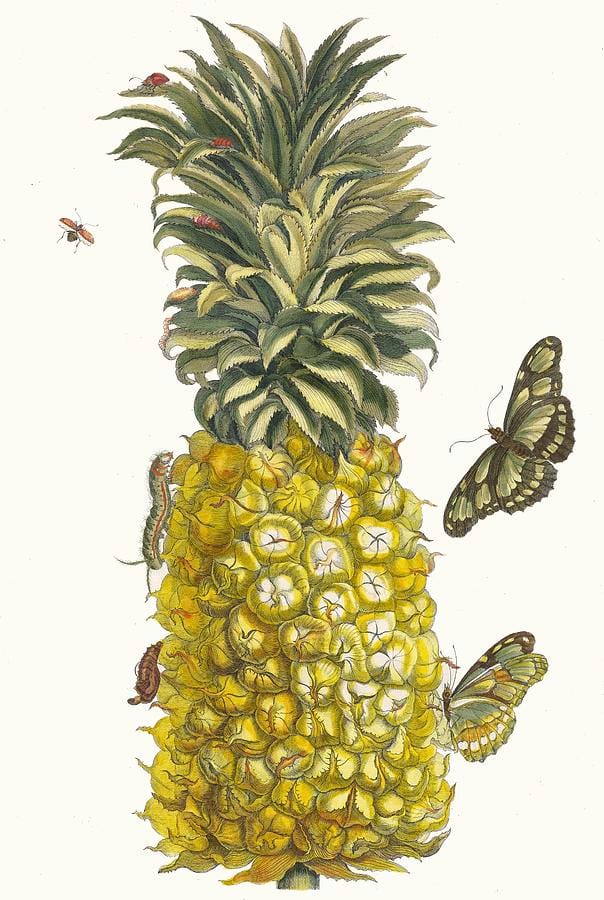
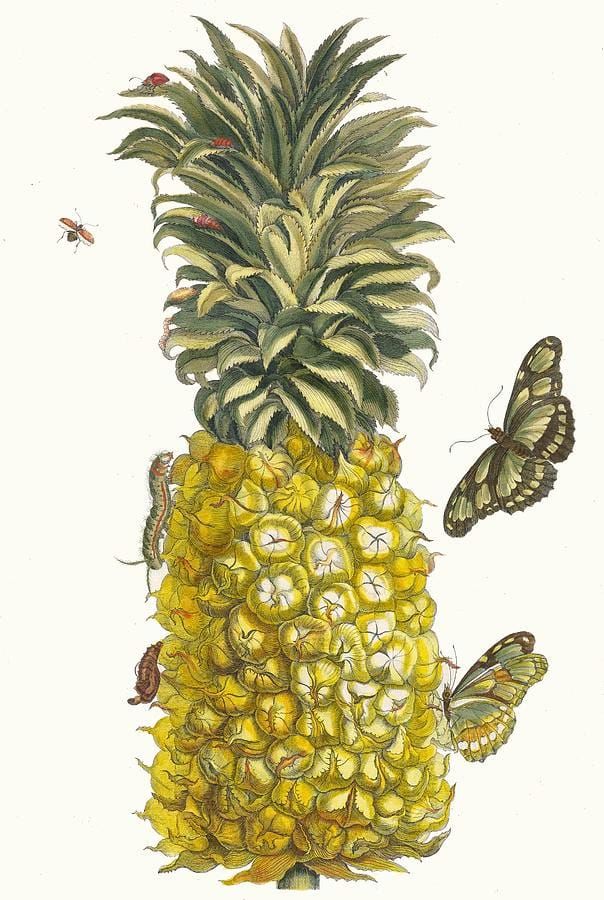
Merian gave the pineapple pride of place at the front of her Surinam book, calling it the most remarkable of all the fruits she had seen, and the plate justifies the billing. The fruit fills the sheet from bottom to top, every scale of its golden skin drawn separately, with the crown of spiked leaves fanning out above. Two butterflies rest against the flank of the fruit and a cockroach scuttles in from the left — an honest touch, since these were the insects that actually turned up on ripe pineapples in a Surinam kitchen. Nothing in the picture is arranged for prettiness, and it is lovely anyway.
Grenadier (The Pomegranate)
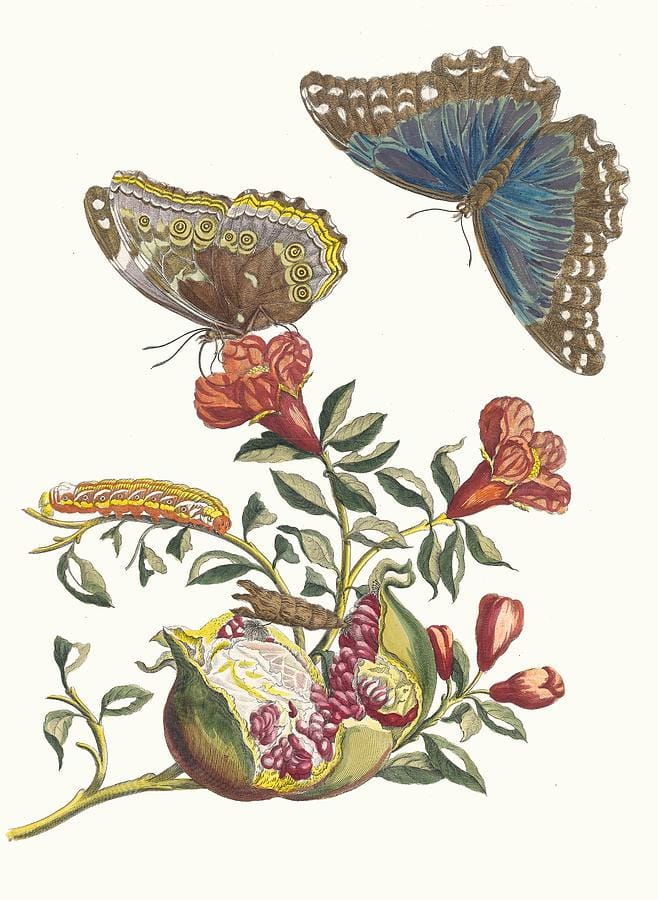
A pomegranate branch curves up the sheet, one fruit split open to show the crimson seeds packed inside, its scarlet flowers still on the stem. Above it Merian sets two large butterflies with their wings spread flat — one an iridescent blue, the other patterned in brown and cream — and along the branch a spiny caterpillar and a chrysalis complete the life cycle. This is her method at its most elegant: the plant is not a background but the insect’s whole world, food and shelter and nursery. She almost never drew a specimen on a blank page if she could help it.
Flos Pavonis (The Peacock Flower)
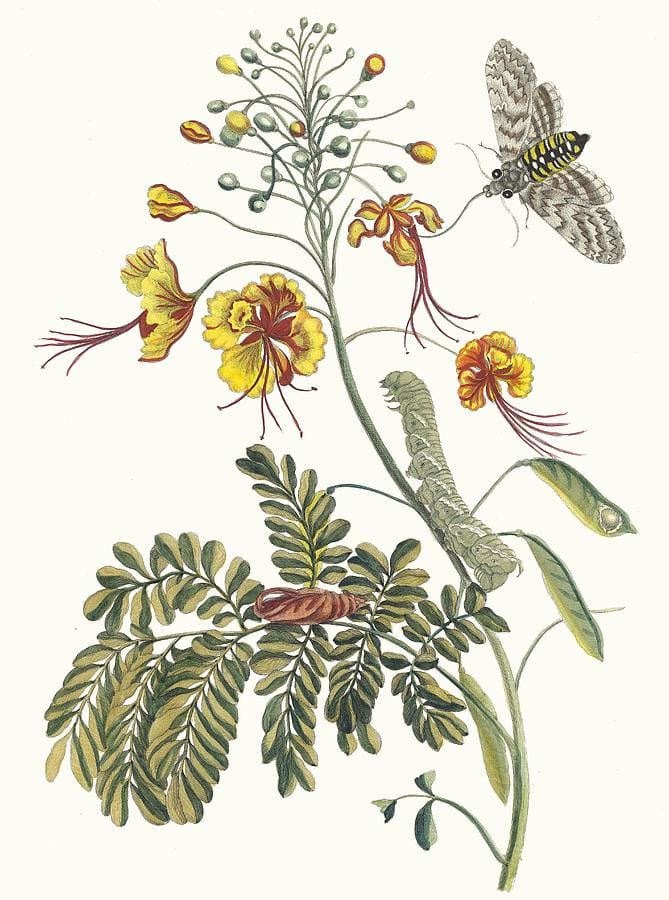
The peacock flower opens in sprays of yellow and scarlet along a feathery stem, with seed pods hanging below and a moth and caterpillar on the branch. Merian’s written note on this plant is one of the most quoted passages she ever published: she recorded that enslaved and Indigenous women in Surinam used its seeds to end pregnancies rather than bear children into slavery, and that they had told her so themselves. It is a reminder that her books were not only pictures. She talked to the people around her, wrote down what she was told, and printed it.
The Caiman and the False Coral Snake
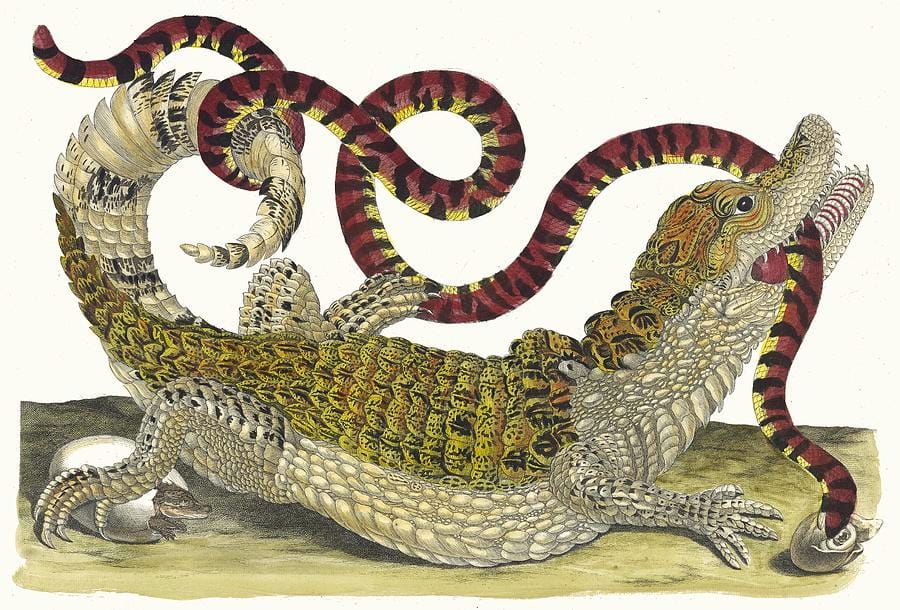
The most dramatic image in Merian’s Surinam work is also the least botanical. A young caiman lies belly-down with its jaws wide, clamped on a banded red, black, and yellow snake that loops in great coils over its armored back. Beneath the struggle, a baby caiman is breaking out of its egg, and a second egg lies cracked at the left. Merian composed it as a single ferocious knot of scales and muscle against a plain ground, with no landscape at all — an eighteenth-century natural history plate that behaves like a battle picture.
Rat de Forêt (The Opossum and Her Young)
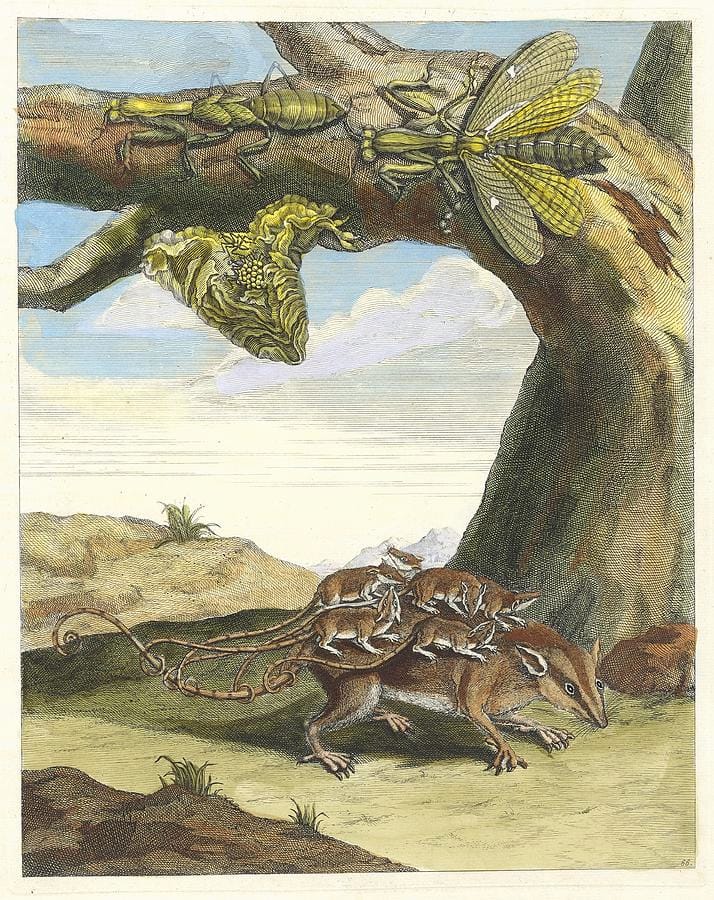
Under the arch of a heavy tree branch, a mother opossum trots across open ground with her litter riding on her back, their long tails wound around hers to hold on. On the branch above, a pair of big lace-winged insects rest beside their nymph, so that a scene of mammal family life and a scene of insect metamorphosis share the same sheet. European readers had heard about the pouched animals of the Americas but had rarely seen one drawn from observation. Merian gives the creature dignity and speed, and gets the improbable detail of the entwined tails exactly right.
Marquiaas (The Passion Fruit)
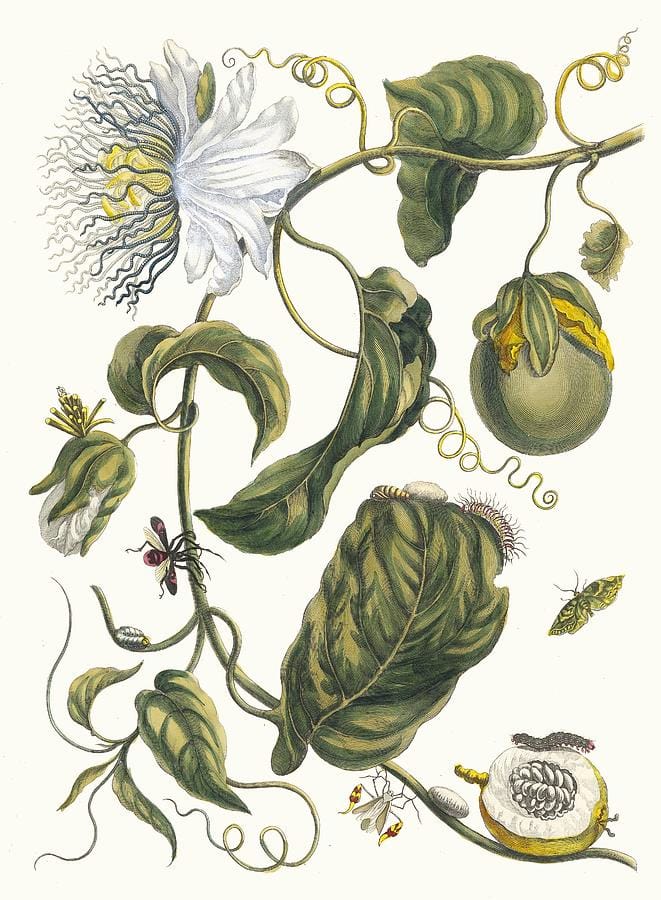
A passionflower vine winds across the page with its tendrils curling into loose spirals, one great white flower open at the top left with its fringe of filaments splayed like wire. Merian shows the fruit twice — whole and green on the vine, and cut across at the bottom to reveal the pale seedy pulp inside. Around them she scatters the insects that lived on the plant: bristled caterpillars along a leaf, a small green moth, a pupa. Few of her plates balance botanical exactness and pure decorative beauty as easily as this one does.
Melon d’Eau (The Watermelon)
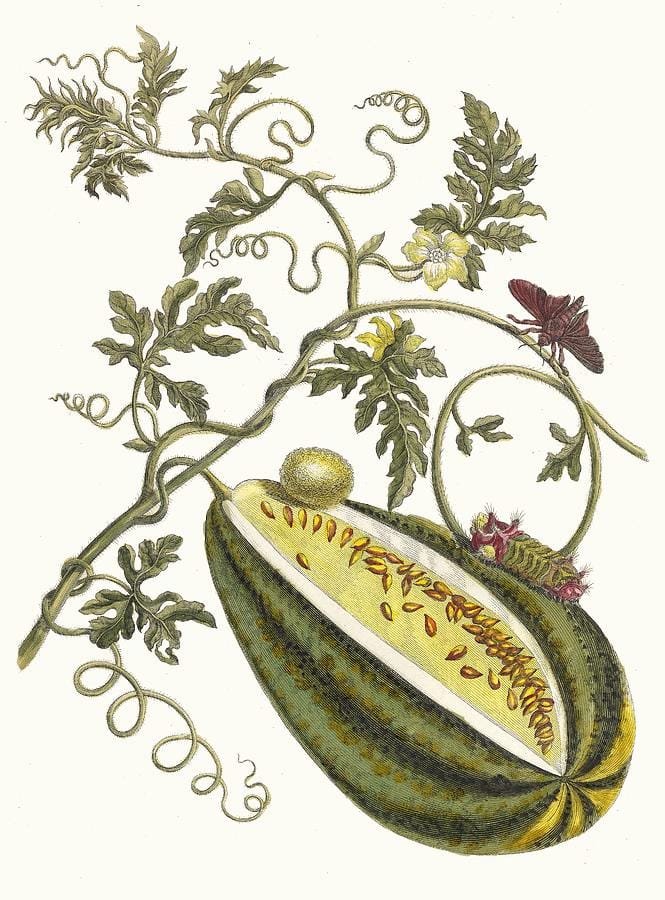
A watermelon lies split lengthwise at the foot of the sheet, its green rind opened to a band of pale flesh, while the vine climbs above it with lobed leaves and coiling tendrils. A striped caterpillar feeds directly on the cut fruit and a moth hovers nearby — the two ends of one life, shown together in the way that became Merian’s signature. She had no interest in the tidy convention of drawing a dried specimen pinned to a card. Insects in her books are always doing something: eating, spinning, hatching, or waiting to.
Cacao
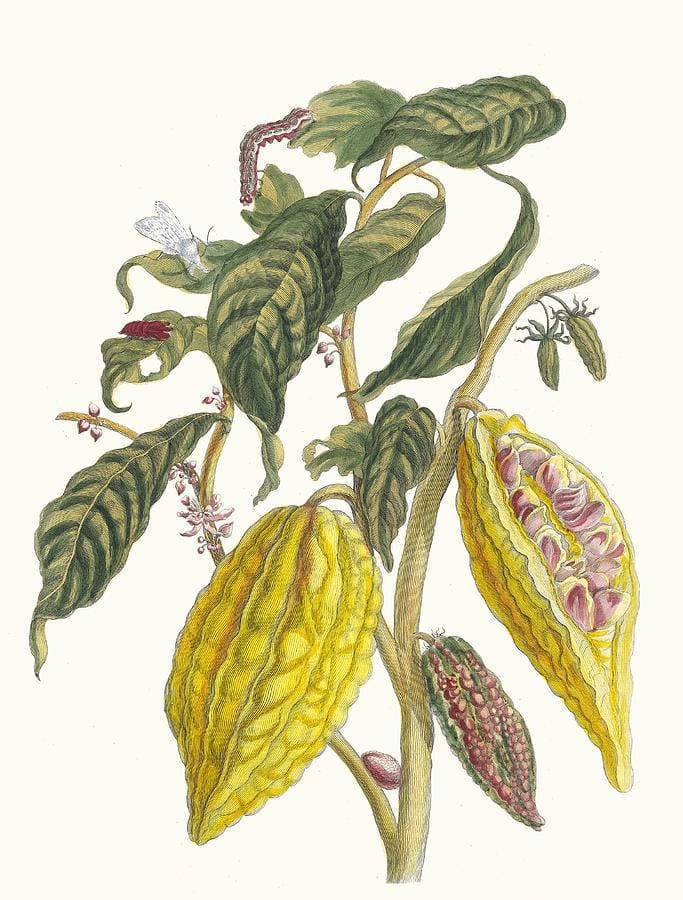
Cacao was already a valuable export when Merian reached Surinam, and her plate shows why the plant is strange: the ribbed pods grow straight out of the woody stem, not from the twigs, and she draws one cut open to show the rows of beans packed in their pale pulp. Dark, deeply veined leaves spread across the sheet, with small flowers, a caterpillar, and beetles among them. For readers in Amsterdam who had drunk chocolate for years without any idea where it came from, this was the first accurate look at the source — a piece of economic botany as well as a beautiful drawing.
Baccores (The Banana)
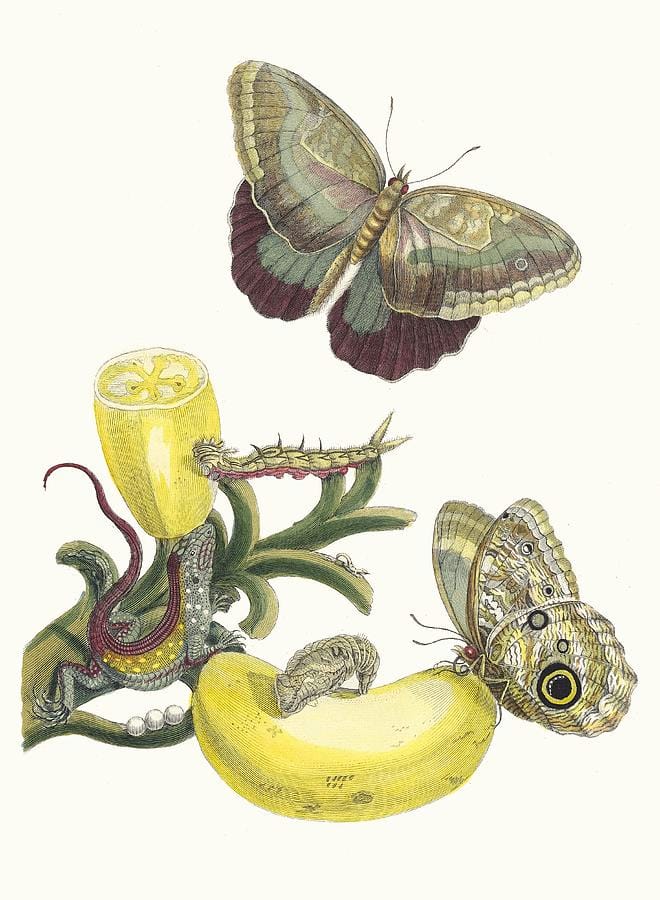
A ripe banana and a second cut yellow fruit anchor the bottom of this plate, and above them Merian places one of the largest insects she ever drew: a great moth with wings marked in olive, cream, and wine red, spread wide across the top of the sheet. A second, paler moth rests below with an eyespot on its wing, and a caterpillar crawls between them. The scale of the insects against the fruit is startling, and deliberately so — she wanted her European readers to understand just how big and strange the moths of the tropics were.
Blue Butterflies
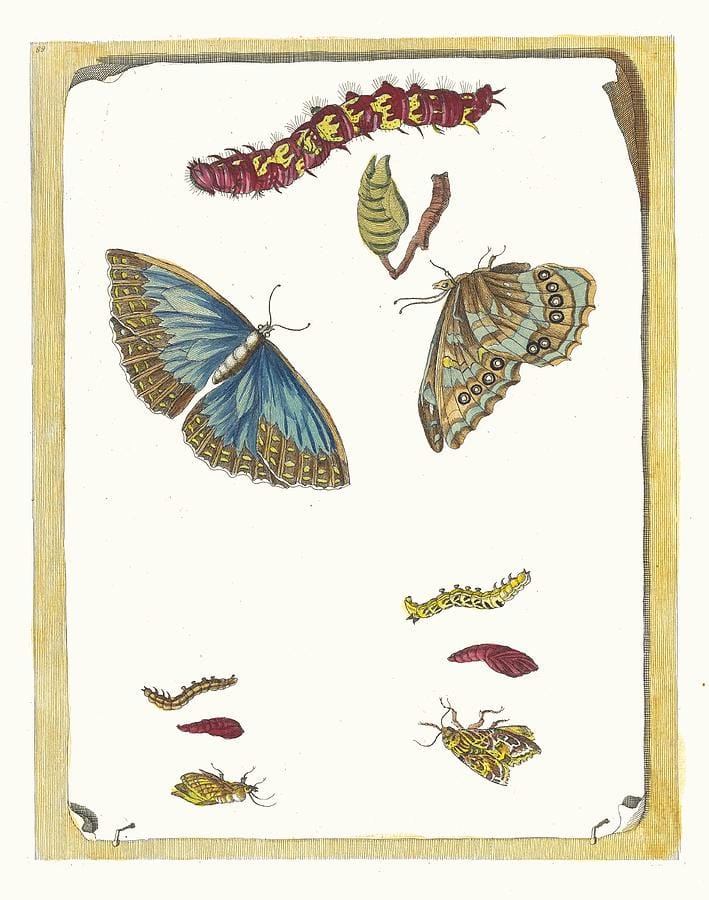
Not every Merian sheet is a full composition. This one is a study on vellum, ruled with a simple drawn border, showing a brilliant blue butterfly with its wings open, a second butterfly with the softly patterned underside turned toward us, a banded caterpillar, and several pupae and beetles set out around the page with clear space between them. Working on vellum gave her colors a depth that paper could not match, and studies like this are where you see the plain accuracy of her eye without any of the theater — just insects, beautifully looked at.
Merian was a working naturalist, a single mother, a publisher, and one of the finest draftswomen of her century, and for a long time she was remembered mainly as a curiosity. That has changed. Her plates hang well in almost any room — kitchens and studies especially — because they are at once decorative and factual, full of color but built on real observation.
Shop Maria Sibylla Merian prints here, and explore the rest of our famous paintings collection for more of the world’s most beloved masterpieces.