John William Waterhouse’s Ten Most Famous Paintings
The Lady of Shalott, The Magic Circle, A Mermaid and more: the ten works by the last of the Pre-Raphaelites and the great painter of enchantresses.

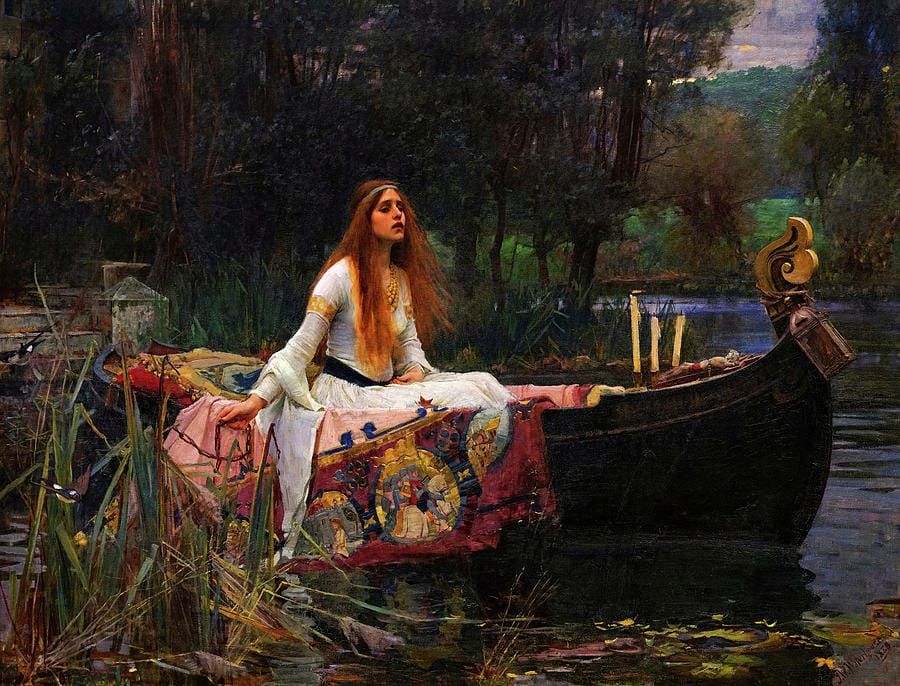
John William Waterhouse (1849–1917) was born in Rome to English painters and trained at the Royal Academy in London, where he later taught. He arrived a generation after the Pre-Raphaelite Brotherhood had formed and dissolved, and he is usually described as the last of them — he took their literary subjects and their red-haired heroines, but painted with a loose, fluent brush learned from French naturalism rather than the hard-edged clarity of the original group.
His subject, over and over, is a woman at a decisive moment: casting a spell, offering a poisoned cup, leaving safety for certain death. He returned to Tennyson, Ovid, Keats, and Shakespeare for stories in which a solitary female figure holds all the power in the scene, and he painted them at the instant before something irreversible happens. His reputation collapsed with the modern movement and recovered late in the twentieth century, when the pictures turned out to be far stranger than their popularity suggested. Here are ten of his most famous paintings.
The Lady of Shalott
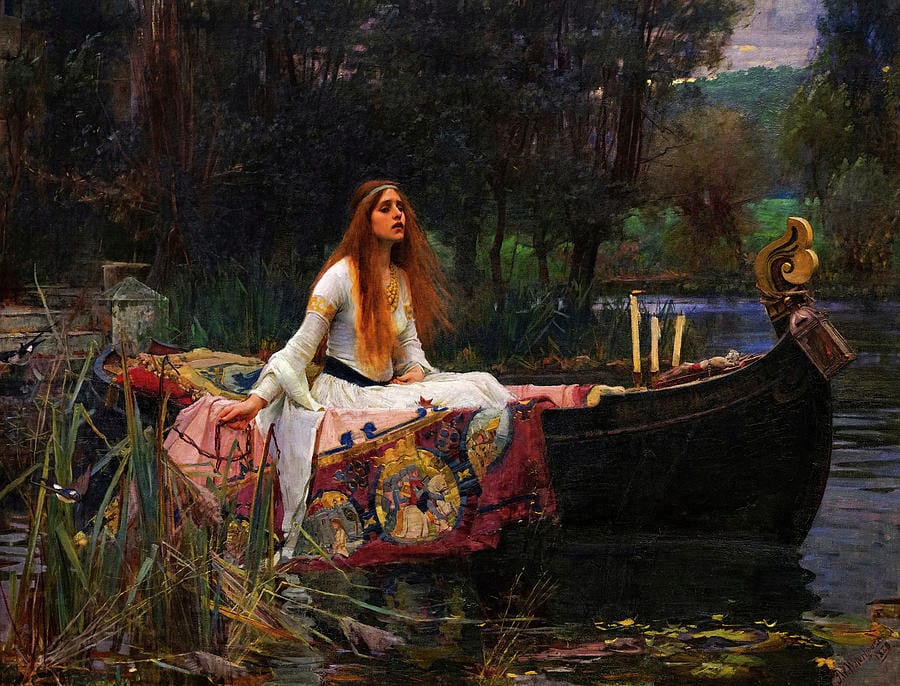
Painted in 1888, this is Waterhouse's best-known work and one of the most reproduced British paintings of the century. It illustrates Tennyson's poem, in which a woman cursed to see the world only through a mirror finally looks directly at Lancelot and dooms herself. Waterhouse chooses the moment she has cast off the chain and is drifting down the river toward Camelot to die. Three candles stand at the prow and two have already blown out; the tapestry she wove during her confinement trails over the side into the water. Her lips are parted — Tennyson has her singing her last song as the boat carries her downstream.
The Magic Circle
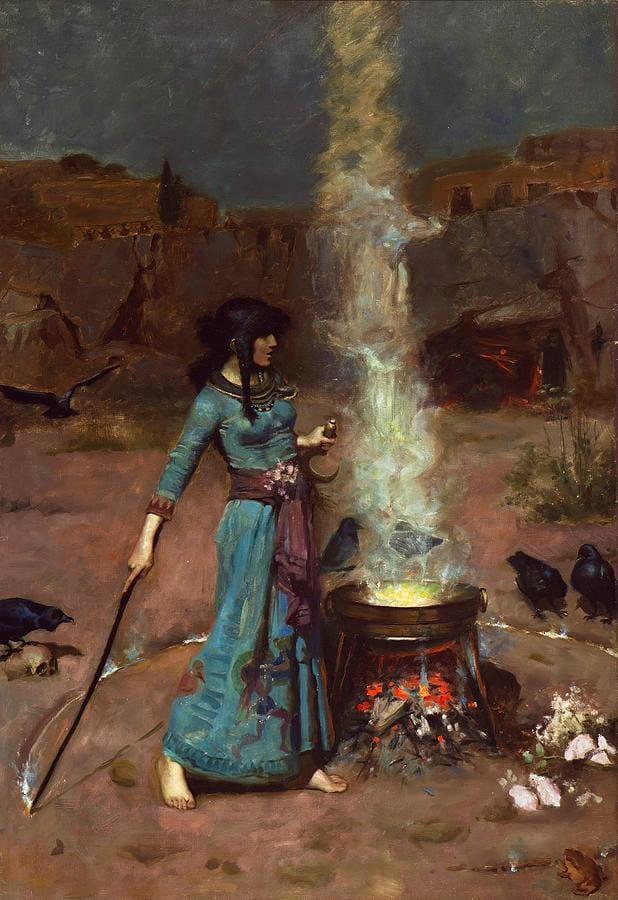
Exhibited in 1886 and bought for the national collection almost immediately, this made Waterhouse's reputation. A sorceress in a heavy embroidered robe draws a circle on the ground with a wand while a pot steams beside her. She is entirely absorbed and entirely in charge; ravens and a frog wait outside the line she is drawing, and the landscape behind her is scorched and bare. What unsettles the picture is its matter-of-factness — the woman is working, with the concentration of a craftsman, and the viewer is standing inside the circle with her.
A Mermaid
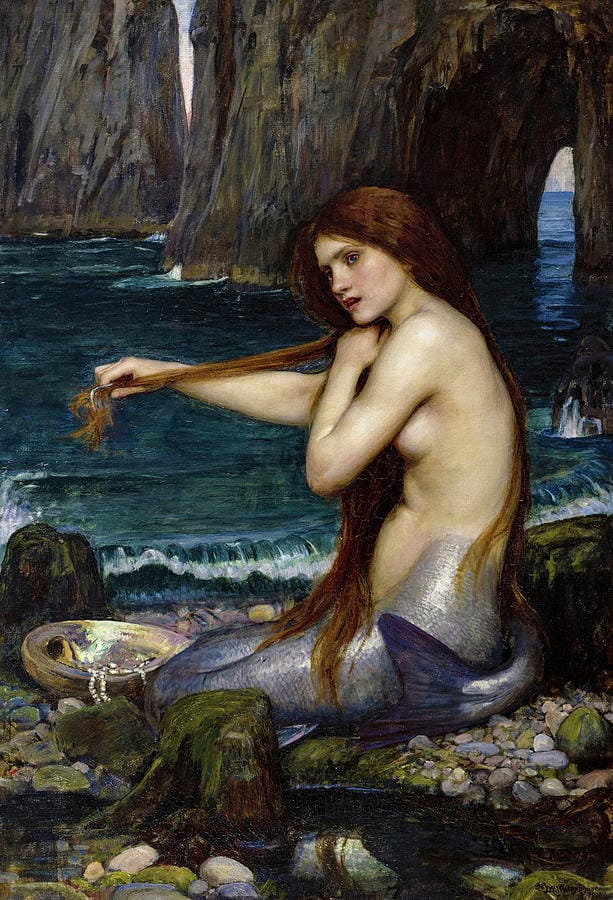
Waterhouse submitted this in 1900 as his diploma work on election to full membership of the Royal Academy, which is why it remains in the Academy's collection. A mermaid sits on the shingle in a cove combing her long hair, a string of pearls spilling from a shell beside her, the sea shut in by dark rocks behind. He worked on the subject for years. The picture is quieter than the enchantress paintings and much less threatening, and the detail of the scales dissolving into the wet stones is some of his most careful painting.
Circe Offering the Cup to Odysseus
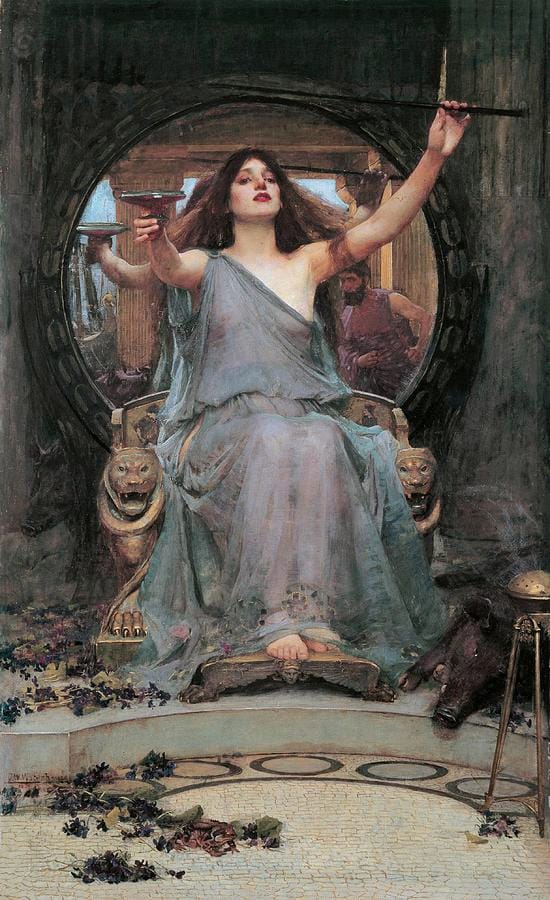
Painted in 1891, and the most theatrical composition Waterhouse ever built. Circe sits enthroned and frontal, raising the cup toward the viewer with one hand and her wand with the other, so that we are placed in Odysseus's position, being offered the drink that will turn men into swine. Behind her a mirror shows his tiny reflected figure at the door, and one of the transformed men crouches at her feet. Making the viewer the target of the spell rather than a spectator of it is the boldest device in his work.
The Soul of the Rose
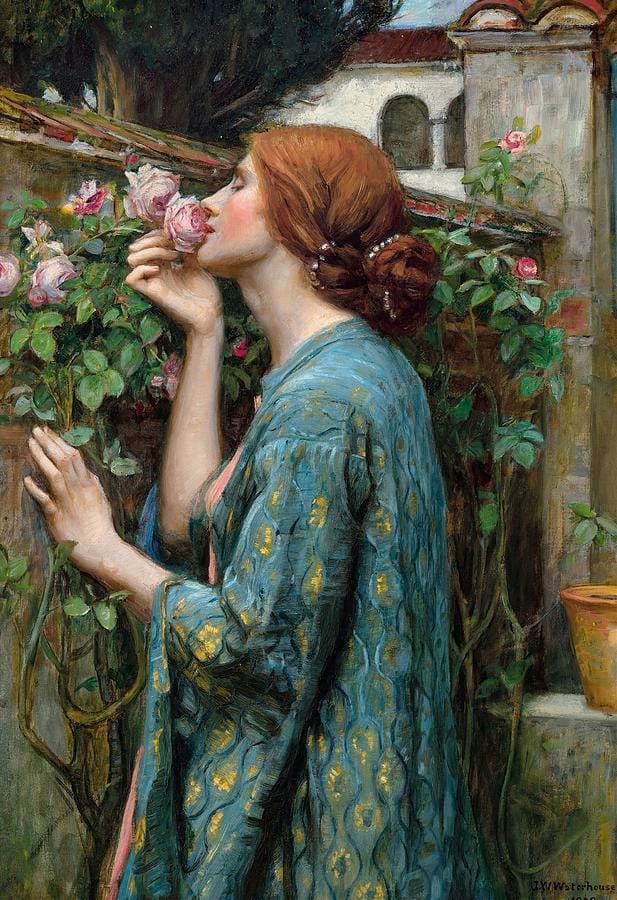
Painted in 1908, and the most intimate of his pictures. A young woman in a russet gown presses her face into a rose growing against a warm stone wall, eyes closed, with a distant blue seascape just visible through a gap. The title comes from Tennyson's “Maud,” a poem about waiting in a garden. There is no story to follow and no threat: the entire painting is about a single act of smelling a flower, and Waterhouse gives it the compositional weight he elsewhere reserved for sorcery and death.
Boreas
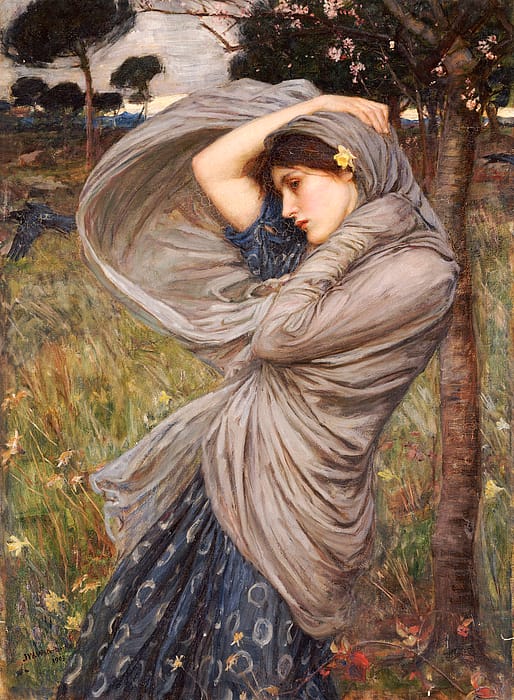
Painted in 1903 and named for the Greek god of the north wind, though the god himself never appears. A girl in a blue dress walks into a hard spring gale, clutching a bunch of flowers, her skirts and hair blown sideways and the grass and blossom around her streaming in the same direction. The whole picture is constructed out of one diagonal force. The painting disappeared from public view for most of the twentieth century and resurfaced at auction in the 1990s.
Miranda
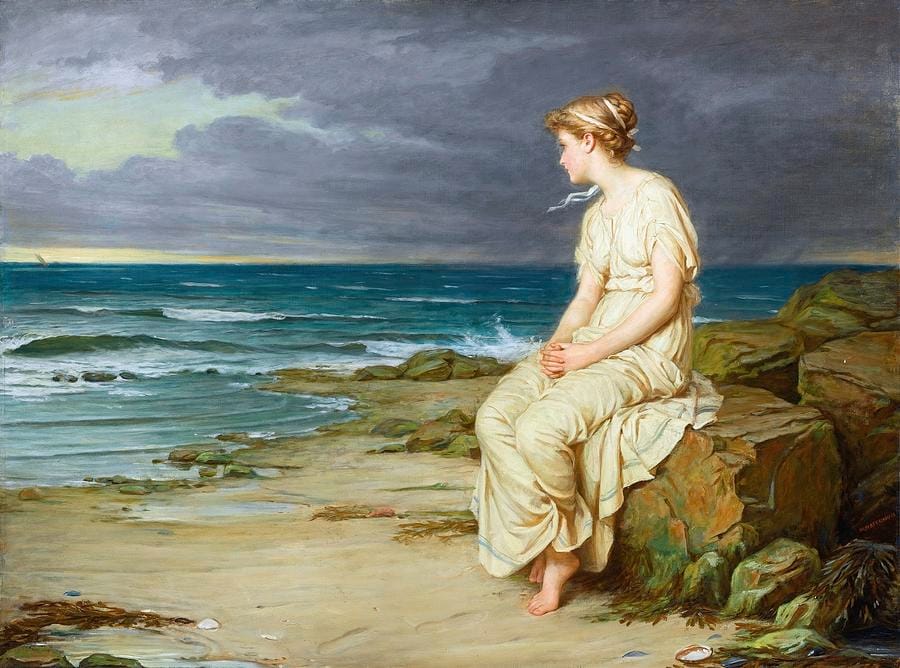
From Shakespeare's The Tempest: Miranda stands on the shore watching the ship carrying her father's enemies break up in the storm her father has raised. Waterhouse paints her from behind and slightly to the side, hair whipping across the canvas, so that we watch the wreck over her shoulder and share her helplessness. He treated the subject more than once. The device of turning the protagonist away from the viewer, so the drama is registered entirely through her posture, is one he used to great effect throughout his late work.
Psyche Entering Cupid's Garden
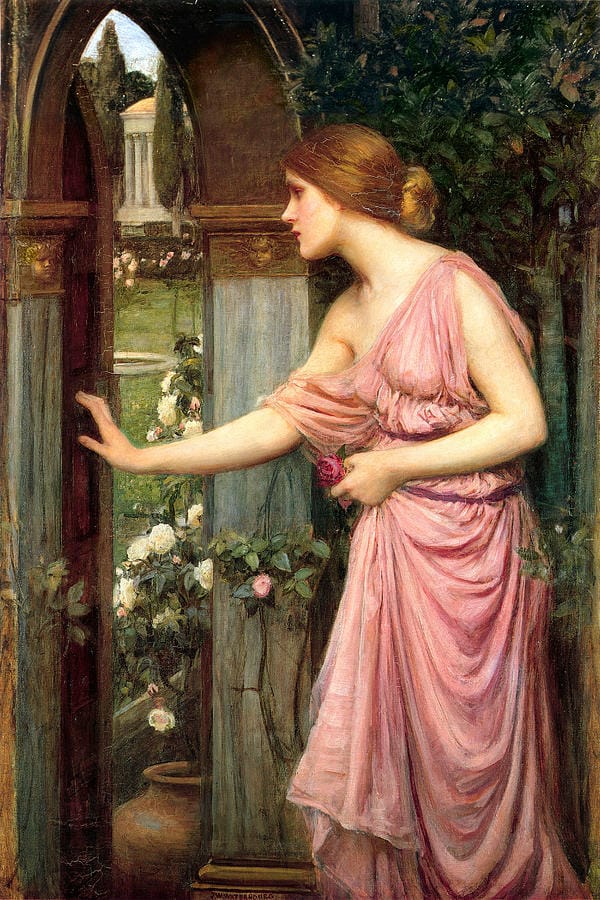
Painted in 1904, from the story in Apuleius. Psyche pushes open a heavy door and steps into the garden of a lover she has been forbidden to look at, and Waterhouse builds the whole picture around the threshold — dark doorway, bright garden, a young woman caught between them with her hand still on the wood. The curiosity that drives the myth is written into the composition rather than acted out. As so often with him, the subject is the instant before a rule gets broken.
Juliet
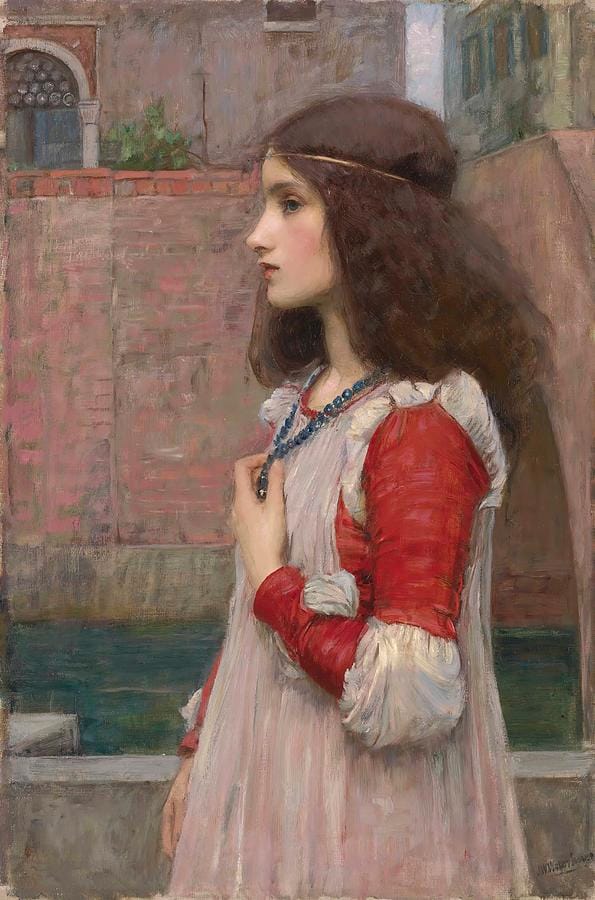
A late work, and a portrait rather than a narrative scene. Juliet is shown close up in a richly patterned gown against a dark ground, her head turned and her expression withdrawn, holding a book. Waterhouse painted a number of these single-figure Shakespearean and literary subjects in his last decade, working with a freer, more visibly brushed surface than in the 1880s. The costume detail is elaborate, but the picture rests on the face and the sense of a decision already taken.
An Orange Garden
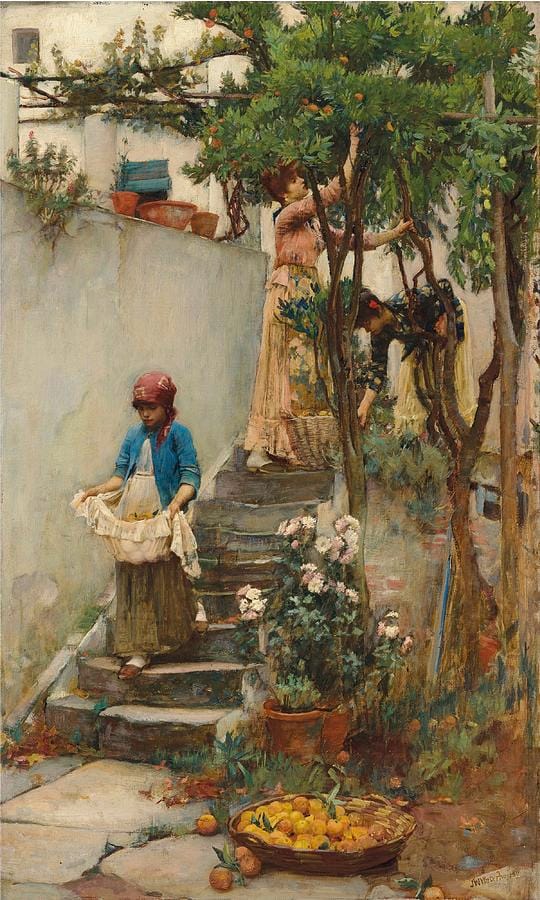
A quieter subject, and a reminder that Waterhouse spent formative time in Italy and returned there repeatedly. Figures gather fruit among orange trees in strong Mediterranean light, and the painting is built from dappled greens and warm ochres rather than the cold blues and greys of his British literary scenes. Pictures like this belong to the classical-subject strain in his work that runs alongside the enchantresses, and they show how much of his skill was ordinary observation of light on leaves and cloth.
Waterhouse kept working until his death in 1917, by which time the art world had moved decisively past him. The paintings never lost their public, though, and The Lady of Shalott in particular has stayed one of the most recognizable images in British art — a picture almost everyone has seen and comparatively few could name the painter of.
Shop John William Waterhouse prints here, and explore the rest of our famous paintings collection for more of the world’s most beloved masterpieces.