Jean-Honoré Fragonard’s Ten Most Famous Paintings
Flying slippers, stolen kisses, and gardens gone wild: the ten works that made Fragonard the last great painter of the Rococo.

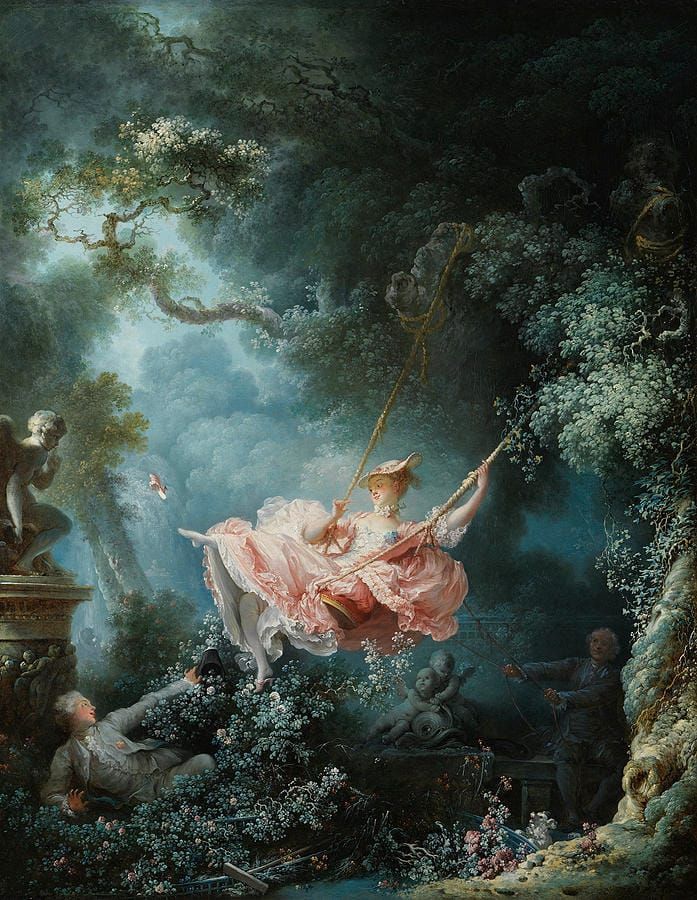
Jean-Honoré Fragonard (1732–1806) was born in Grasse, in the perfume country of Provence, and sent to Paris as a boy to be apprenticed to a notary. He drew instead. A brief spell with Chardin, several years with François Boucher, the Prix de Rome at twenty, and five years in Italy gave him a training as thorough as any painter of his century received — and he then spent his career largely ignoring the grand public commissions it was designed to produce.
What he wanted was speed, pleasure, and private patrons. He painted lovers in overgrown gardens, women reading and dozing, children and dogs, and a handful of frankly erotic pictures for collectors who kept them behind curtains. He worked so fast that some of his portraits carry inscriptions claiming they took an hour. The Revolution destroyed the world he painted for; he died in 1806 largely forgotten, and was rediscovered by nineteenth-century collectors who could not get enough of him. Here are ten of his most famous paintings.
The Swing (Les Hasards heureux de l’escarpolette)
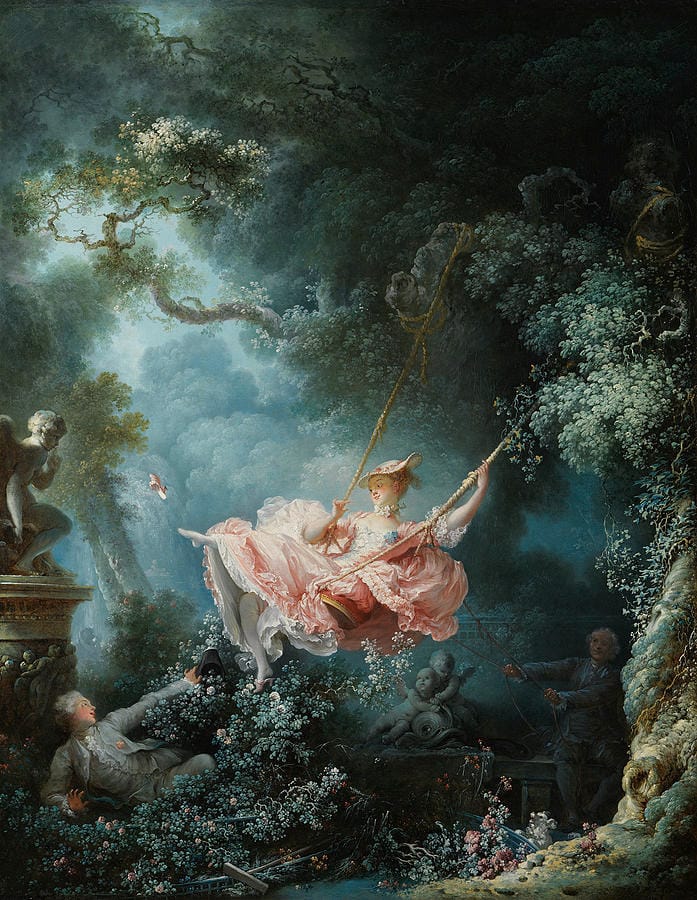
The most famous Rococo painting in existence, made around 1767. A young woman in billowing pink swings out over a dark, overgrown garden; her lover lies in the bushes below, gazing up beneath her skirts, while an unwitting older man works the ropes in the shadows behind. One slipper has just flown off her foot. According to a contemporary account the commission came from a courtier who had first asked another painter to portray his mistress on a swing pushed by a bishop; that painter refused, and Fragonard cheerfully took it on. It now hangs in the Wallace Collection in London.
A Young Girl Reading
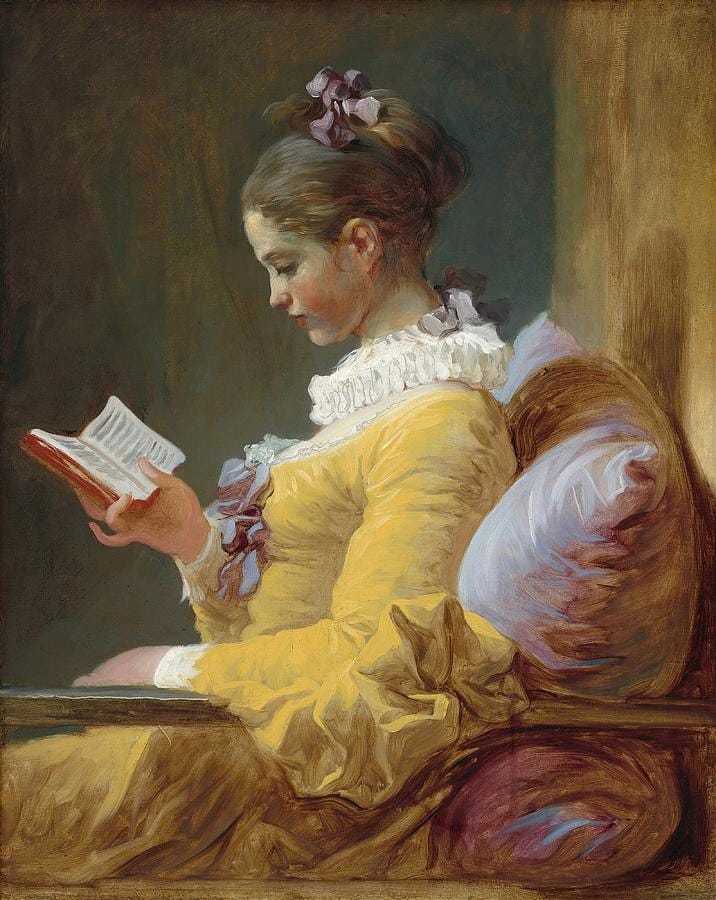
A girl in a lemon-yellow dress sits in profile against a plum-colored cushion, holding a small book delicately between finger and thumb, entirely absorbed. Painted around 1769 and now in the National Gallery of Art in Washington, it is the least anecdotal picture Fragonard ever made and possibly the best. The paint is applied with astonishing freedom — the ruff at her throat is a few whipped strokes of white, the cushion a single loaded sweep — and yet the mood is perfectly still. X-rays show that Fragonard first painted the sitter facing outward before turning her away from us, which is what makes the picture work.
The Love Letter
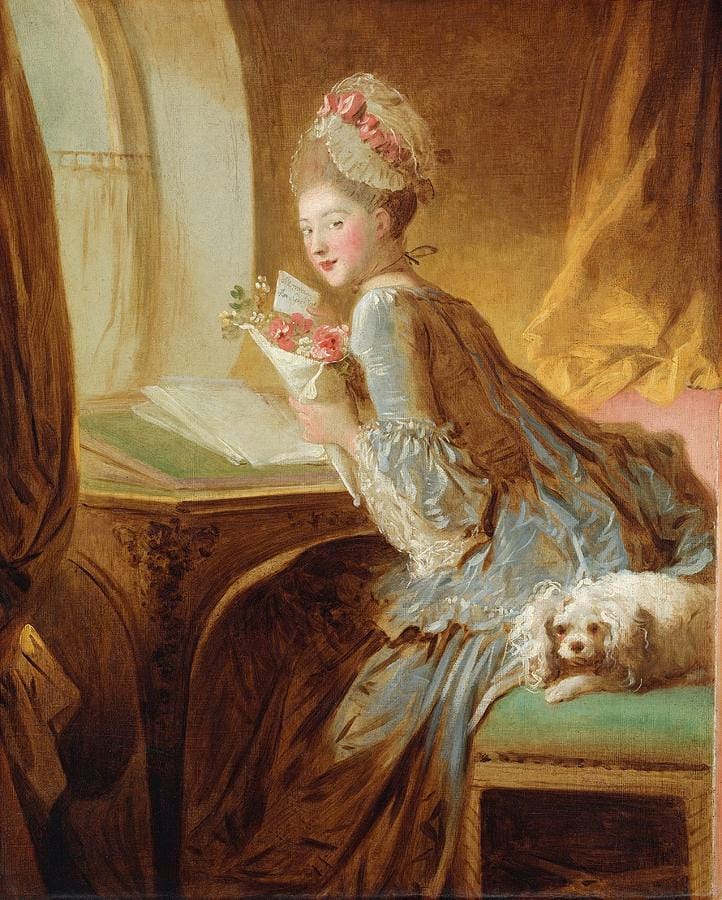
A young woman at her writing table turns toward us with a bouquet in her hands and a small card tucked among the flowers, addressed in a legible hand to “Monsieur mon Cavalier.” Her lapdog watches from the cushions beside her. Painted in the 1770s and now in the Metropolitan Museum of Art, it is Fragonard in his most companionable mode: the whole drama consists of a card, a smile, and our own complicity in reading over her shoulder. The handling of the white silk and the tumbled roses is as loose and confident as anything in eighteenth-century painting.
The Stolen Kiss
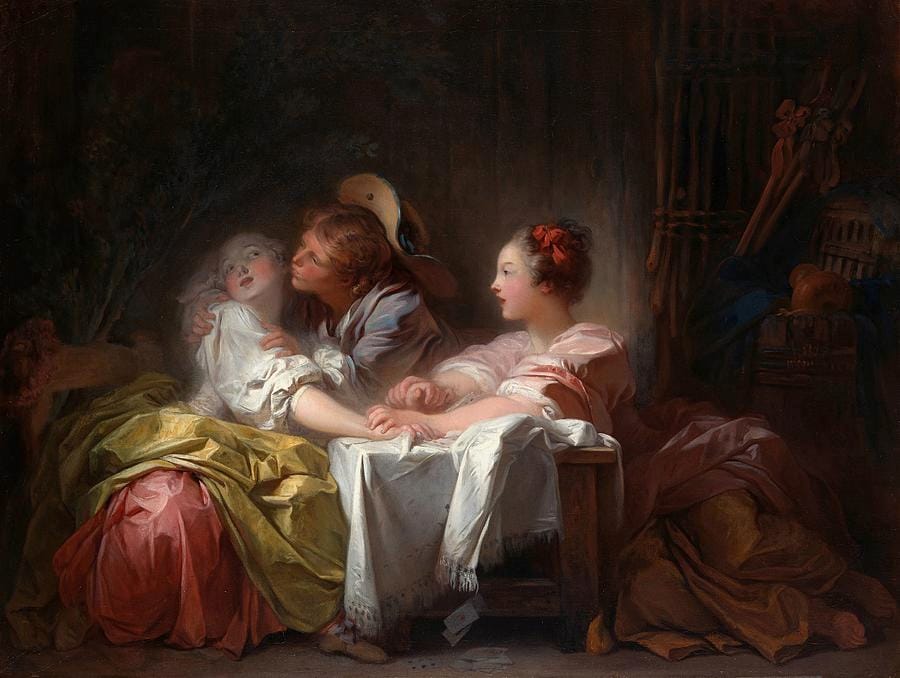
Fragonard painted the stolen kiss more than once, and in this version, from around 1760, the scene is a shadowy back room. Three young people are gathered at a table draped in white linen: a young man with a straw hat pushed back off his head leans across and kisses the cheek of a girl in cream silk, who tips her head back with her eyes half closed, while a second young woman in pink watches from the far side. Playing cards lie scattered on the floor. Everything is painted in warm browns and reds with the linen blazing white at the center, and the picture works entirely by suggestion — nobody is caught, nothing is decided.
The Bolt (Le Verrou)
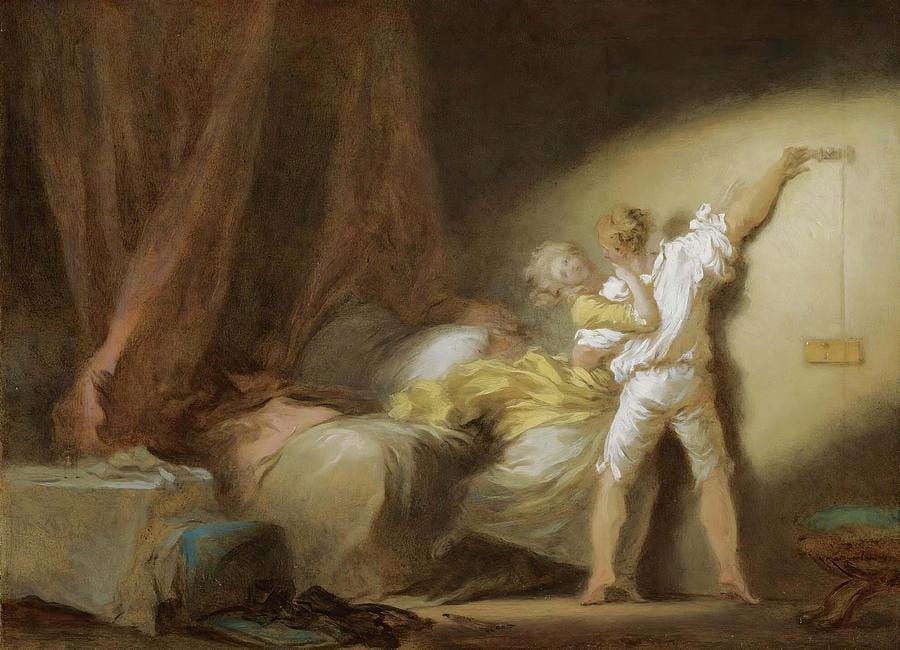
In a room dominated by a great tumbled crimson bed, a young man reaches up to shoot the bolt on the door while the woman in his arms twists away — or perhaps toward him; the painting has been argued over for two centuries. A single shaft of light rakes across the composition from the lower left, and an apple sits on the table at the other end of it. Painted around 1777, The Bolt is Fragonard at his most theatrical and his most severe, and it hangs in the Louvre. The strong diagonal and the near-empty right half give it a tension his earlier work never attempted.
The Progress of Love: The Meeting
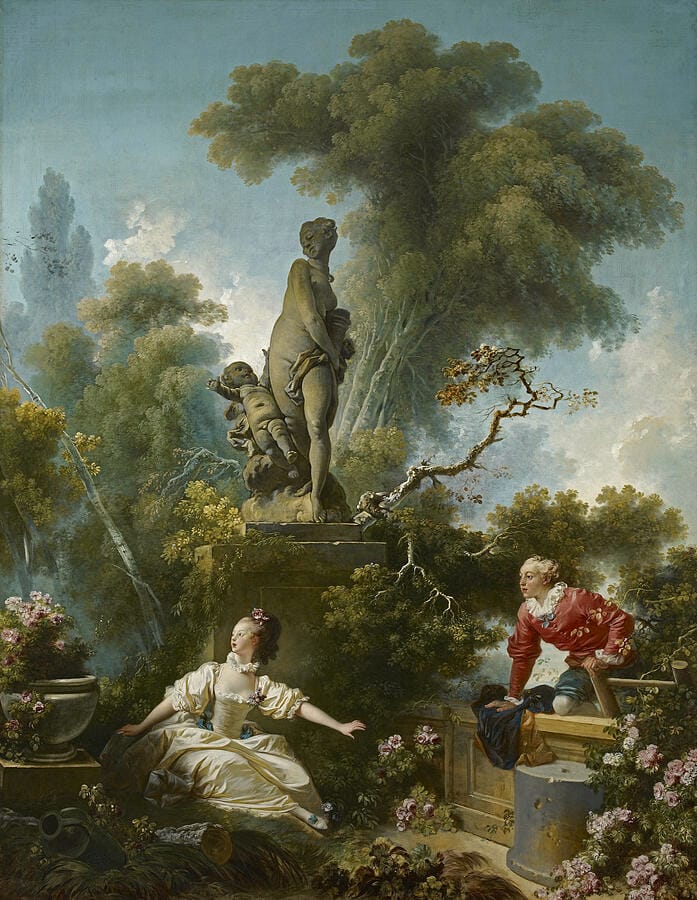
In 1771 Madame du Barry, mistress of Louis XV, commissioned a set of large canvases for a garden pavilion at Louveciennes. In this one a young man vaults over a wall into a garden while his lover starts up from a bench, looking anxiously back toward the house; a garden statue presides over the whole business. The panels were returned to Fragonard within two years — the pavilion’s architecture had turned Neoclassical and his Rococo lovers no longer suited it. He kept them, and today the series is one of the great sights of the Frick Collection in New York.
Jean-Claude Richard, Abbé de Saint-Non
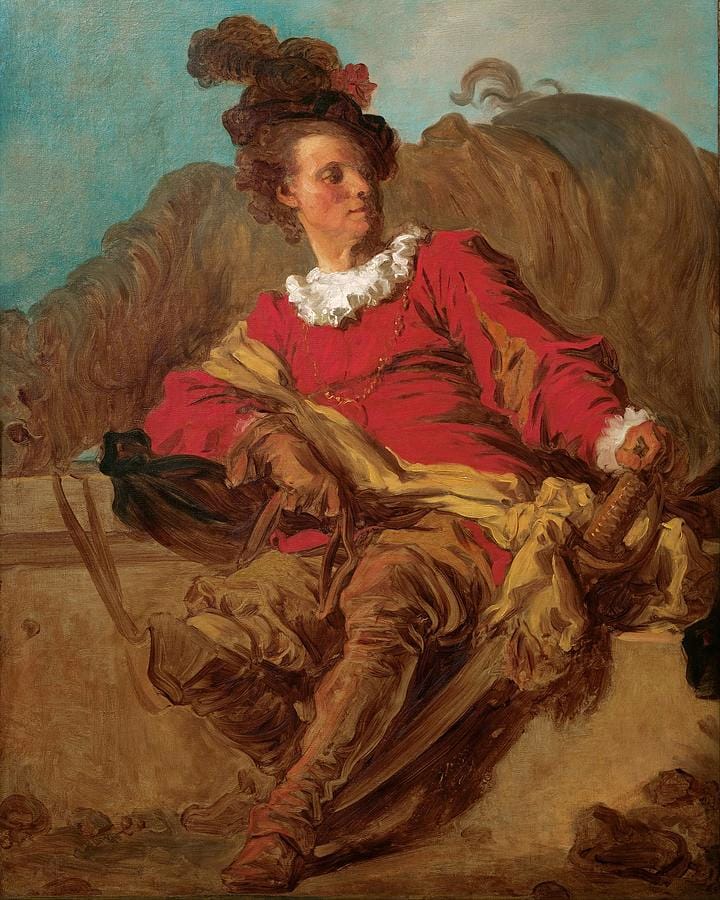
Fragonard’s “fantasy figures” are a group of portraits of friends and patrons dressed in loose theatrical Spanish costume, painted with slashing, visible brushwork. This one shows the Abbé de Saint-Non — a wealthy cleric, amateur engraver, and the man who took Fragonard traveling through Italy — sprawled in a chair in flame-red silk, half turning as though interrupted. An inscription associated with the series claims the pictures were each painted in a single hour. Whether or not that is literally true, the speed is visible in every stroke, and the results are among the freshest portraits of the eighteenth century.
Blind Man’s Buff
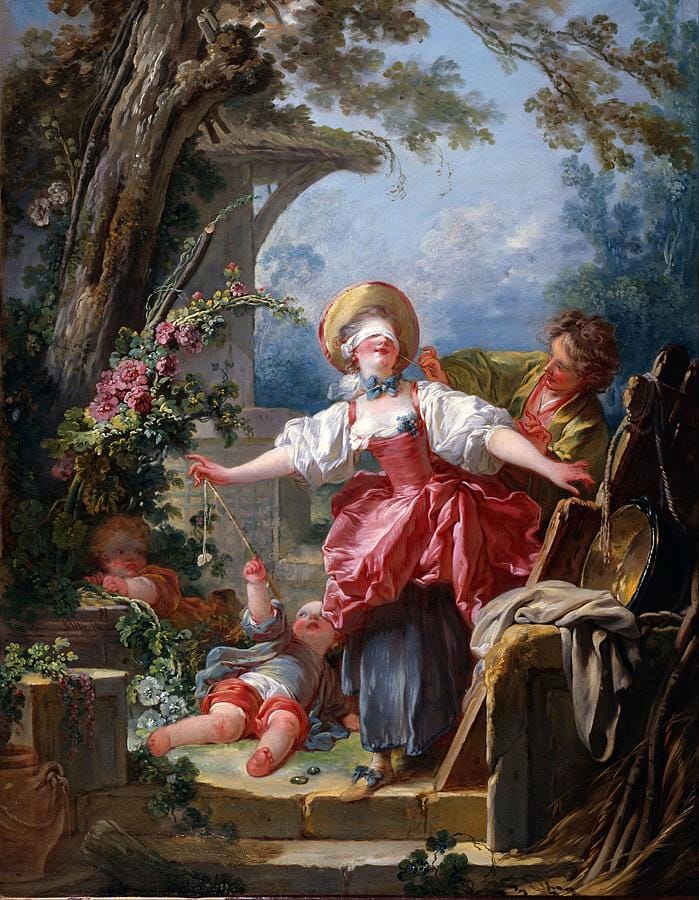
A young woman stands blindfolded on a garden step in a straw hat and a rose-colored gown, arms spread wide, groping toward a young man in green who leans back just out of reach. Two small children play at her feet, one sprawled on the stone with a toy dangling from a string, while a flowering vine climbs a trellis behind her. Fragonard painted the game more than once; it was a stock subject of Rococo decoration precisely because it licensed a great deal of contact under cover of innocence. Pictures like this were made as overdoors and wall panels for private houses, meant to be glanced at rather than studied.
A Boy as Pierrot
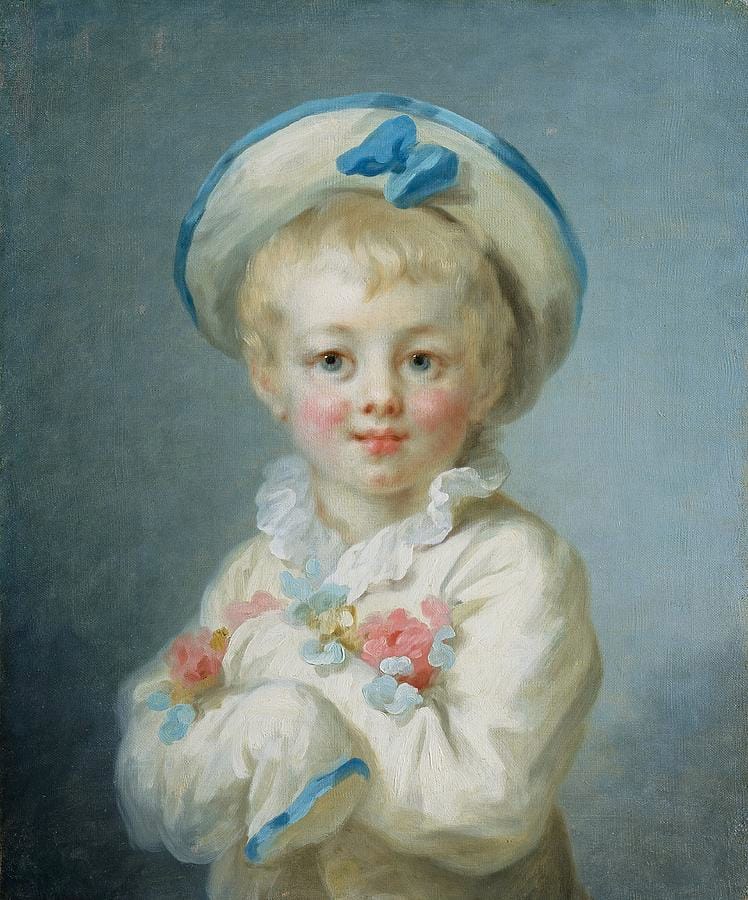
A small boy in the white ruffed costume and blue-ribboned cap of Pierrot, the sad clown of the Italian comedy, looks out with a fresh, faintly startled expression, a spray of flowers held against his chest. Fragonard painted a number of children in dressing-up clothes, and they avoid the sentimentality the subject invites: the paint is quick and dry, the face genuinely a child’s rather than a doll’s. The picture became enormously popular in reproduction in the nineteenth century, and it remains one of the most instantly likable things he ever made.
Le Petit Parc
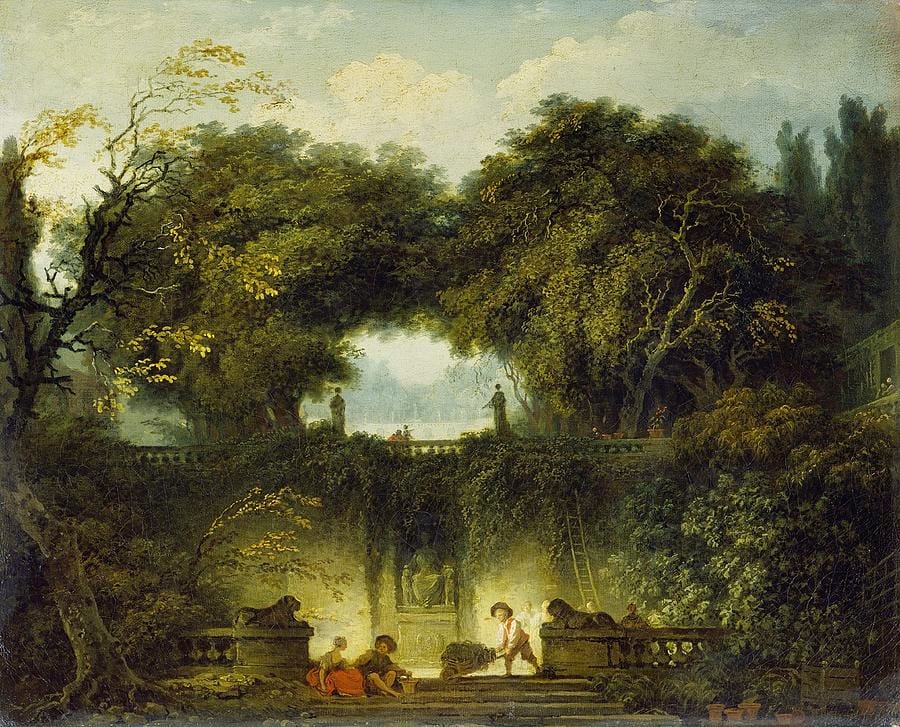
Fragonard’s Italian years left him with a permanent taste for gardens that had begun to run wild — the great cypresses and crumbling terraces of the Villa d’Este at Tivoli, which he drew obsessively in the company of Hubert Robert. In this small landscape an avenue of enormous trees closes over a stone balustrade and a fountain, with a few tiny figures at play in the shade below. The scale of the trees against the people is the whole point. Painted in warm greens and golds, it shows how much Fragonard could do with a subject that has no story in it at all.
For a century after the Revolution, Fragonard stood for everything a serious painter was not supposed to be — frivolous, decorative, in love with pleasure. The Impressionists rescued him, recognizing a painter whose brushwork was as free as their own, and he has been securely great ever since. His pictures bring lightness into a room without emptiness, which is a rarer combination than it sounds.
Shop Jean-Honoré Fragonard prints here, and explore the rest of our famous paintings collection for more of the world’s most beloved masterpieces.