Jean-François Millet’s Ten Most Famous Paintings
Gleaners, sowers and shepherdesses: the ten works in which Millet gave the French peasant the dignity of an Old Master saint.

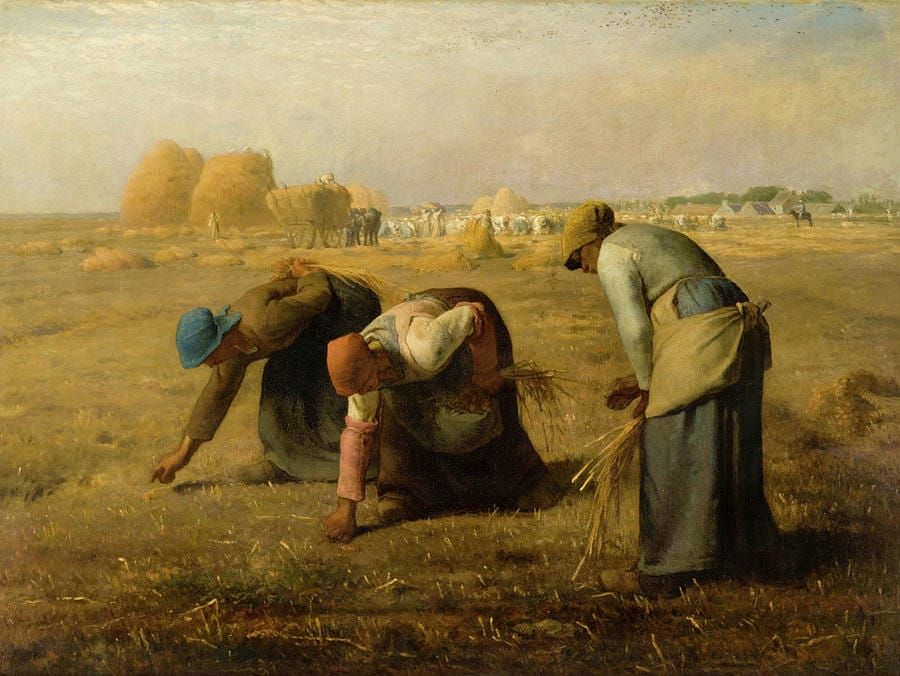
Jean-François Millet (1814–1875) grew up on a farm at Gruchy, on the windy Normandy coast near Gréville, and never stopped painting the people he had worked beside as a boy. He trained in Cherbourg and Paris, scraped a living from portraits and mildly risqué mythological scenes, then in 1849 moved his family out to Barbizon on the edge of the Forest of Fontainebleau. He stayed for the rest of his life, and the village gave its name to the loose group of landscape painters — Rousseau, Diaz, Daubigny — who gathered there.
What set Millet apart was scale and seriousness. He painted gleaners, sowers and shepherds at the size and with the gravity that art had previously reserved for kings and saints, and conservative critics in the 1850s found it genuinely alarming, reading socialism into pictures the artist insisted were simply true. Later generations disagreed about almost everything except their power: Van Gogh copied him obsessively, Pissarro and Seurat studied him, and Dalí built an entire private mythology around one of his paintings. Here are ten of his most famous works.
The Gleaners
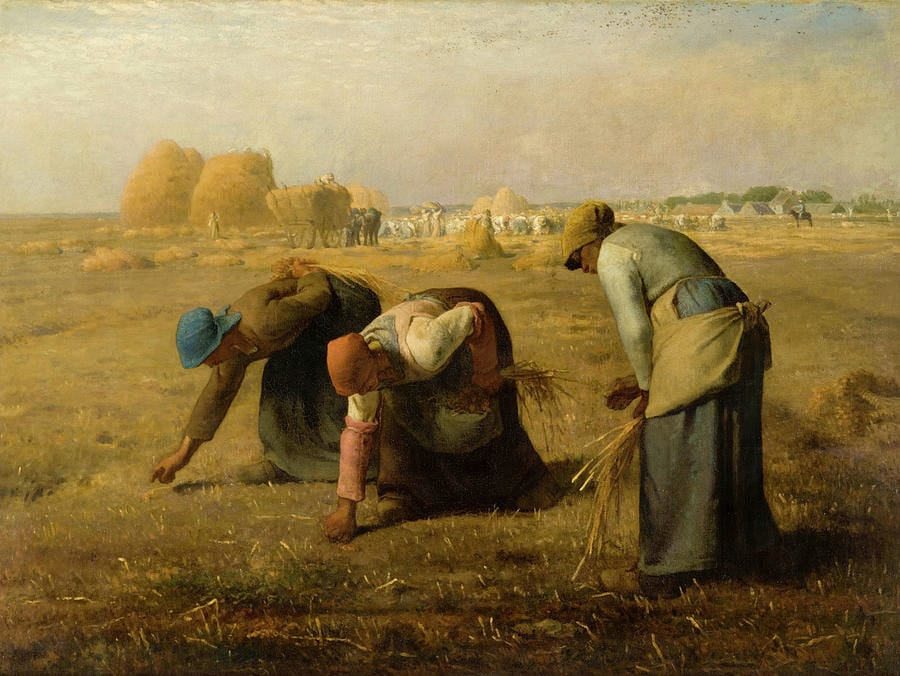
Three women bend over a shorn wheat field, picking up the few stalks left behind after the harvest. Gleaning was the right of the very poorest, and Millet gives these women — one still stooping, one straightening, one rising with an armful — the weight and rhythm of figures in a classical frieze. Behind them, at a comfortable distance, sit the loaded carts and haystacks of the farm that does not need what they are gathering. When it was shown in 1857 critics attacked it as political agitation in disguise. It hangs today in the Musée d’Orsay and is the most famous image of rural labor ever painted.
The Angelus
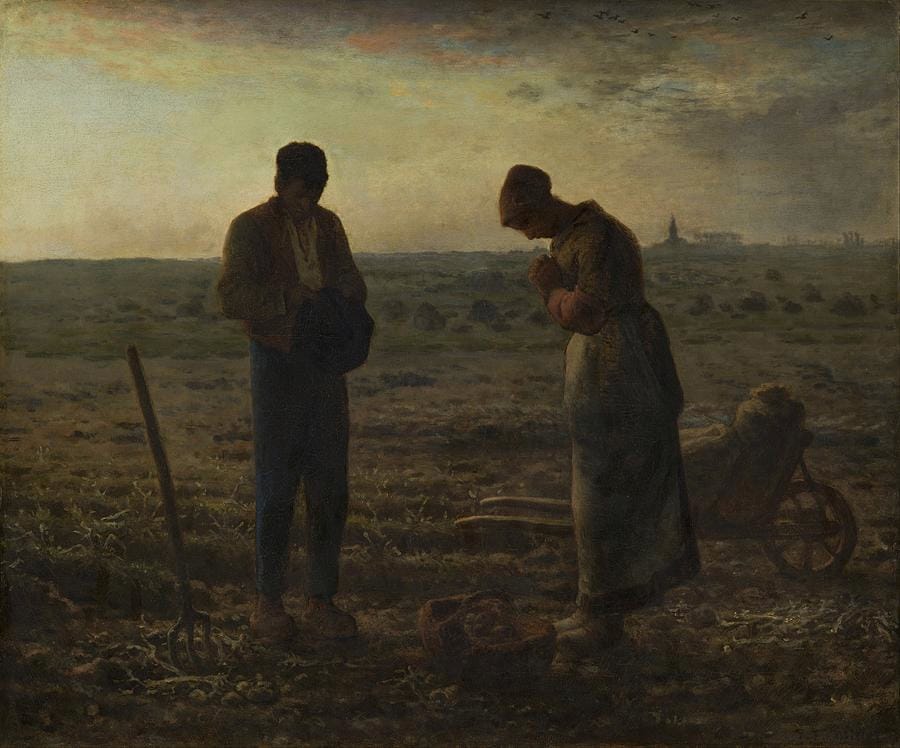
At dusk in a potato field, a man and a woman stop work and bow their heads; a distant church spire on the horizon explains why. Millet said the picture came from a memory of his grandmother making the family pause at the sound of the evening bell. Painted at the end of the 1850s, The Angelus became one of the most reproduced images of the nineteenth century, hung in kitchens and schoolrooms across Europe and America, and in 1889 it set an auction record in a bidding war between French and American buyers. Salvador Dalí was obsessed with it and wrote a whole book of interpretations. It is now in the Musée d’Orsay.
The Sower
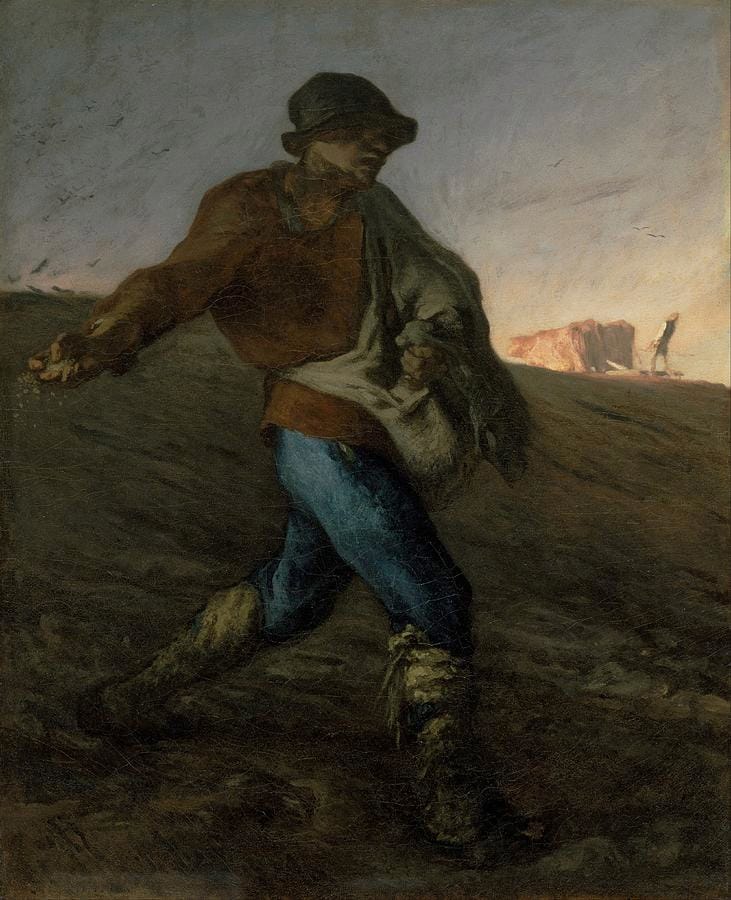
A man strides down a plowed slope at first light, right arm flung across his body in mid-throw, seed bag slung at his hip, his face lost in shadow under a hat. Millet exhibited the composition in 1850 and it made his name — and his reputation as a dangerous radical, because a labourer had never before been painted this large, this close, or this monumentally. He returned to the subject repeatedly in drawings and prints. Van Gogh drew and painted his own versions of it for years, calling Millet a father figure, and the striding silhouette became one of the standard images of nineteenth-century France.
Man with a Hoe
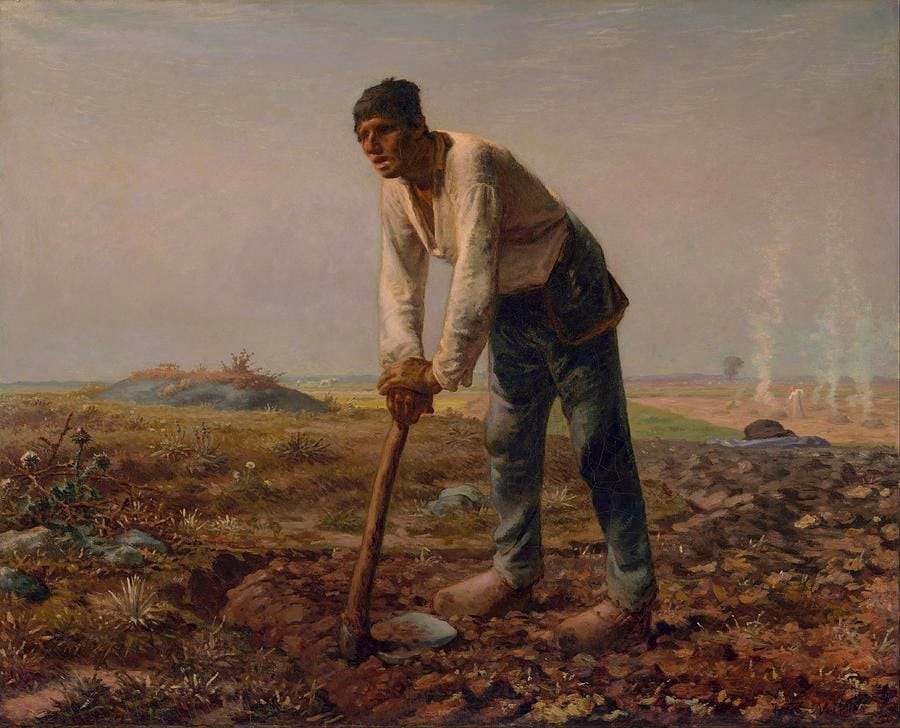
Millet worked on this picture through the early 1860s, and it is his bleakest. A labourer pauses in a field of stones and thistles, leaning on the handle of his hoe, mouth open, exhausted past the point of expression. Nothing is prettified: the ground is bad, the work is endless, and the smoke of weed fires drifts across the horizon. Critics found the figure brutish and said so loudly. Decades later the American poet Edwin Markham turned it into a protest poem that swept the newspapers of 1899, giving the painting a second life as a political emblem. It is now in the J. Paul Getty Museum.
Shepherdess and Her Flock
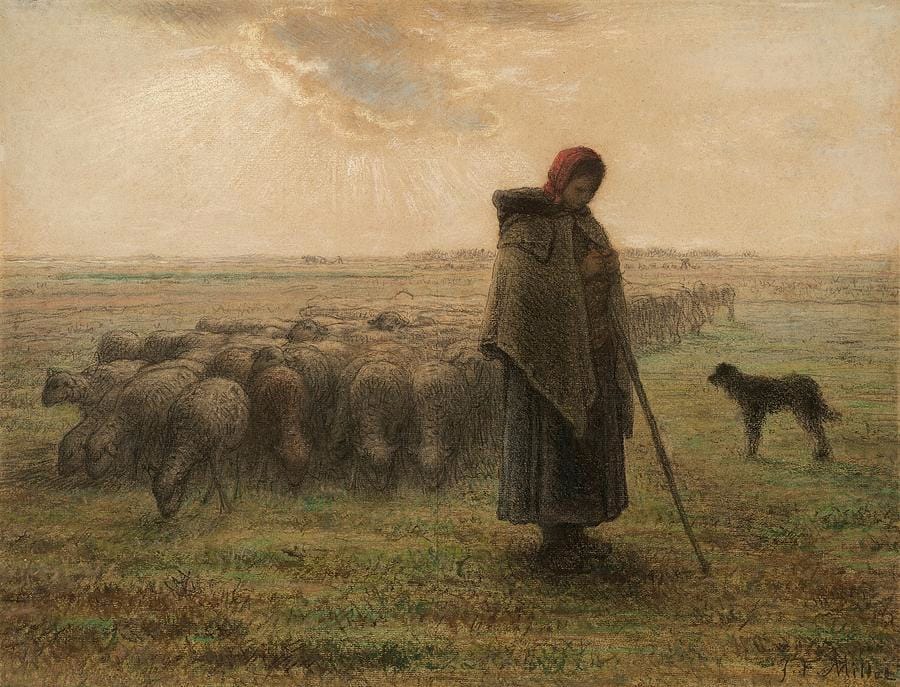
Sheep were Millet’s favorite excuse for painting light. Here a shepherdess in a heavy hooded cloak stands at the edge of her flock as it spreads across a flat plain, her dog alert beside her, the sun breaking low through a bank of cloud. The animals are barely more than a gray-brown drift; the figure is a dark upright note holding the whole width of the picture together. Subjects like this were enormously popular in his later years, and they show the side of Millet that admired the calm of seventeenth-century Dutch landscape as much as he did the sculpture of Michelangelo.
The Potato Harvest
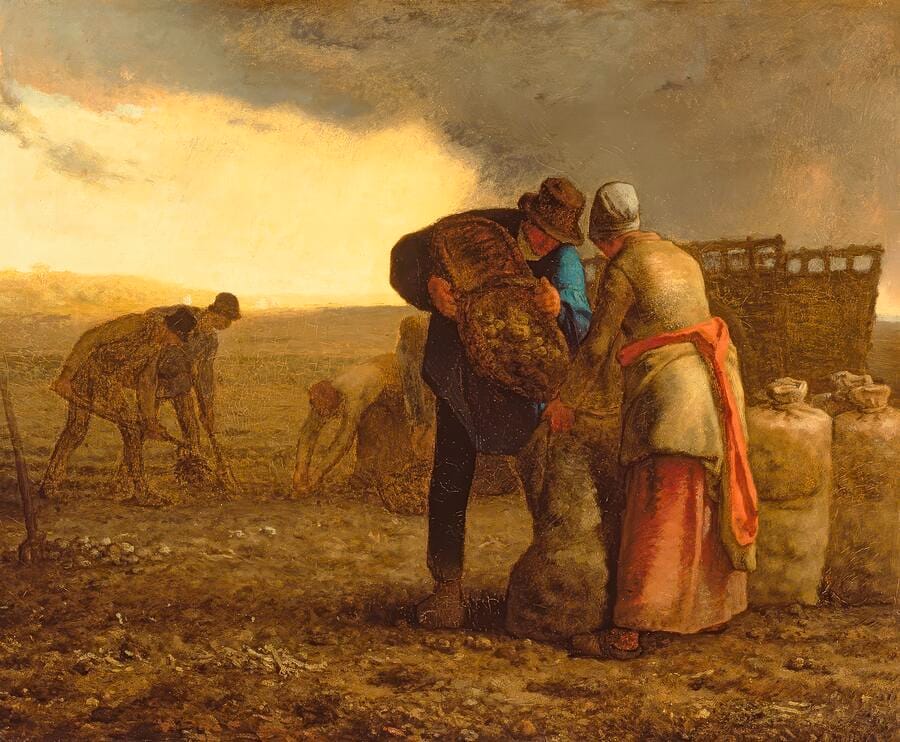
A man and a woman work together at the end of a long day, tipping potatoes into sacks while a low sun turns the dust in the air to gold. Other figures stoop in the middle distance and a cart waits at the edge of the field. Painted in the mid-1850s, it is one of Millet’s most sympathetic pairings of two workers as partners rather than as isolated symbols. The warm, smoky light — closer to Venetian painting than to anything in a French field — is a reminder that his peasants were built out of long study in the Louvre as much as long observation in Barbizon.
Going to Work
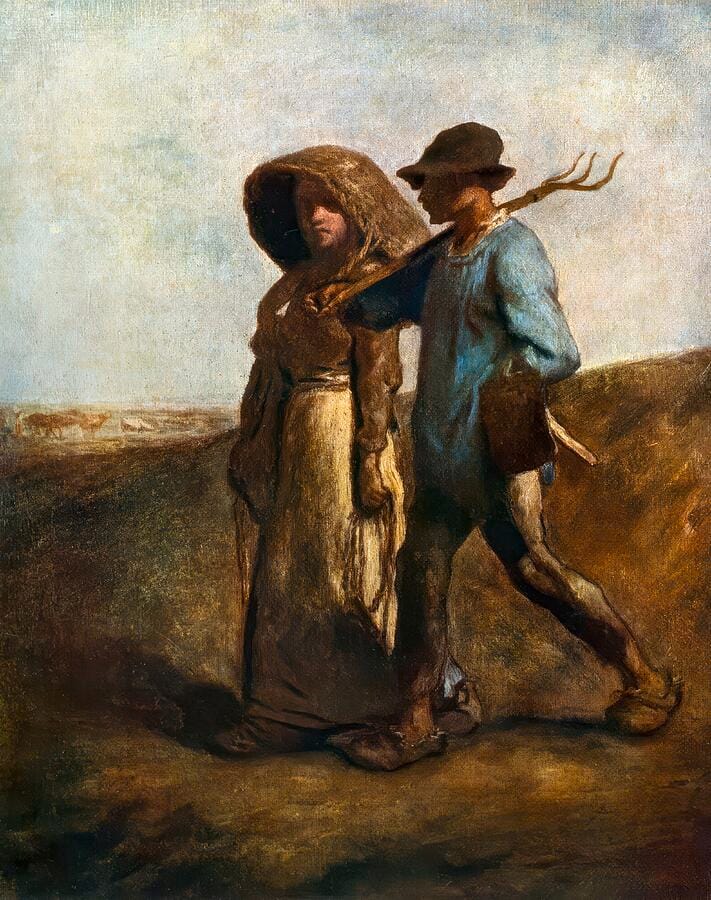
A young couple walk out into the fields at dawn, he with a pitchfork over his shoulder, she with a basket on her arm and a bundle at her hip. They move in step, silhouetted against a cool morning sky, in a composition so balanced that it has often been compared to an expulsion from Eden. Millet painted the subject in the early 1850s and returned to it more than once. It was among the works Van Gogh copied in the last year of his life, and it distils what Millet did better than anyone: turning an ordinary walk to work into something close to ritual.
The Knitting Lesson
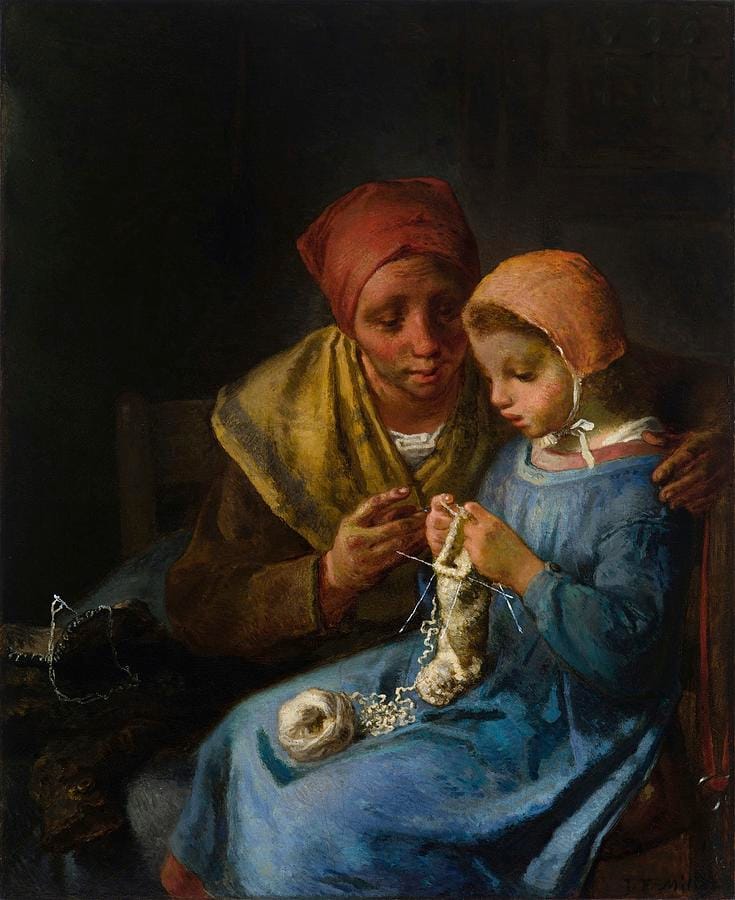
Millet painted several versions of a mother teaching her daughter to knit, and this is the closest and warmest of them. The two heads lean together in a dim cottage interior, the woman’s hands guiding the girl’s on the needles and the half-made stocking, everything reduced to red, blue and brown lit from a single window. There is no drama at all, which is the point — the whole picture is about patience being passed from one generation to the next. Millet had nine children of his own, and his domestic scenes have a directness that his grander field paintings sometimes hold at arm’s length.
First Steps
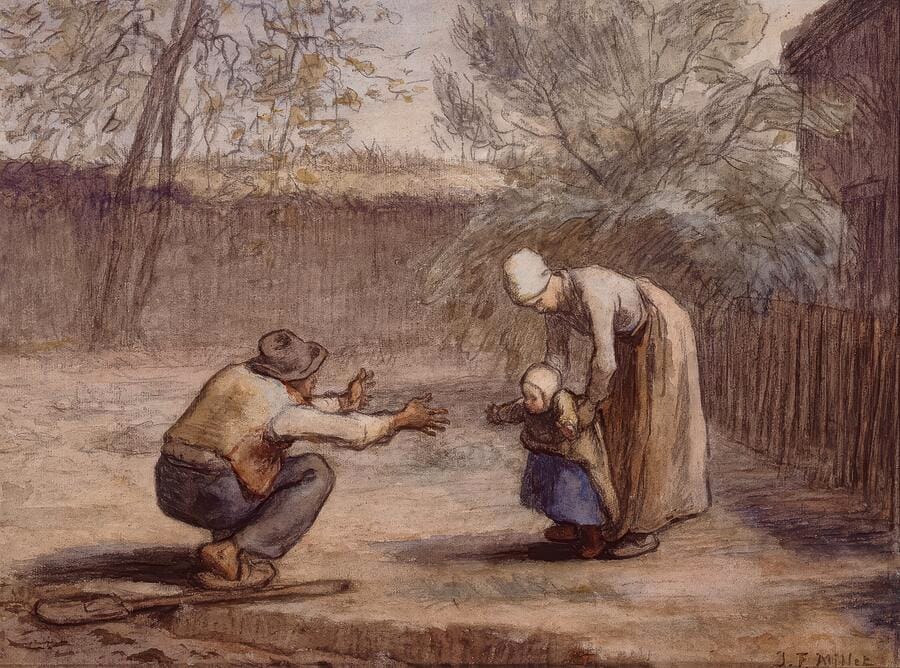
In a walled cottage garden, a father sets down his spade, crouches on the path and opens his arms; the mother steadies a toddler who is about to let go and walk to him. Millet made this scene in chalk and watercolor in the 1860s, and it is one of his tenderest works. Its lasting fame comes partly through Van Gogh, who painted a large color version after a print of it while at Saint-Rémy in 1890, calling such copies his way of translating Millet into another language. Compared side by side, the two versions are a lesson in what one artist can take from another.
Autumn Landscape with a Flock of Turkeys
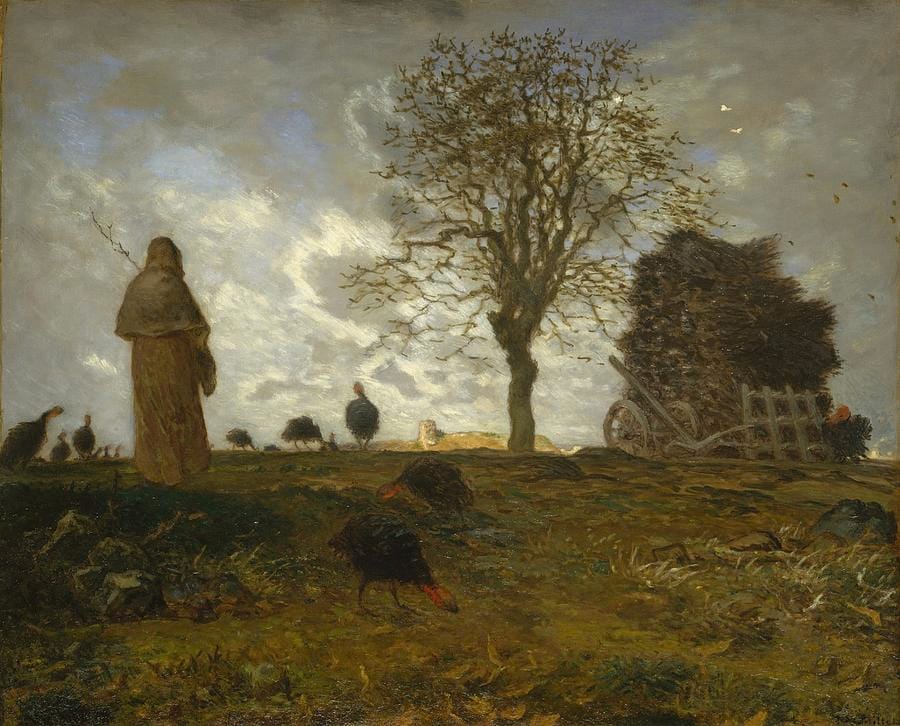
Late in life Millet turned increasingly to pure landscape, and this picture from the early 1870s is among the finest. Turkeys scatter across a bare autumn field beneath a bare-branched tree while a woman in a shawl stands apart on the ridge, small and still. The color is muted to gray, ochre and dull green, and the mood is entirely weather — damp air, failing light, the year turning. It belongs to the Metropolitan Museum of Art, and it shows the painter that Pissarro and later Van Gogh had in mind when they described Millet as a landscape artist first and a moralist second.
Millet’s pictures have a stillness that very little nineteenth-century painting can match, and they wear their age lightly. Their muted earth colors and quiet horizons sit easily in a kitchen, a study or a hallway, and they reward the sort of long, unhurried looking that busy rooms rarely get.
Shop Jean-François Millet prints here, and explore the rest of our famous paintings collection for more of the world’s most beloved masterpieces.