Jean-Auguste-Dominique Ingres’s Ten Most Famous Paintings
Cool porcelain skin, impossible curves, and the finest line in French painting: the ten works that define Ingres.

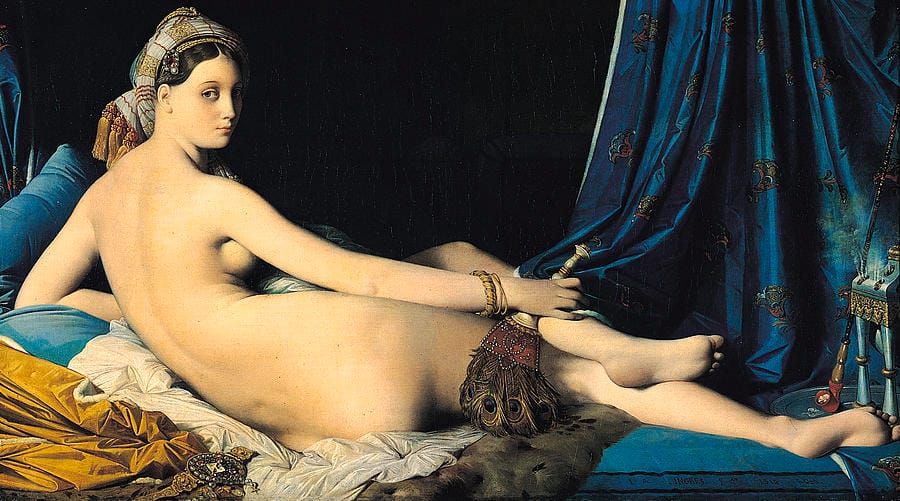
Jean-Auguste-Dominique Ingres (1780–1867) was the great defender of drawing in French art. Trained under Jacques-Louis David and sent to Rome after winning the Prix de Rome in 1801, he spent eighteen years in Italy studying Raphael and returned to France as the standard-bearer of a cool, linear classicism — the opposite pole to Delacroix and the Romantics, who put their faith in color and movement. “Drawing is the probity of art,” he insisted, and he meant it as a moral position.
What makes his paintings so odd and so magnetic is that the discipline keeps giving way to something stranger. Backs grow extra vertebrae, arms bend where they should not, silk and cashmere are described with a jeweller’s exactness while the flesh beneath turns to smooth porcelain. Critics of the day called him a Gothic primitive; a century later Picasso and Matisse studied him closely. Here are ten of his most famous works.
La Grande Odalisque
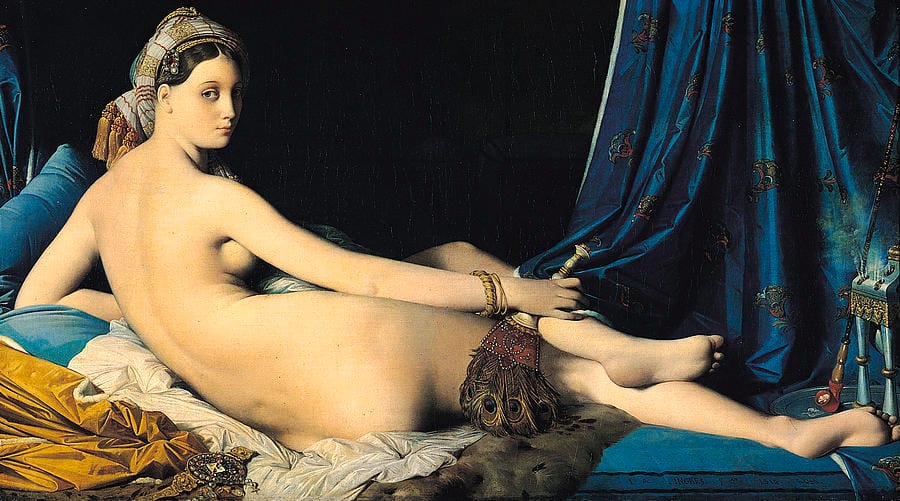
Commissioned in 1814 by Caroline Murat, Napoleon’s sister and queen of Naples, La Grande Odalisque shows a harem concubine reclining on a bed of blue drapery, turning her head to look back over her shoulder with complete composure. The props — turban, peacock fan, hookah — belong to a Turkey Ingres never visited and knew only from books and prints. Critics at the 1819 Salon were appalled by the anatomy, complaining that the long, boneless back seemed to have several vertebrae too many. It does. Ingres was after a continuous cool curve rather than a correct spine, and the painting has hung in the Louvre as a masterpiece of French art ever since.
Napoleon I on His Imperial Throne
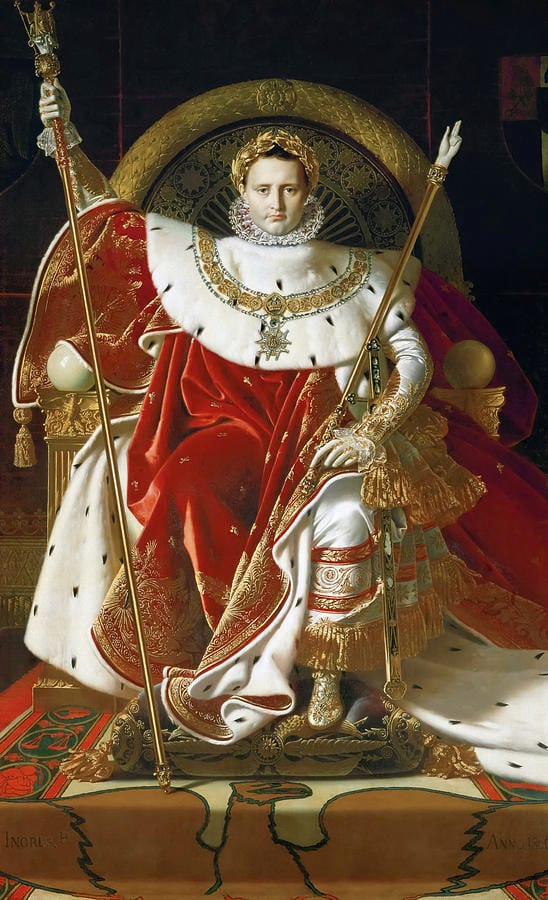
Painted in 1806, when Ingres was in his mid-twenties, this is the most extraordinary of all images of Napoleon. The Emperor sits rigidly frontal in ermine and crimson velvet, gold laurel wreath on his head, sceptres in both hands, staring out with a fixed, unblinking gaze. Ingres borrowed the pose from medieval images of God enthroned and from the great gold-and-ivory statues of antiquity, and the effect is deliberately inhuman — an icon rather than a man. Contemporaries disliked it intensely, finding it archaic and cold. It survives today in the Musée de l’Armée in Paris, and its strangeness is now the reason people look.
The Valpinçon Bather
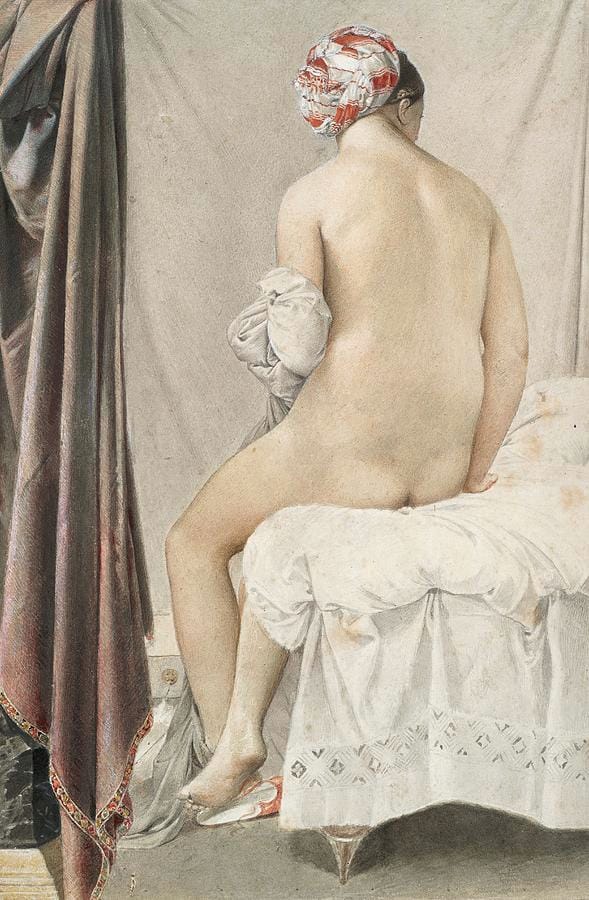
A woman sits on the edge of a bed with her back to us, a white sheet falling across the bed beside her and a patterned cloth knotted around her hair. Nothing happens. Painted in Rome in 1808 as one of the works a Prix de Rome student was required to send home, The Valpinçon Bather — named after a later owner — is built almost entirely from a single unbroken contour running from the turban down the shoulder, back, and thigh. Ingres returned to the pose for the rest of his life, repeating this figure decades later in The Turkish Bath. It now hangs in the Louvre.
Oedipus and the Sphinx
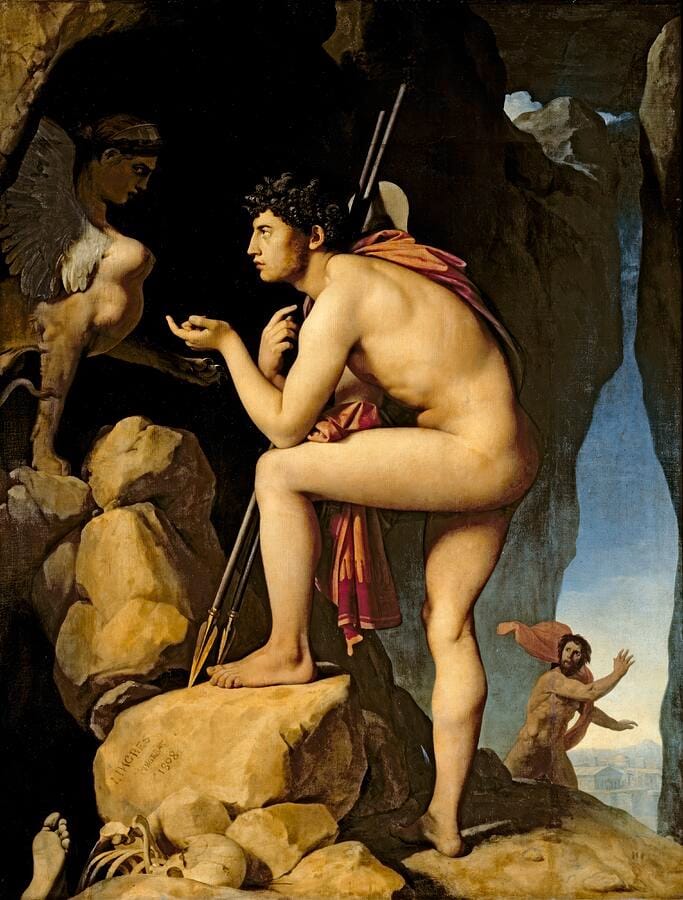
Ingres painted this scene from Greek myth in Rome in 1808 and enlarged it years afterward. Oedipus stands in a rocky pass, leaning forward with one foot raised on a stone, calmly working through the riddle put to him by the Sphinx, whose winged, breasted body is half in shadow in the cave mouth beside him. A human foot and some scattered bones in the foreground make plain what happened to the travelers who answered wrongly. It is a picture about intellect facing down a monster, and the young Ingres gives Oedipus the polished, statue-like body of a classical hero. The painting is in the Louvre.
The Apotheosis of Homer
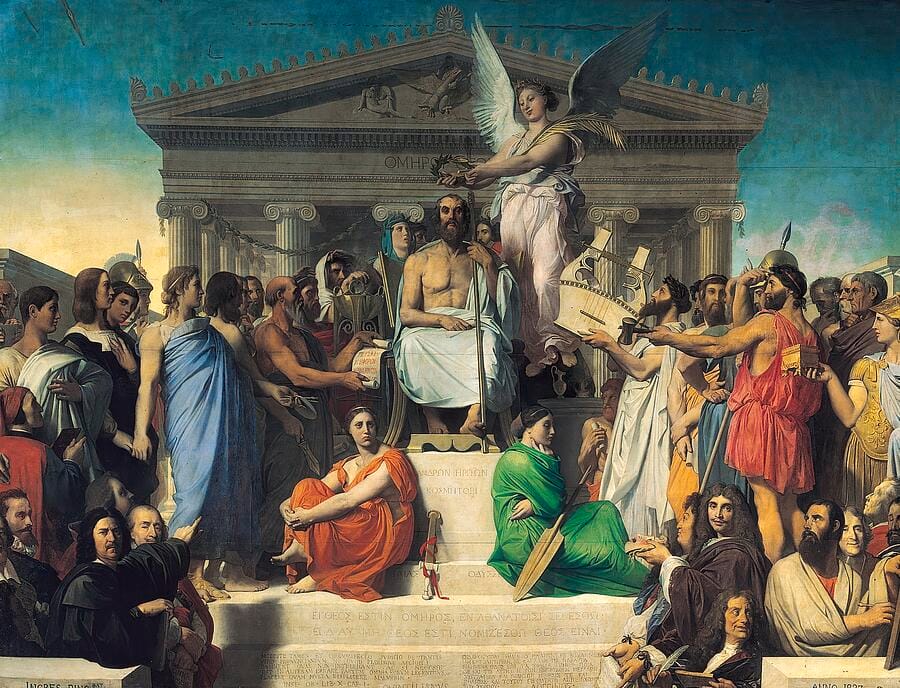
Painted in 1827 as a ceiling for a room in the Louvre, this vast composition is Ingres’s statement of faith. Homer sits enthroned before a Greek temple as a winged figure crowns him, with the personifications of the Iliad and the Odyssey seated at his feet. Ranged symmetrically below is a congregation of the artists and writers Ingres judged worthy — Raphael, Dante, Poussin, Mozart, Molière and dozens more. He is drawing up a canon and placing himself inside it, and the rigid frontal order of the picture argues his case for classical art as clearly as anything he ever wrote.
Comtesse d’Haussonville
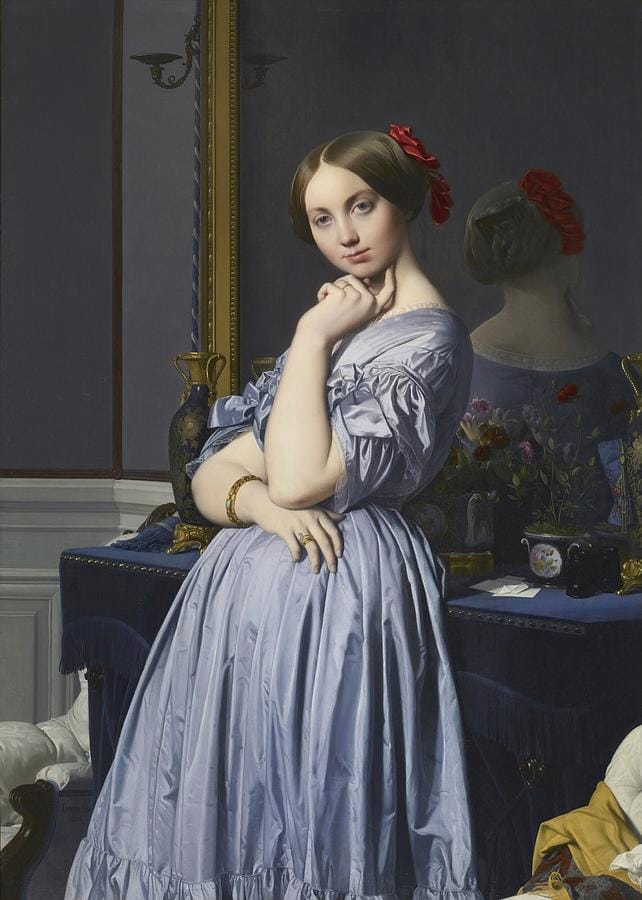
Louise, Comtesse d’Haussonville — a granddaughter of the writer Madame de Staël, and a writer herself — stands in a pale blue silk gown before a mirror, one finger tucked under her chin, her head tipped in a pose of easy thought. Ingres worked at the portrait for three years and complained bitterly about the difficulty before finishing it in 1845. The mirror behind her doubles the back of her head and the clutter of the mantelpiece, so the sitter is seen twice at once. The result, now in the Frick Collection in New York, is often called the most beguiling female portrait in French painting.
Portrait of the Princesse de Broglie
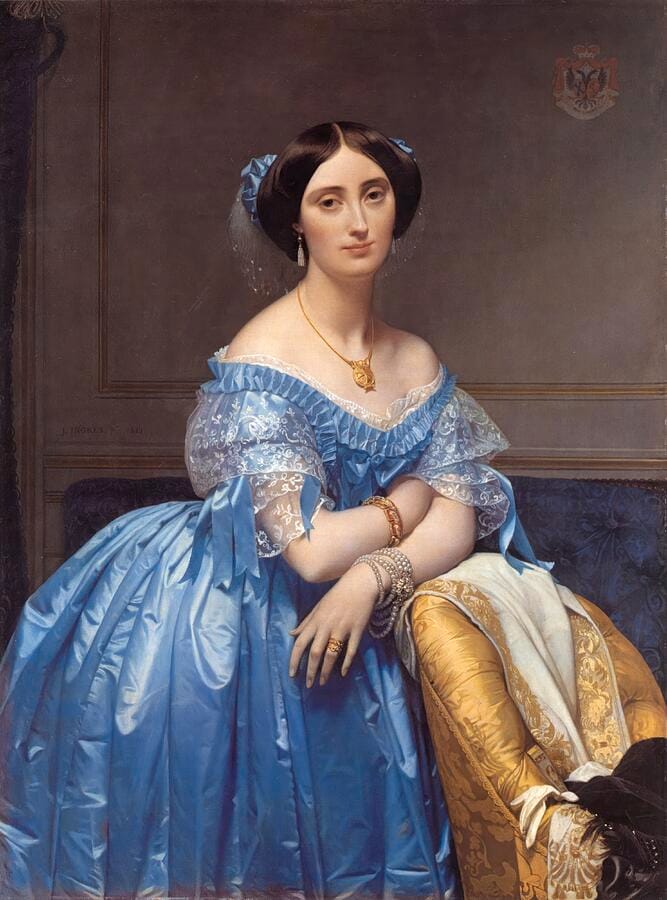
Pauline de Broglie was in her late twenties when Ingres painted her between 1851 and 1853, standing beside a gilt chair in a pale blue satin gown, arms crossed lightly at the wrist. The description of the fabric is almost hallucinatory — you can count the threads of the lace and feel the weight of the ribbons — while her face is smoothed into something remote and slightly anxious. She was shy, devout, and unhappy in society, and she died of tuberculosis in 1860 at thirty-five. Her husband is said to have kept the portrait covered for the rest of his life. It hangs in the Metropolitan Museum of Art.
Madame Moitessier
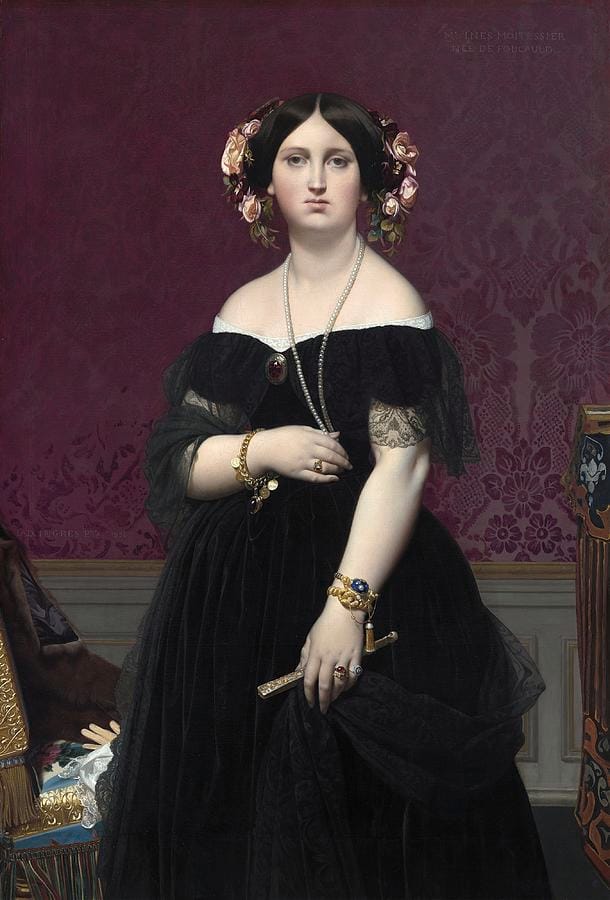
Ingres did not want this commission. He disliked painting bankers’ wives, and only agreed after meeting Inès Moitessier and being struck by what he called her terrible beauty. The picture then took him more than a decade, and he painted her twice: this standing version, finished in 1851, shows her in a black velvet gown with roses in her hair against a deep red wall, one hand hanging heavy with bracelets. The second, seated version was not completed until 1856. Between them they occupy twelve years of an old man’s working life, and the standing portrait is now in the National Gallery of Art in Washington.
Joan of Arc at the Coronation of Charles VII
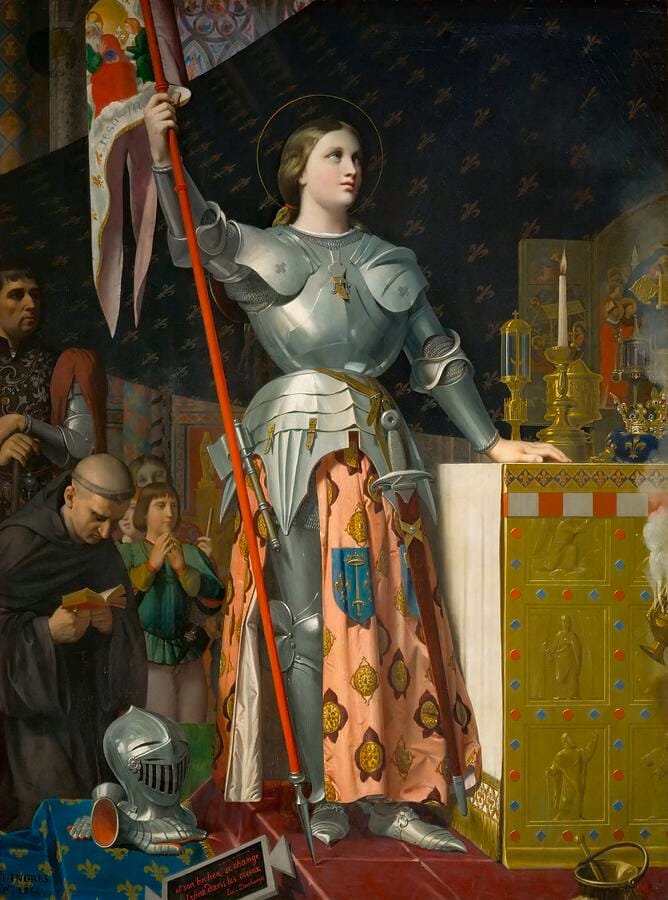
Finished in 1854, when Ingres was in his seventies, this shows Joan of Arc in full armor at the coronation of Charles VII in Reims cathedral, one hand resting on an altar loaded with gold plate, her banner held upright beside her, her eyes raised. The armor is painted with a metalworker’s attention, every rivet and reflection in place, and the composition rises like a devotional image rather than a history painting. France was rediscovering Joan as a national symbol in these years, decades before her canonization. The painting is in the Louvre.
Self-Portrait at Twenty-Four
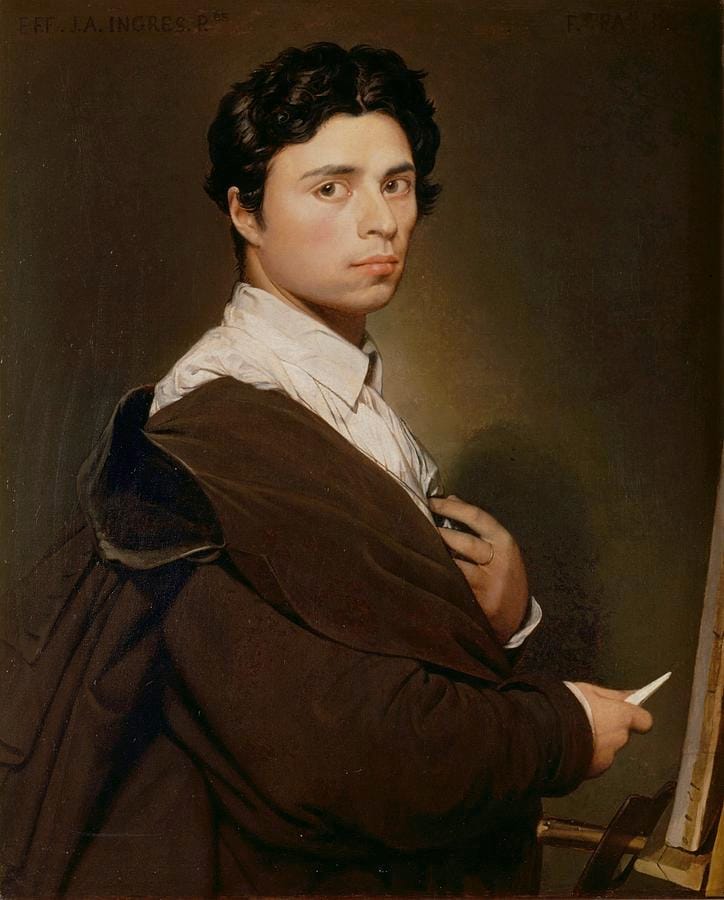
Ingres painted himself in 1804 as a young man in a heavy brown cloak, half turned, dark eyes fixed on the viewer with an intensity that borders on challenge. He had just won the Prix de Rome and was waiting, impatiently, for the state to send him to Italy. The picture was badly received when he first showed it, and like much of his work he went back to it in later years and reworked parts of the composition, softening some of the youthful bravado. What survives is the look — the unmistakable self-belief of a painter who intended to reform French art and eventually did.
Ingres spent his long life arguing that line came first and everything else followed, and the paintings still make the case. They are cool, exact, and quietly eccentric, and they reward slow looking more than almost anything else in nineteenth-century art. On a wall at home, an Ingres portrait brings a note of stillness and formality that holds its own in a room of any period.
Shop Jean-Auguste-Dominique Ingres prints here, and explore the rest of our famous paintings collection for more of the world’s most beloved masterpieces.