Francisco Fierro’s Ten Most Charming Watercolors of Old Lima
Water sellers, veiled ladies, dancers and bullfights: ten watercolors by the self-taught artist who painted nineteenth-century Lima into memory.

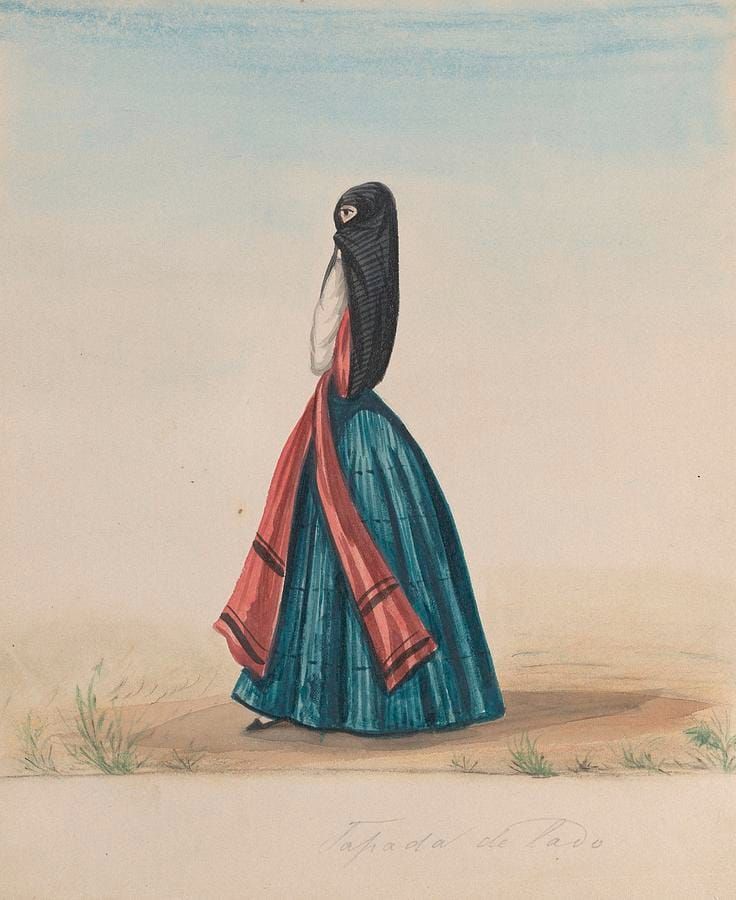
Francisco Fierro (c. 1807–1879), known to everyone in Peru as Pancho Fierro, was a self-taught Afro-Peruvian artist who spent his life painting the city of Lima. He worked small and fast, in watercolor on single sheets of paper, and his subject was never grand history but the street: vendors, muleteers, monks, dancers, soldiers, bakers, fortune tellers, and above all the women of Lima in their extraordinary veiled costume. Travelers bought his sheets as souvenirs, and the writer Ricardo Palma was among the collectors who gathered them into albums.
That habit of collecting is why so much of his work survives. Fierro belongs to costumbrismo, the nineteenth-century Latin American fashion for recording local types and customs, and because he was working just before photography reached Peru, his watercolors are the closest thing we have to a photographic record of Lima in the decades after independence. Most are undated and few are titled by the artist himself. Here are ten of the most memorable.
A Woman Wearing the Saya and Manto
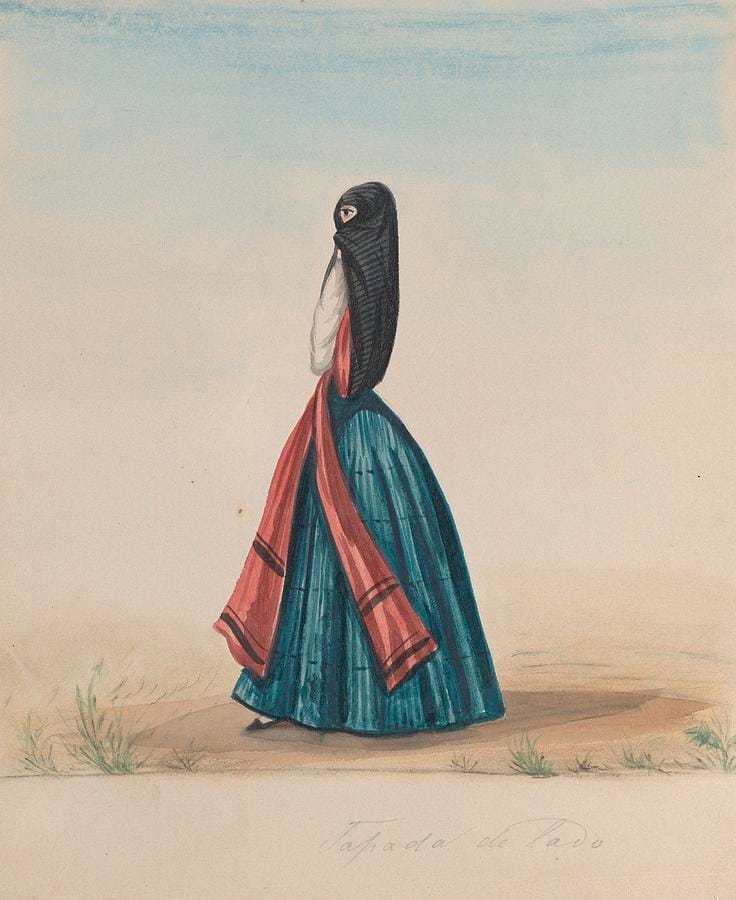
No subject was more closely associated with Fierro than the tapada limeña. A woman stands in profile against a bare ground in a narrow teal skirt — the saya — with a heavy red shawl over her shoulders and a dark manto wrapped so tightly around her head that only one eye is left visible. The costume was worn by Lima women for generations and gave them a freedom to move through the city unrecognised that scandalised visiting foreigners and delighted everyone else. Fierro painted dozens of these figures, usually alone on an empty page, and the single exposed eye does all the work.
A Man and Woman Dancing the Zamacueca
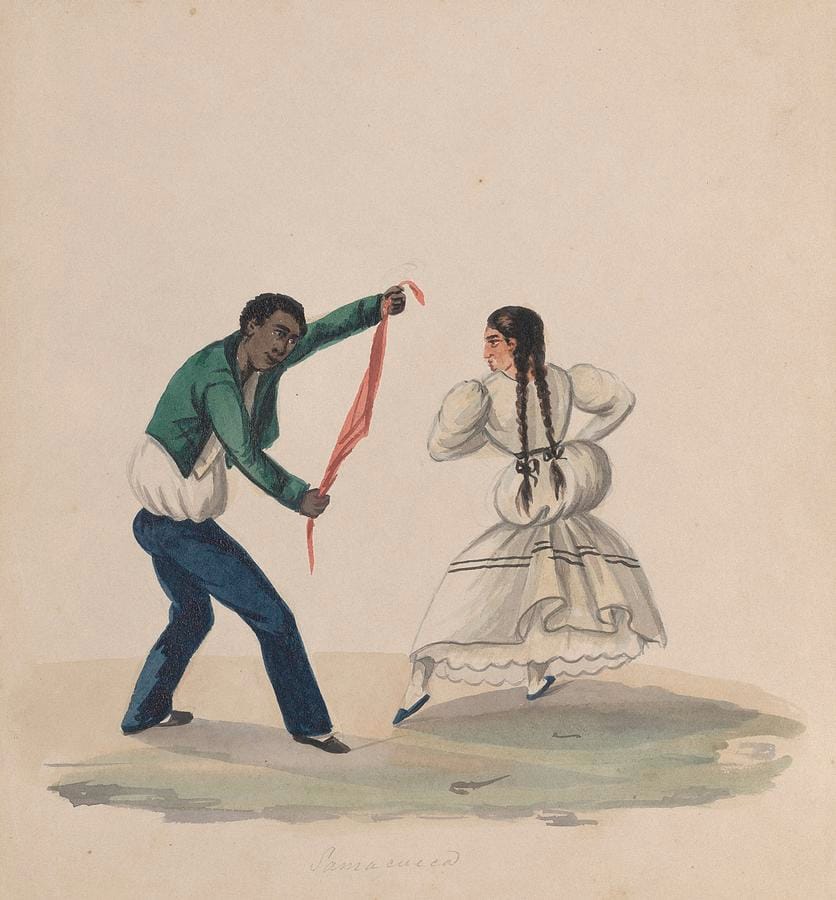
The zamacueca was the great popular dance of nineteenth-century Peru, danced by a couple who circle and pursue one another with handkerchiefs held high, and it is the direct ancestor of the marinera still danced today. Fierro caught the moment of the chase: a man in a green jacket and blue trousers lunges forward with a red handkerchief snapping above his head, while his partner, in a white dress with her hair in long braids, spins away from him with her own cloth raised. Their shadows are the only setting. Nobody recorded Peruvian dance of this period more often, or with more evident pleasure.
The Water Vendor
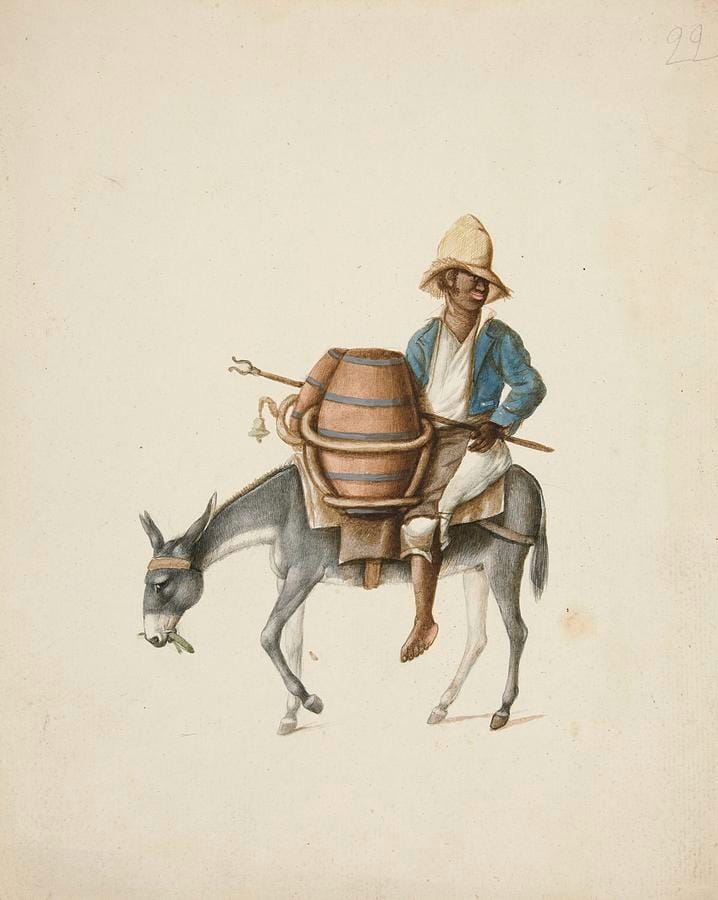
Before Lima had piped water, it had aguadores. Fierro shows one riding astride a small gray donkey almost buried under its load — a big wooden cask lashed across the animal’s back, a bundle of gear underneath, and the vendor perched on top in a broad straw hat and blue jacket, one leg hanging loose. The donkey plods along at the pace of a working animal that has done this route a thousand times. The water carrier was one of the recognizable characters of the old city, calling his way through the streets, and this is one of the artist’s most affectionate portraits of a Lima trade.
Woman Smoking a Cigar Before a Bread Stand
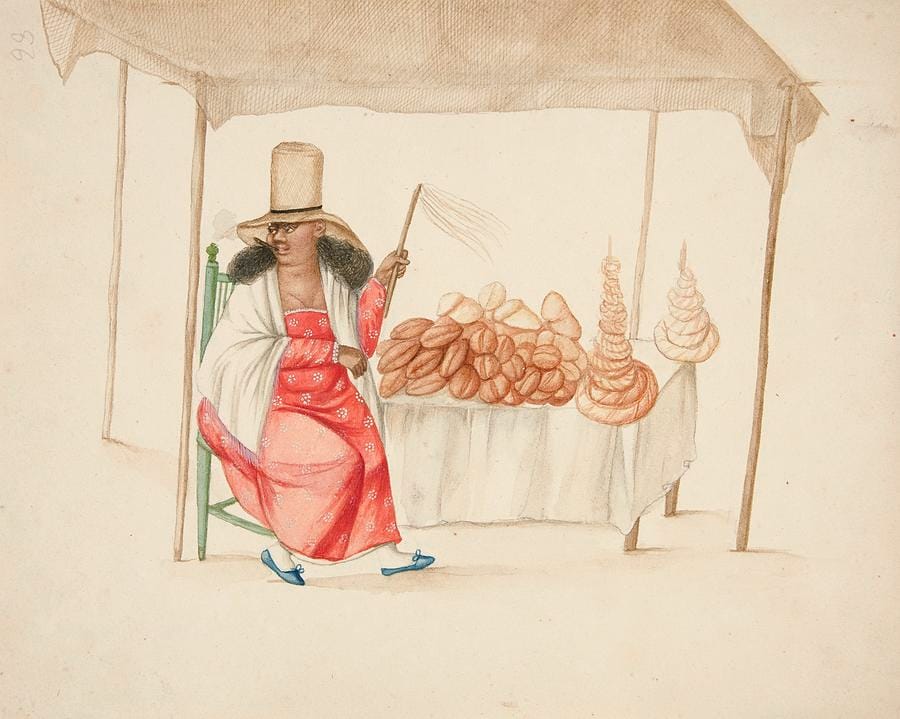
Under a plain cloth awning, a woman leans against a green chair beside her table, which is heaped with bread rolls and topped by tall spiral cones of sugared pastry. A cigar is clamped in her teeth, trailing a thread of smoke, and she has raised a straw fly whisk on a stick to keep the insects off her stock. She wears a tall stovepipe hat over a wide straw brim, a white shawl, and a red dress printed with small white flowers, and she is entirely at ease. Fierro built much of his career on stall-holders like this one — the sellers of bread, fruit, sweets and drinks who filled Lima’s plazas — and he gives her the confident stance and direct attention that painters of the time normally reserved for people of higher rank.
A Priest of the Mercedarian Order
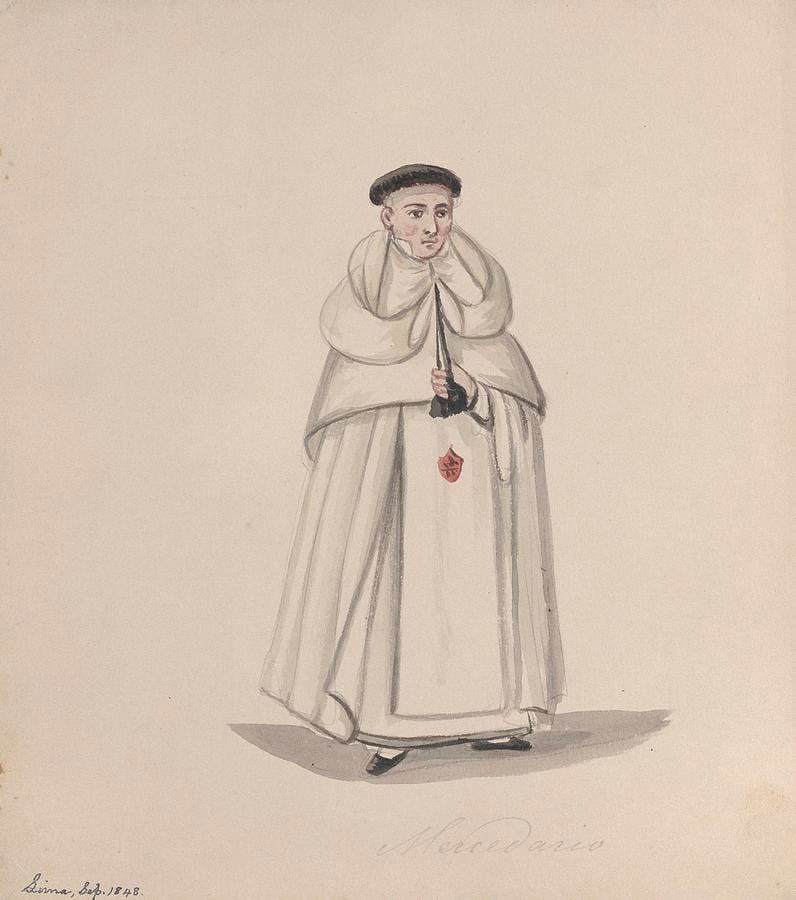
Lima was a city of convents and religious orders, and Fierro recorded their habits with a costume-maker’s precision. This friar of the Order of Mercy stands alone on the page in a full white habit and scapular, hands folded into his sleeves, tonsured head bare, with the order’s red-and-white shield hanging at his chest. The drawing is quiet and almost affectionate, and the artist has resisted any temptation to caricature. Sheets like this one were bought by travelers who wanted a record of the religious and social types they had seen in the street, and together they add up to a directory of the old city.
The Bullfight
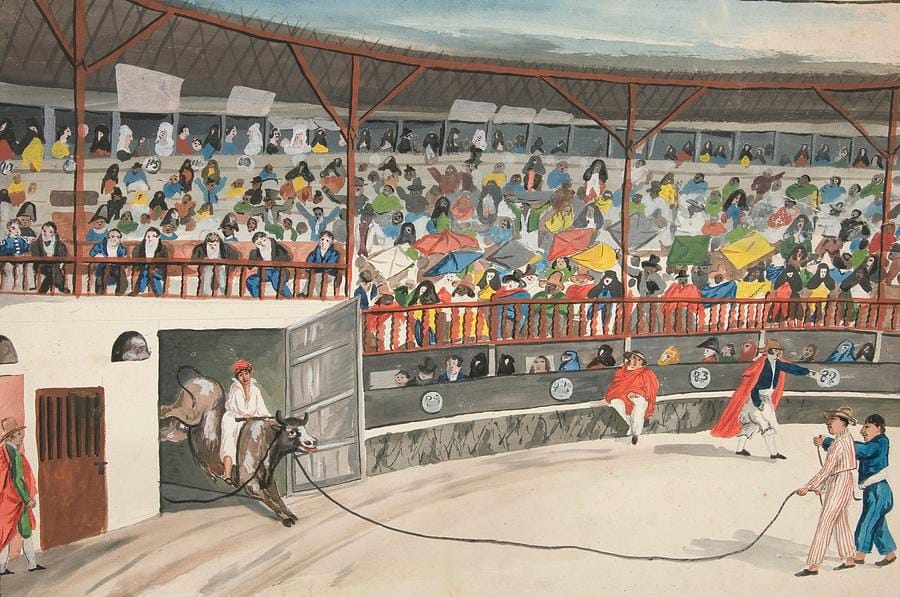
Bullfighting arrived in Peru with the Spanish and was still one of Lima’s great public entertainments in Fierro’s lifetime. Here he pulls back to take in the whole ring: tier upon tier of spectators packed under a wooden roof, parasols and bright clothes making a band of color around the top, an open gate at the left where a mounted man waits, and a scatter of tiny figures with capes out on the empty sand. It is a crowd scene rather than a study of a matador, and it shows how well this miniaturist of single figures could handle several hundred people at once.
Two Musicians and a Man Carrying a Rooster
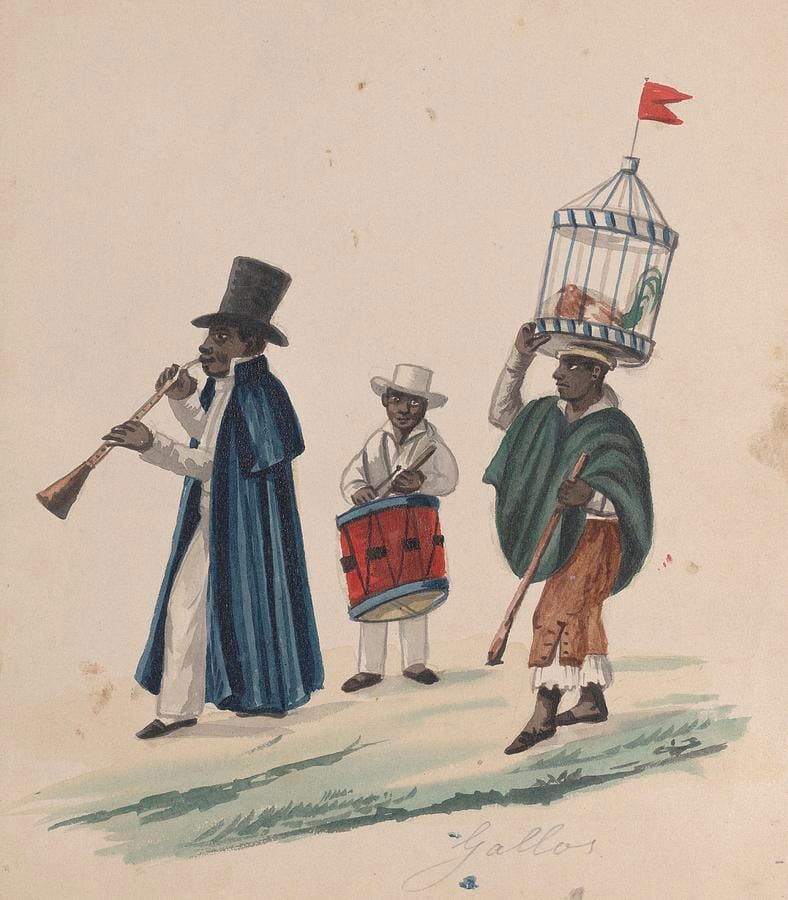
Three men walk together across the page: one in a long blue coat and top hat blowing a wind instrument, a smaller drummer beating a red side drum, and behind them a man in a green poncho balancing a wooden cage on his head with a small red pennant flying from the top. They are almost certainly on their way to a fiesta or a cockfight, and the little procession has the ragged, cheerful look of a street band in motion. Fierro’s figures rarely stand still; even in a picture with no background at all, he gives you the sense of a city going somewhere.
An Elegantly Dressed Woman and Her Page
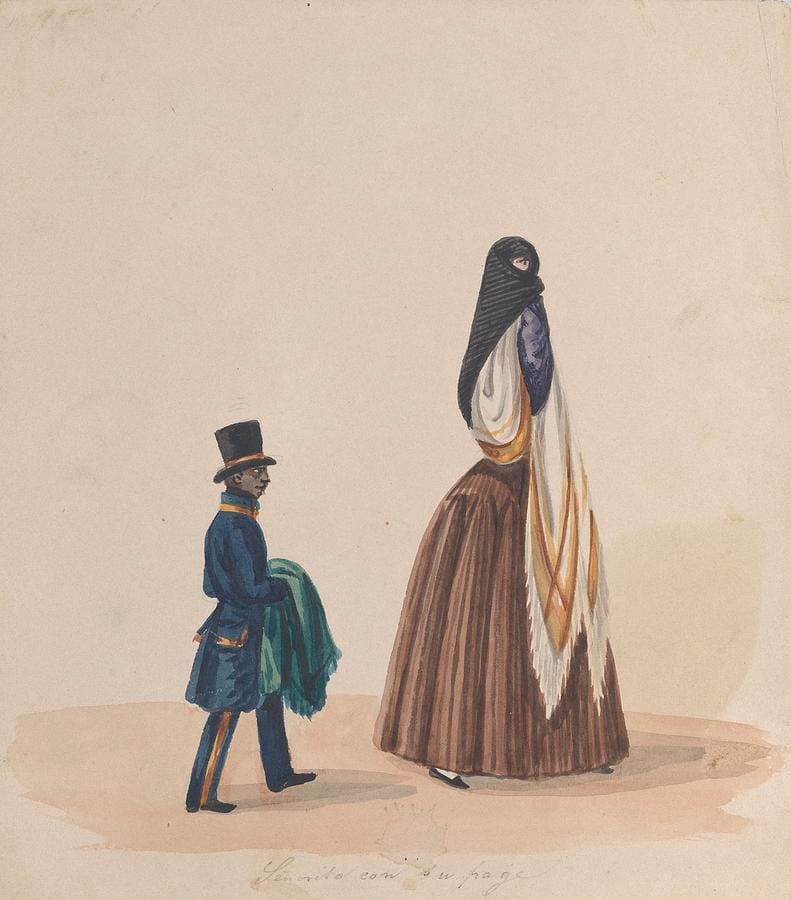
A lady sweeps across the page in a wide skirt of cream and russet with a black manto drawn over her head, and behind her walks a small boy in a blue coat and top hat, carrying a folded green wrap. The pairing is the whole point: Fierro was documenting a society in which servants, many of them of African descent like the artist himself, appeared in public as part of a wealthy woman’s costume. He records it without commentary, but the contrast of scale between the towering skirt and the child struggling along behind it tells its own story.
A Woman Walking with a Llama
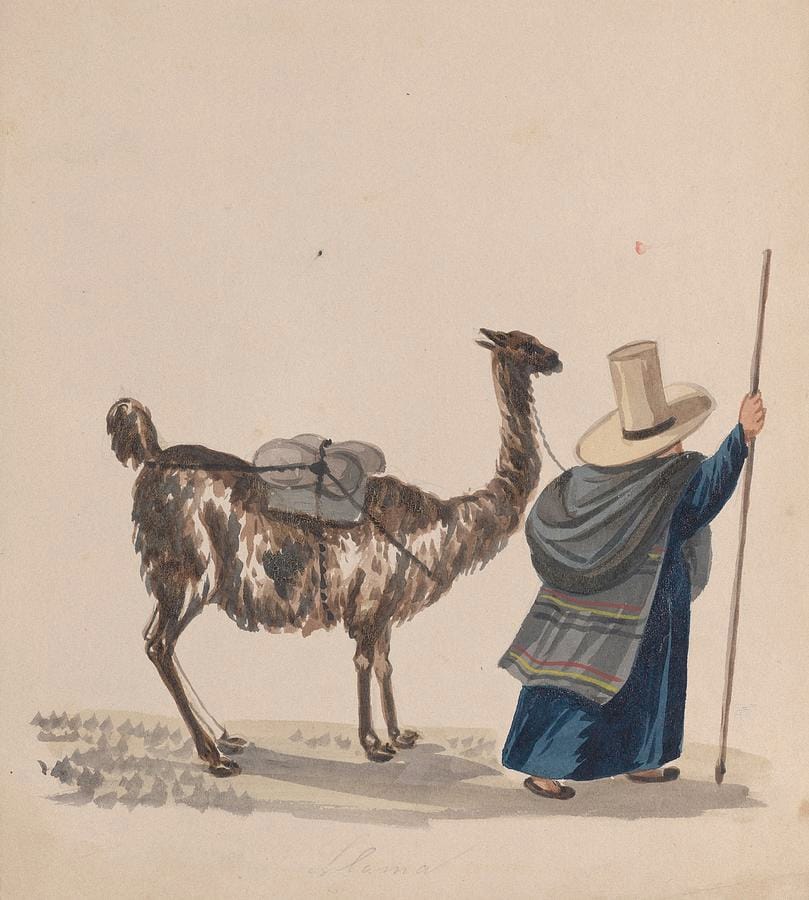
Seen from behind, a woman in a broad straw hat, striped shawl and long blue skirt walks a laden llama across an empty ground, a staff in her free hand. The llama, shaggy and dark, turns its head with the wary expression llamas always have. Animals brought down from the sierra to the coastal capital were a familiar sight in Lima’s markets, and Fierro treats this one with real attention to its build and its coat. Choosing the back view is characteristic of him — he was as interested in the shape a costume made from behind as in a face.
The Pastry Shop
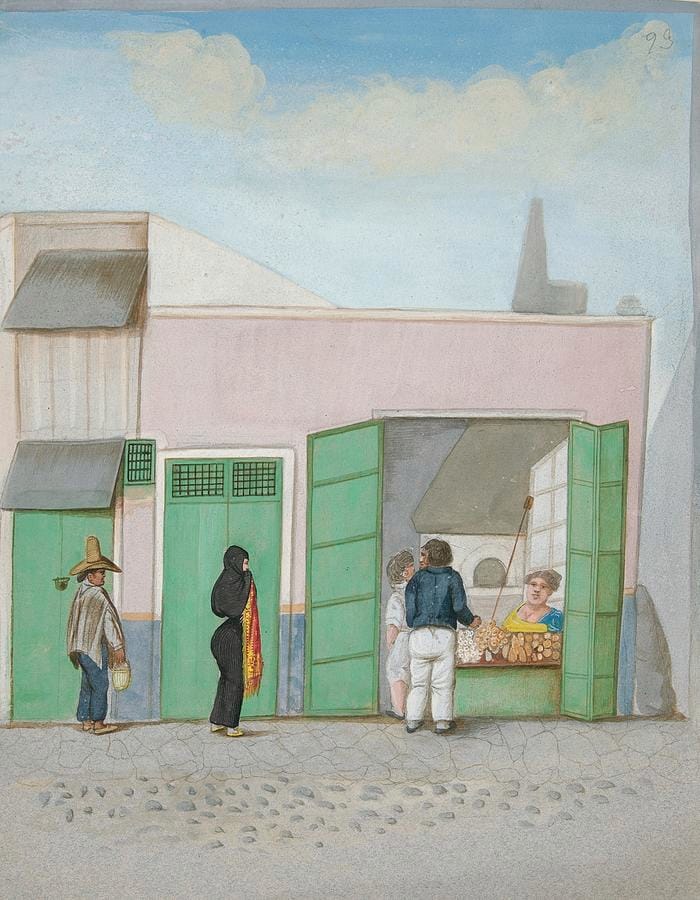
Here Fierro gives his figures a setting. A corner shop stands open to the street, its green shuttered doors folded back and its walls washed pink and pale blue under a low gray roof, with a tower rising behind. Customers cluster at the counter — men in straw hats and ponchos, a woman wrapped in a black manto, a child — while the seller waits behind her counter among baskets of goods. The architecture is as carefully observed as the clothing: this is what a street in Lima looked like when everything was low, shuttered and painted in colors that could take the sun.
Fierro painted no altarpieces and no great battles, but he did something rarer: he looked hard at the ordinary life of his own city and set it down while it was still happening. The sheets are small, bright and full of character, and a group of them hung together brings warmth and a great deal of personality to a wall.
Shop Francisco Fierro prints here, and explore the rest of our famous paintings collection for more of the world’s most beloved masterpieces.