Édouard Vuillard’s Ten Most Famous Paintings
Wallpaper, lamplight, and his mother at her sewing table: ten paintings by the quietest radical of the Paris avant-garde.

Édouard Vuillard (1868–1940) grew up in a cramped Paris apartment where his widowed mother ran a dressmaking workshop, and he never really left it. He lived with her until she died in 1928, when he was nearly sixty, and called her his muse without a trace of irony. Bolts of cloth, pattern books, seamstresses bent over their work, and above all wallpaper — endless wallpaper — became the raw material of one of the strangest and most beautiful bodies of work in modern painting.
In 1889 he joined the Nabis alongside Pierre Bonnard, Maurice Denis, and Paul Sérusier, young painters who had absorbed Gauguin’s lesson that a picture is a flat arrangement of colors before it is anything else. Vuillard applied that idea to the family sitting room. In his best pictures a figure nearly disappears into the pattern of the sofa behind her, space collapses into a mosaic of small marks, and a scene of complete domestic ordinariness turns quietly unsettling. Here are ten of his most famous works.
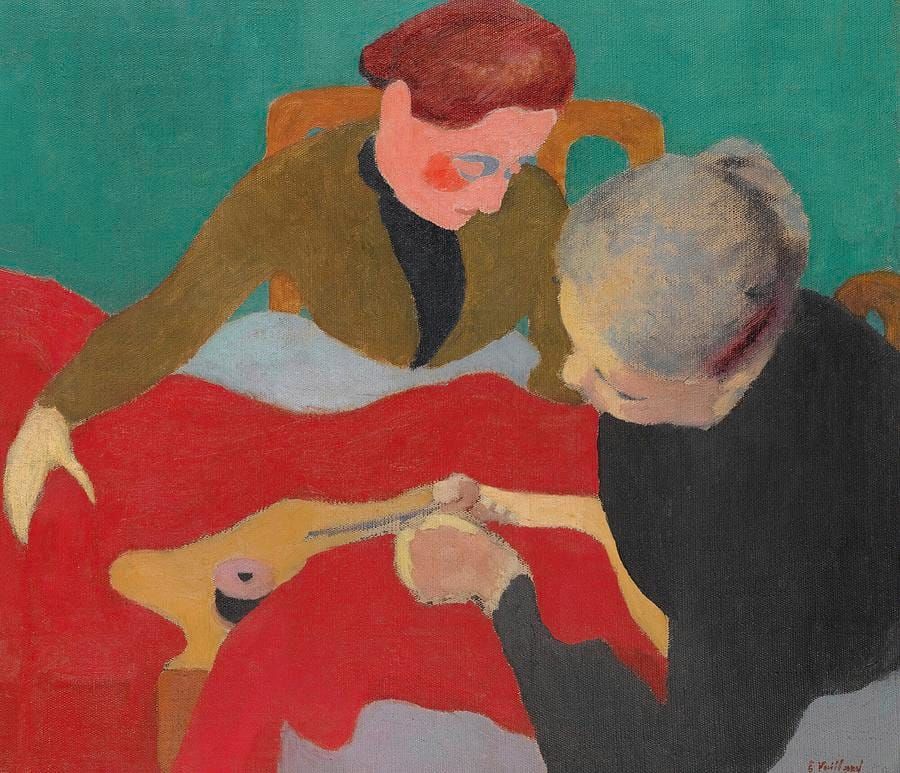
Les Couturières (The Dressmakers)
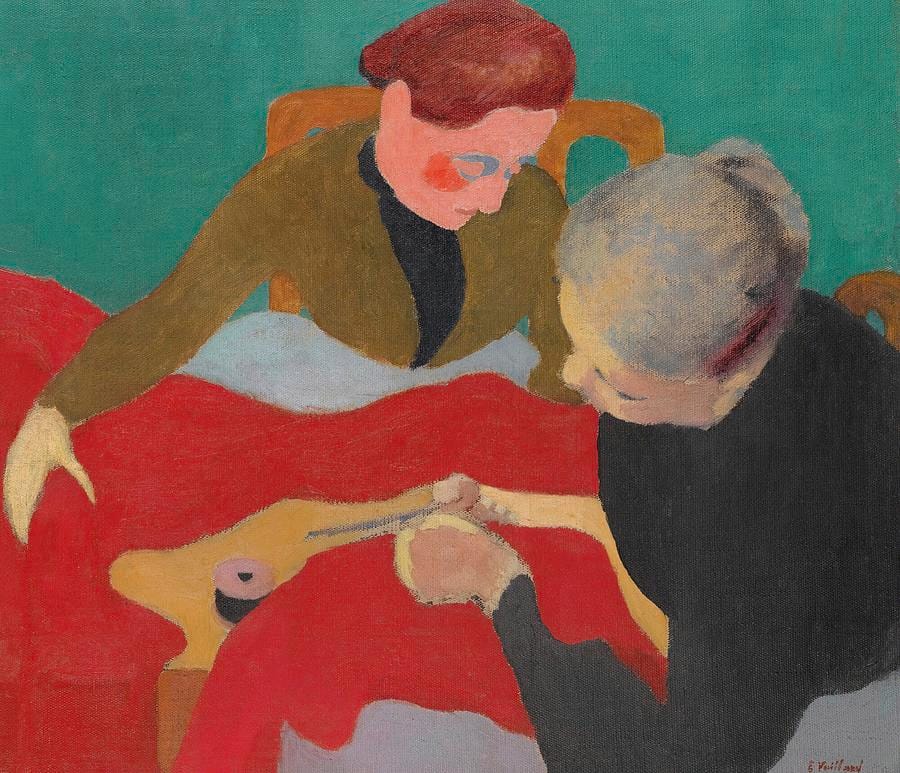
Two women bend over a great sheet of red cloth spread across a table, one red-haired and young, the other gray-haired and dressed in black, their hands almost meeting on the fabric. Behind them the wall is flat emerald green. Painted around 1890, when Vuillard was in his early twenties, it is one of the boldest things he ever did: the red is laid down as a single uninterrupted shape, faces are simplified almost to masks, and depth is abolished. The subject is his mother’s workshop, the world he knew best, treated with the seriousness other painters reserved for history and myth.
In Bed (Au Lit)
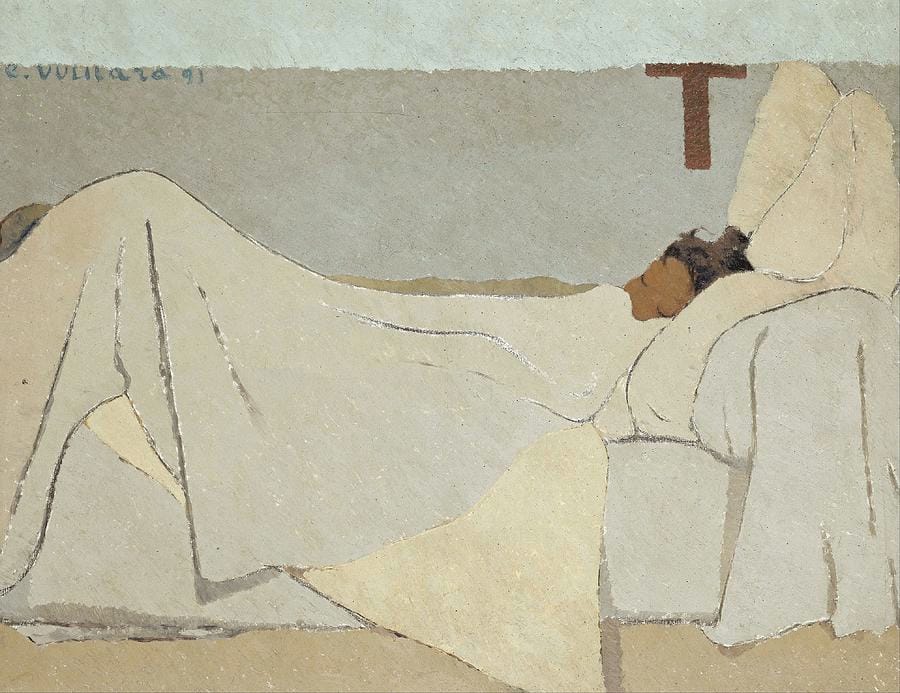
Almost nothing is here: a bed, a sheet, a sleeper’s head, and a small dark cross on the wall. Vuillard painted In Bed in 1891, reducing a whole figure to two or three pale ivory planes divided by a few soft lines, in a range of creams and grays that barely differ from one another. It is one of the most radical paintings of its decade and among the most admired works of his career, now in the Musée d’Orsay. Look at it long enough and the shapes resolve into a sleeping person; look again and they flatten back into pattern. That double reading is the whole point.
The Yellow Curtain
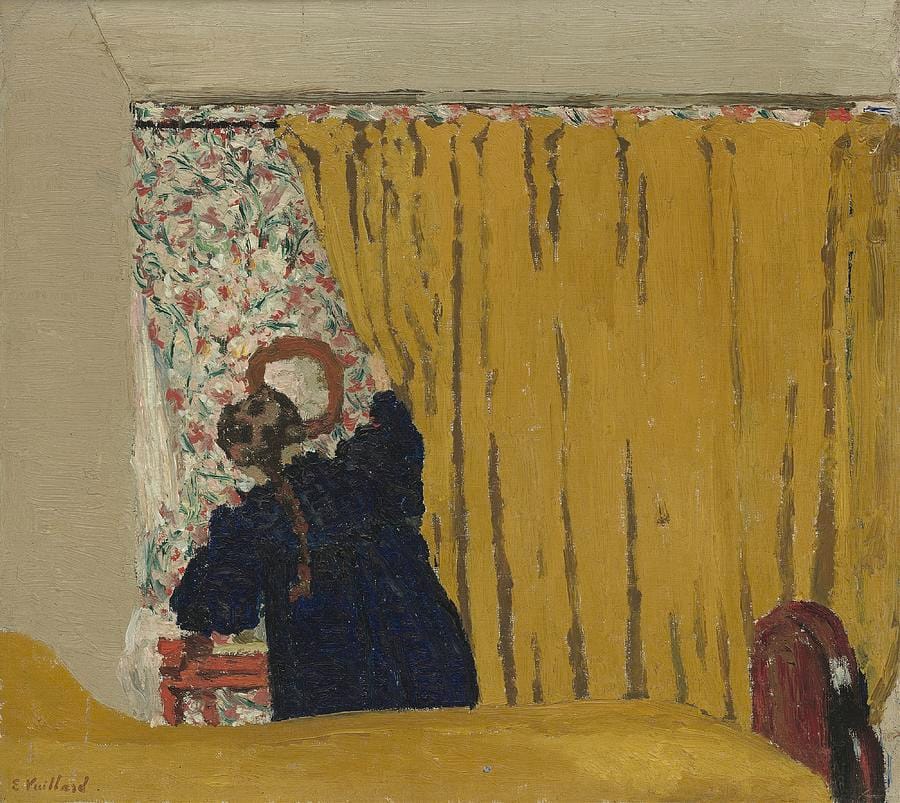
A woman in dark clothes leans over the back of a chair against a wall of small floral wallpaper, while a heavy yellow curtain hangs beside her, filling the center of the picture like a slab of light. She is turned away and barely legible; the curtain gets all the attention. Vuillard made this in the early 1890s, at the height of his Nabi years, and it demonstrates his signature move — the human figure loses the argument to the furnishings. The rough weave of the support shows through thinly brushed paint, which gives the whole surface the look of the textiles it depicts.
Madame Vuillard Sewing
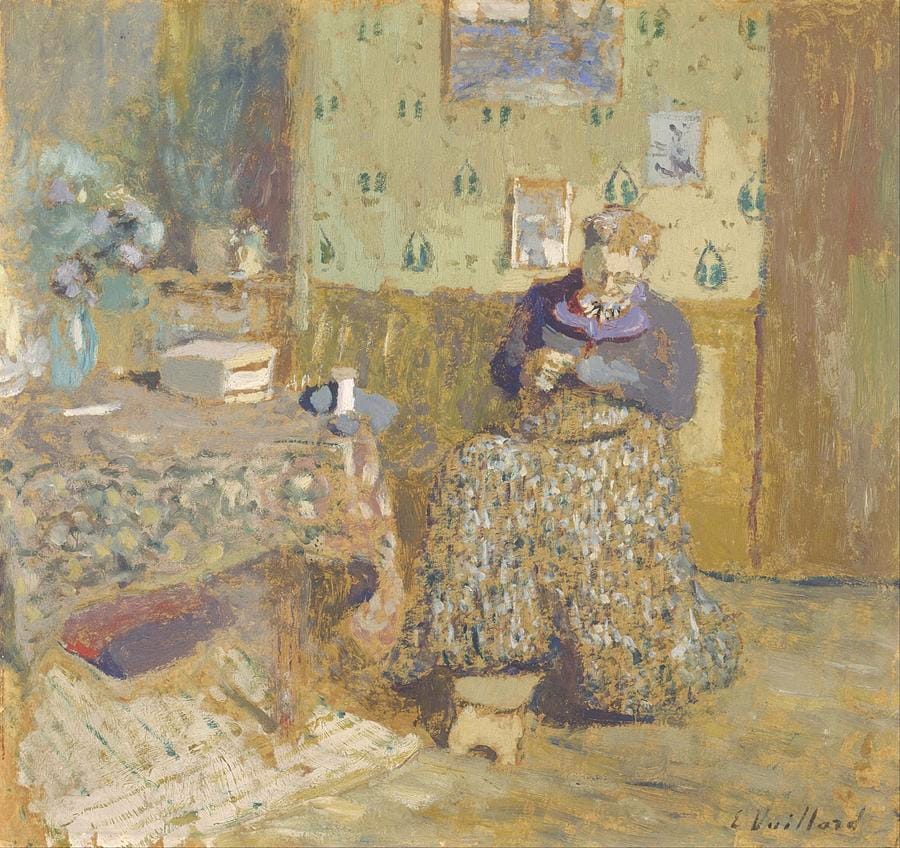
Vuillard’s mother appears in his paintings more often than any other person, usually seated, usually working. Here she sits in a corner of the apartment with her needlework, wearing a bright patterned skirt, surrounded by patterned wallpaper, patterned upholstery, and framed pictures — so much pattern that the eye takes a moment to find her at all. Vuillard once said that his mother was his muse, and he meant it practically: she was the model who was always there, never posed, and never objected. The picture’s warmth comes from long familiarity rather than from any attempt at flattery.
Misia and Vallotton at Villeneuve
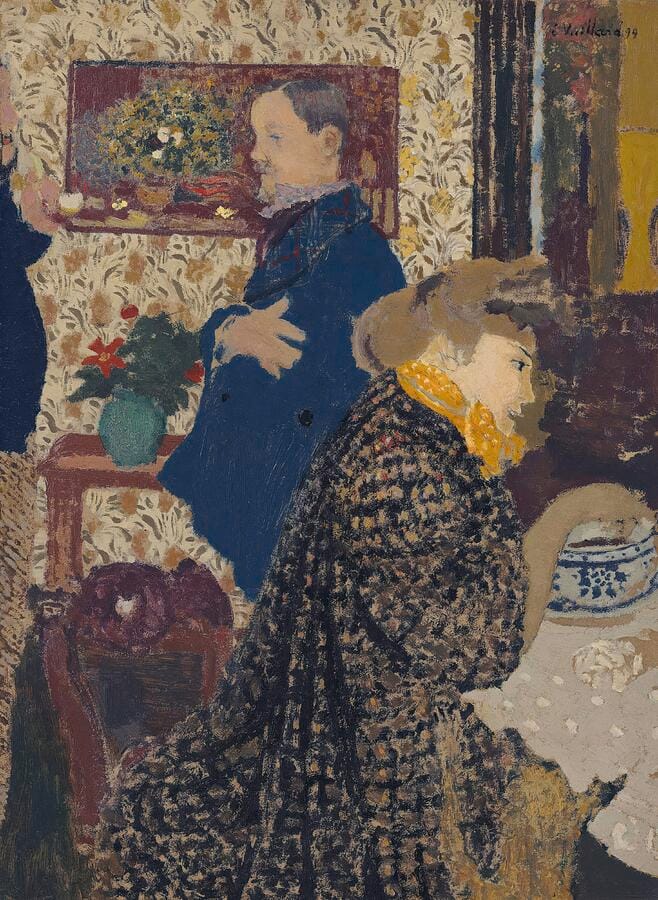
Two friends occupy a room papered in dense floral print: the painter Félix Vallotton stands at left in a blue coat, gesturing mid-sentence, while Misia Natanson sits in profile in an enormous checked coat, apparently ignoring him. Misia was the wife of Thadée Natanson, publisher of the avant-garde journal La Revue Blanche, and the presiding muse of the whole circle — later painted by Renoir and Toulouse-Lautrec too. Dating from 1899, the picture is a group portrait disguised as a wallpaper sample, and it captures exactly how these friendships felt: constant company, comfortable silence, everything half-said.
Self-Portrait, Aged 21
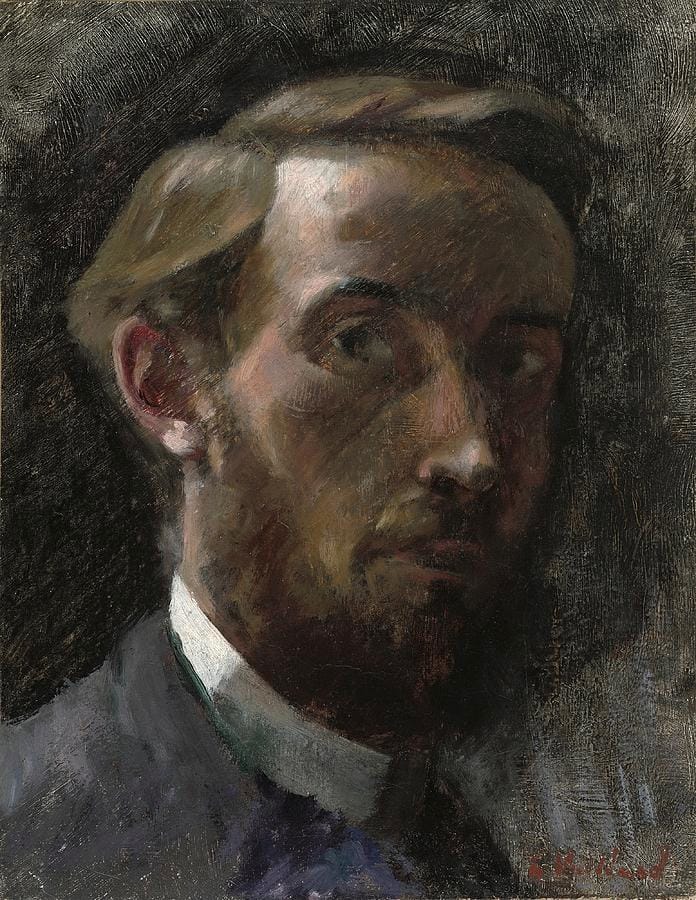
Before the wallpaper and the flattened rooms, Vuillard could paint like an old master, and this early self-portrait proves it. He shows himself with a short reddish beard and a stiff white collar, emerging out of a dark ground with the light catching one side of his face — a young man taking his own measure. It dates from about 1889, the year he fell in with Bonnard, Denis, and Sérusier and abandoned the academic manner almost overnight. Knowing what came next makes the picture more interesting, not less: this is the last look back before the leap.
The Child at the Door
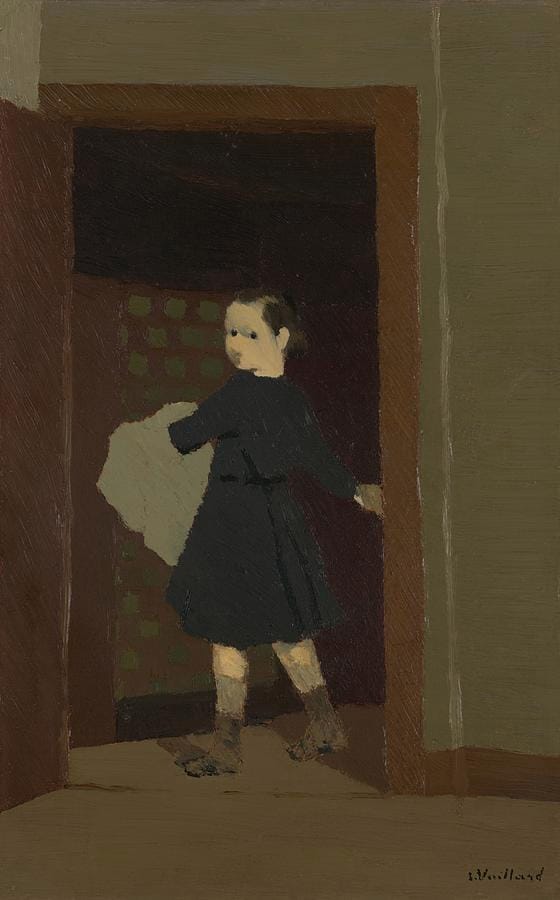
A small child in a dark blue smock stands in an open doorway holding a large sheet of white paper, framed by the pale rectangle of the door and the deep brown of the wall. Vuillard built the whole picture from four or five flat zones of color, and the white paper in the child’s hands is the brightest thing in it. He was a devoted uncle — his sister married the painter Ker-Xavier Roussel — and children appear throughout his work, always caught mid-errand rather than posed. The composition is essentially a Japanese print: a figure held inside a frame within the frame.
Place Vintimille
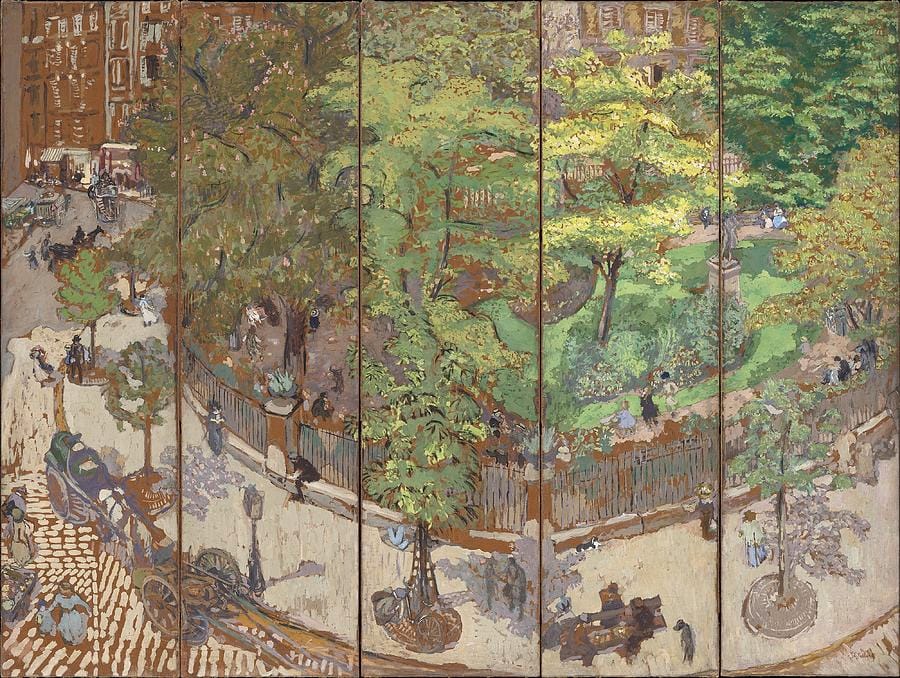
In 1908 Vuillard moved into an apartment overlooking the small triangular square then called Place Vintimille, and he painted the view from his windows for the rest of his life. This version is a five-panel folding screen from 1911, painted in distemper — glue-based paint that dries chalky and matte — so that the leaves, railings, nursemaids, and strolling dogs seem woven rather than painted. Splitting the square across five vertical panels turns a small patch of Paris into something closer to tapestry, and it remains one of the most admired decorative works of the early twentieth century.
The Art Dealers
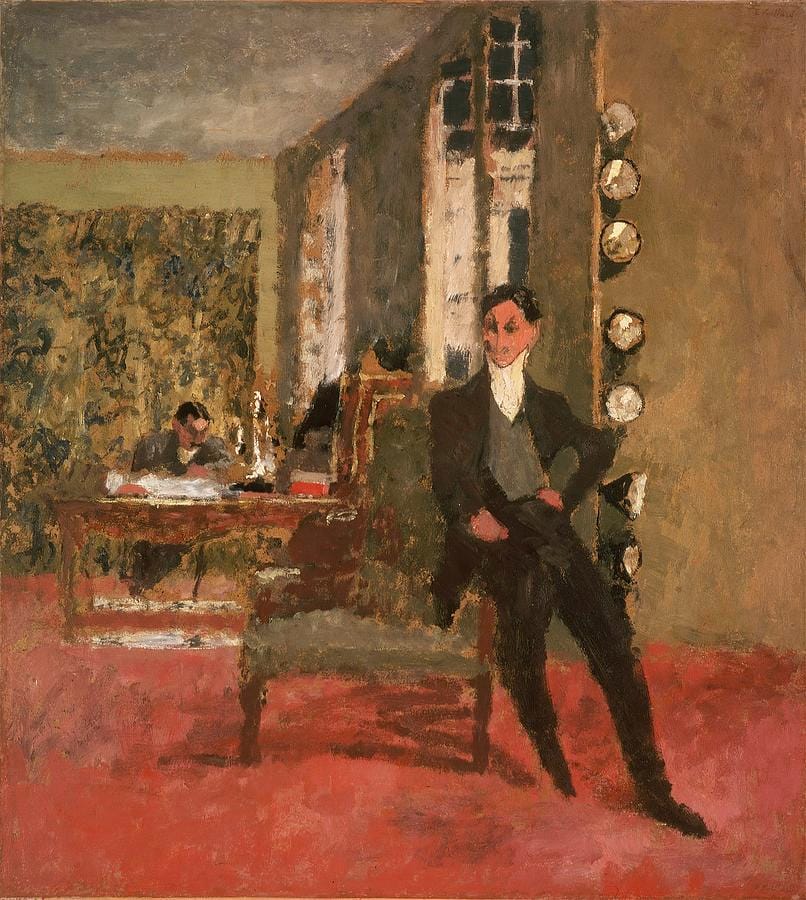
Two men in dark suits inhabit a room whose floor is a startling expanse of red: one leans back against a chair with elegant, faintly impatient ease, the other works at a desk behind him. They are the Bernheim-Jeune brothers, the Paris dealers who represented Vuillard for decades and helped build the market for modern French painting. Made around 1912, it is a business portrait in which the business is barely visible — no pictures being sold, no clients — only two men at home in a room that Vuillard has turned into a single glowing field of color.
Vase of Flowers on a Mantelpiece
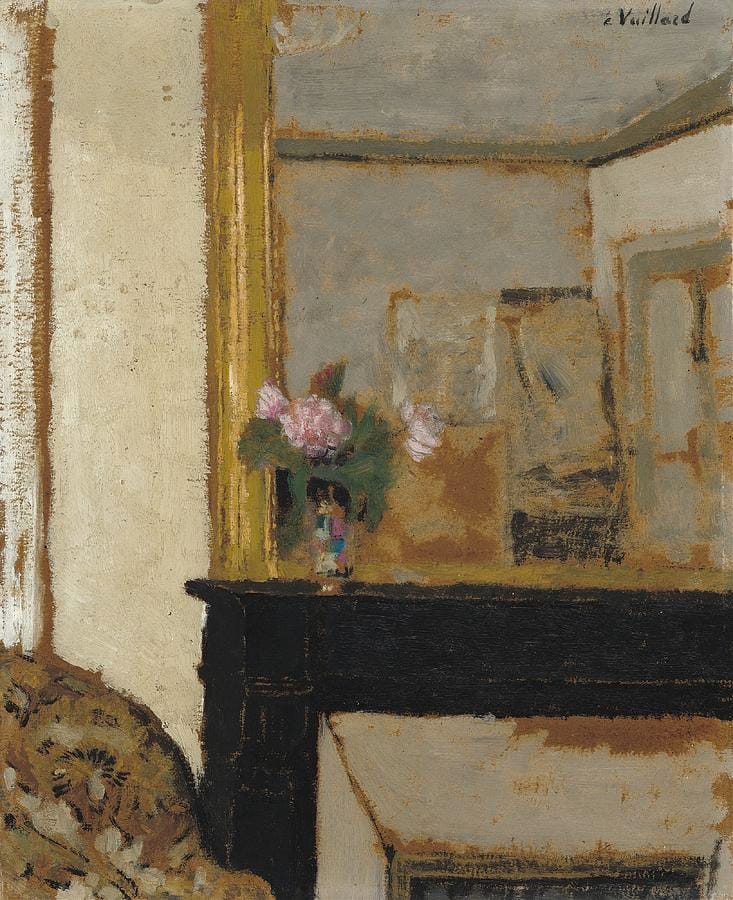
A small vase of pink flowers sits on a black marble mantelpiece in a pale, chalky room, with the corner of a patterned armchair intruding at the lower left and canvases stacked against the wall. It is barely a still life and barely an interior — a corner of a working painter’s apartment, noticed rather than arranged. Vuillard’s great gift was for this register: paintings that look like nothing much and hold their interest for decades, because every inch of the surface has been considered and almost none of it insists on being seen.
Vuillard was the least theatrical of the great modern painters, and that is exactly his appeal. His rooms are the rooms people live in — cluttered, patterned, softly lit — and a print of one on the wall does something no dramatic picture can do, which is to make the space around it feel calmer.
Shop Édouard Vuillard prints here, and explore the rest of our famous paintings collection for more of the world’s most beloved masterpieces.