Charles-François Daubigny’s Ten Most Famous Paintings
Rivers, orchards, and wide gray skies: ten landscapes by the Barbizon painter who opened the door for the Impressionists.

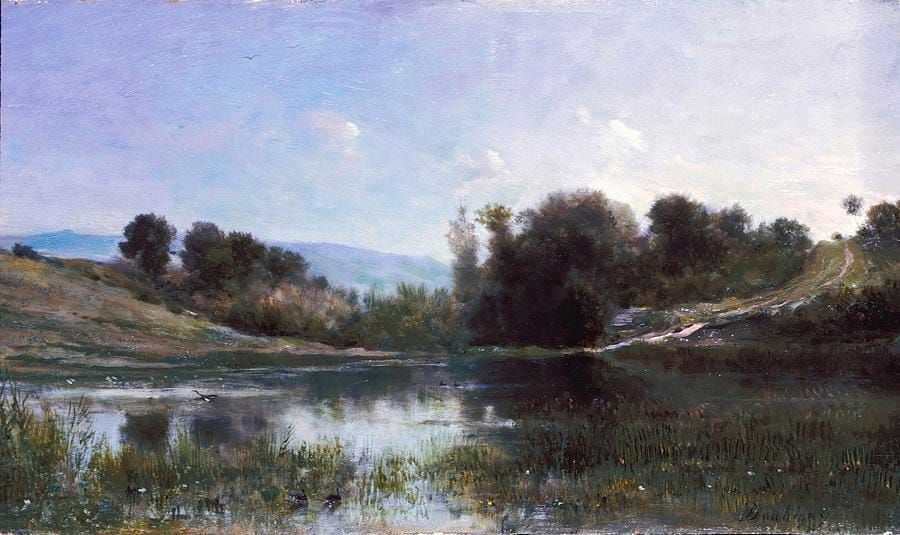
Charles-François Daubigny (1817–1878) painted rivers. Associated with the Barbizon school and its campaign to treat plain French countryside as a subject worthy of serious art, he went further than his colleagues in one crucial respect: he worked outdoors, on the spot, and left the evidence of it in the finished picture. In 1857 he had a small boat fitted out as a floating studio, named it Le Botin — “the little box” — and spent years drifting down the Oise and the Seine, painting the banks from the middle of the water.
Critics complained that he exhibited impressions rather than paintings, which turned out to be the highest compliment available. Daubigny sat on Salon juries and fought for the young Monet, Pissarro, and Renoir; when Monet was rejected in 1870 he resigned in protest. Later that year, both men found themselves in London, and it was Daubigny who introduced Monet to the dealer Paul Durand-Ruel — an introduction that changed the course of modern art. Here are ten of his best-known paintings.
Pond at Gylieu (Étang de Gylieu)
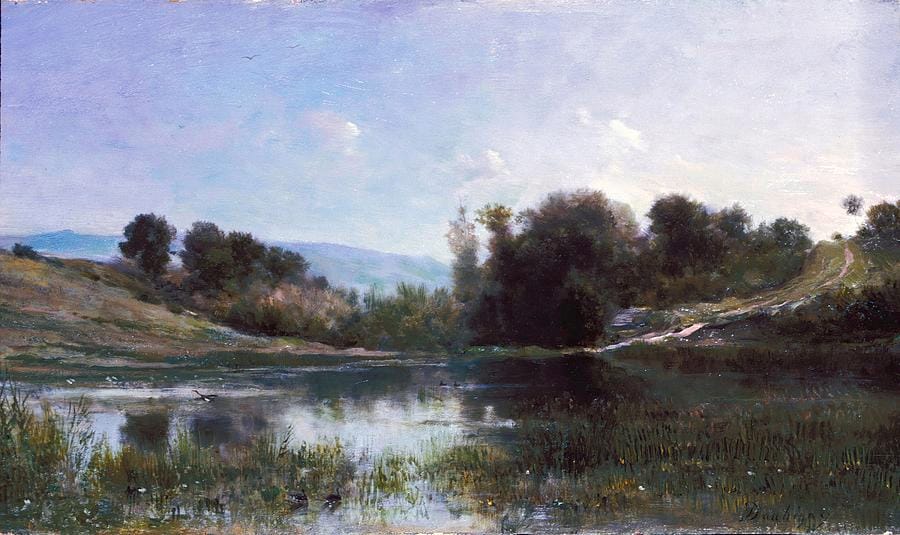
Still water spreads across the foreground under a soft violet sky, fringed with reeds and ducks, edged by dark trees, with a pale track climbing the bank on the right and blue hills beyond. Gylieu, a pond in the Dauphiné, gave Daubigny the subject that made his name: the picture of it he sent to the Salon of 1853 won a first-class medal and was bought by Napoleon III himself, and he returned to the motif afterward. What the jury admired was the calm — no storm, no ruins, no story, just a pond at the end of an afternoon. Twenty years of French landscape painting followed from the discovery that this was enough.
The Harvest
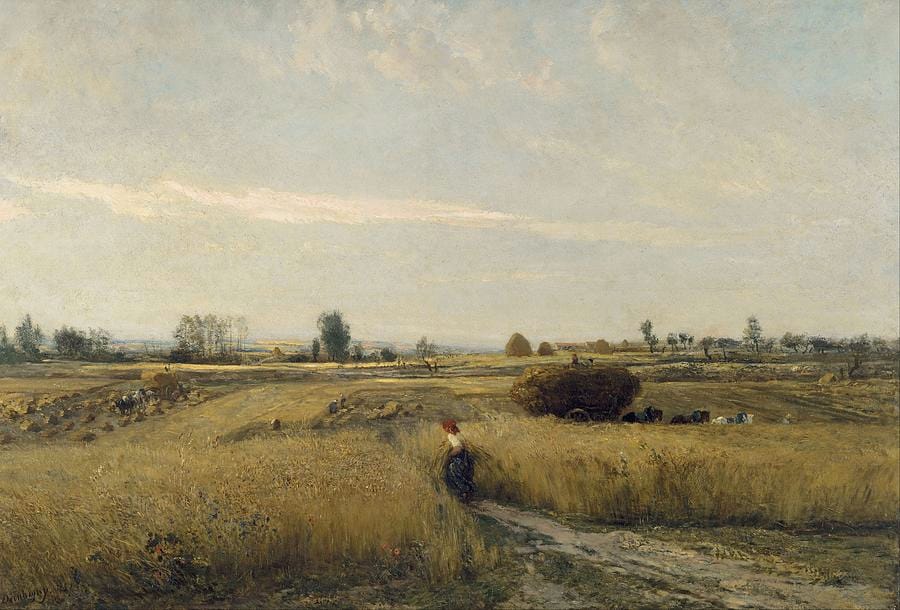
A vast wheat field runs to a low horizon under an enormous pale sky, with harvesters, carts, and stooks reduced to small dark punctuation marks in the gold. Daubigny showed The Harvest at the Salon of 1851 and it entered the French national collections; it now hangs in the Musée d’Orsay. The composition is startlingly plain — roughly two-thirds sky, one-third field — and that emptiness is the argument. Rather than arranging the countryside into a picturesque scene, Daubigny gives you the actual proportions of standing in the middle of a working plain in August.
The Hamlet of Optevoz
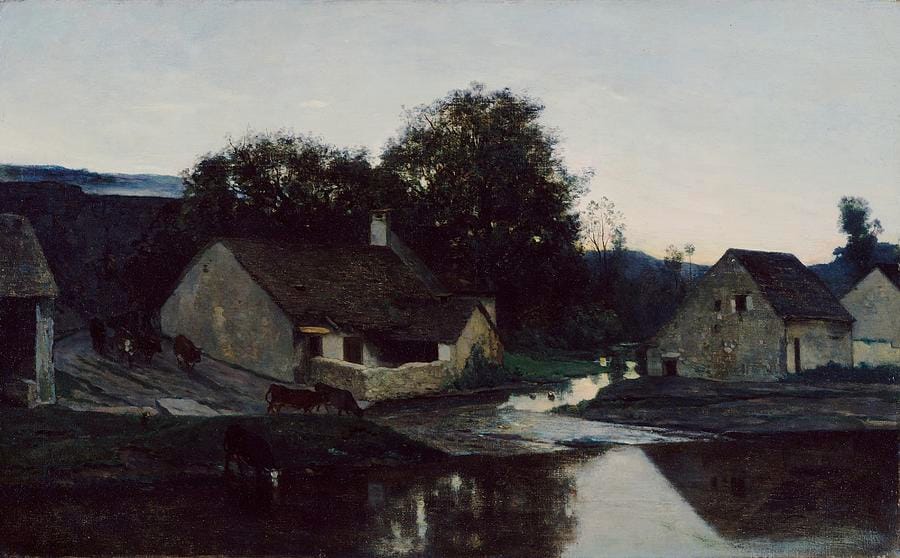
Whitewashed cottages with heavy thatched and tiled roofs cluster at the edge of a still stream, their reflections doubling them in the water, under a dense mass of dark summer trees. Daubigny worked repeatedly at Optevoz, a village in the Isère east of Lyon, during the 1850s, as did Corot and other friends. The picture shows his gift for tonal painting at its best: almost everything is brown, green, and cream, and the whole scene is held together by the single bright wall catching the light at its center. Rural France, painted without a shred of sentimentality.
The Crossroads of the Eagle’s Nest, Fontainebleau Forest
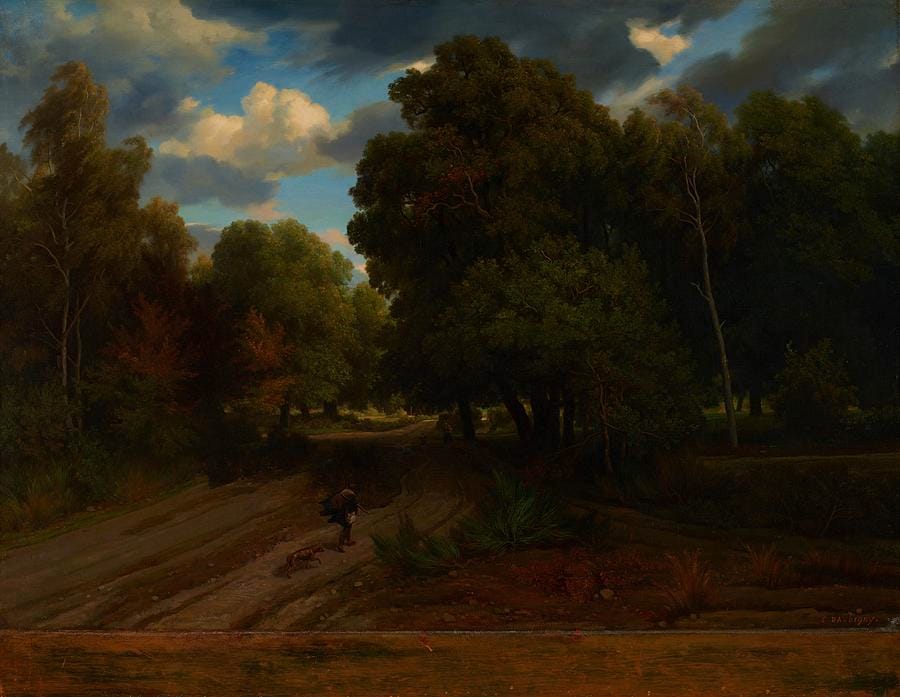
A sandy track curves through the great forest of Fontainebleau between banks of oak and birch, with a bruised sky breaking overhead and a solitary figure on the path. This is early Daubigny, from the 1840s, painted when the forest south of Paris was the crucible of French landscape — the place where Rousseau, Millet, Corot, and Diaz worked out how to paint nature without dressing it up as mythology. The handling is darker and more traditional than his later river scenes, but the instinct is already there: find an ordinary spot, and stay until the weather does something.
Landscape with a Sunlit Stream
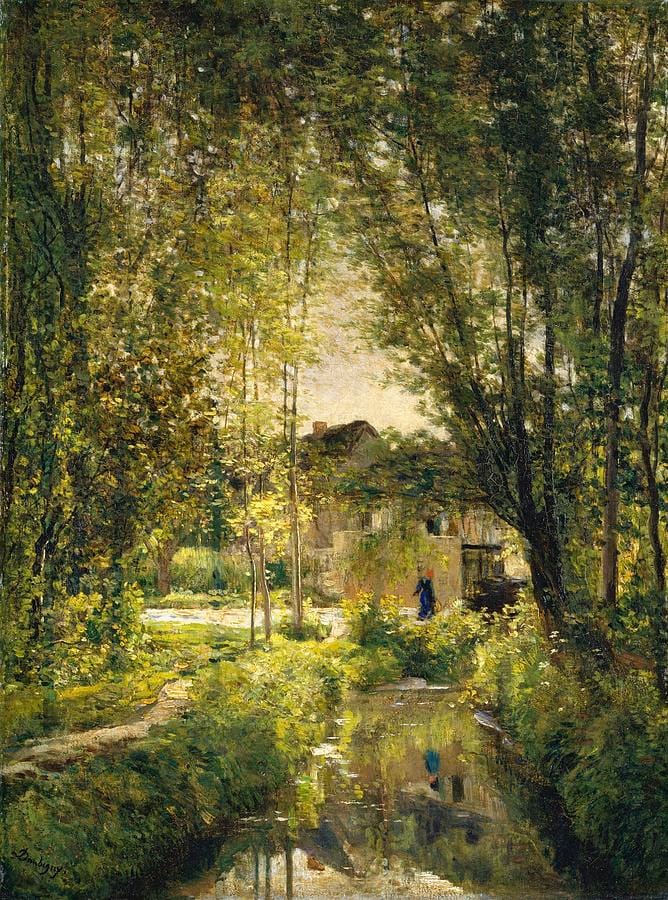
Tall slender trees rise the full height of the canvas, and between them a stream catches an opening of white light, with a figure and a low cottage half-lost in the greenery at the left. It is one of Daubigny’s most concentrated pictures of dappled shade — a wall of green, punctured. The upright format is unusual for him and makes the effect stronger, since the eye has nowhere to go but up the trunks and back down into the water. Painters half a generation younger, Monet and Sisley among them, built entire careers on effects Daubigny worked out first.
Banks of the Oise at Auvers
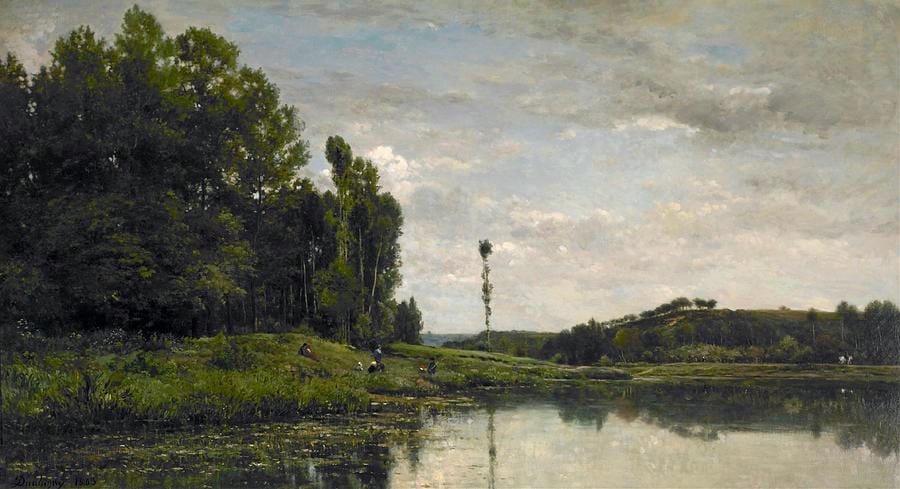
Dark trees crowd the left bank and one bare poplar rises alone against a wide sky of moving gray and white cloud; a handful of small figures sit and stand on the grass at the water’s edge, and a low wooded ridge closes the far side of the still, reflecting river. Daubigny settled at Auvers-sur-Oise in the early 1860s and built a house and studio there, decorating it with the help of Corot and Daumier. The village became a place of pilgrimage for younger painters: Pissarro, Cézanne, and finally Vincent van Gogh, who spent the last weeks of his life at Auvers in 1890 and painted Daubigny’s garden three times.
Apple Blossoms
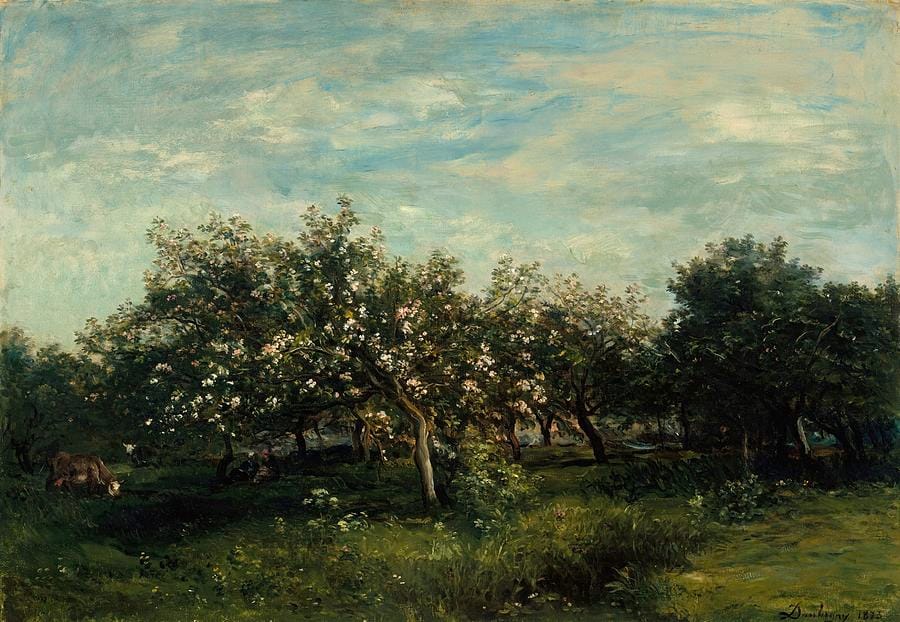
An orchard in full bloom fills the canvas — gnarled apple trees loaded with white blossom, long grass beneath, cows grazing at the left, and a fresh blue sky with clouds sailing across it. Painted in 1873 and now in the Metropolitan Museum of Art, it is the sunniest and most immediately charming of Daubigny’s late pictures, and the blossom is handled with a loose, broken touch that comes remarkably close to Impressionism proper. It sold well in his lifetime and has never stopped being popular, for the simple reason that spring is difficult to paint and this is spring.
Villerville Seen from Le Ratier
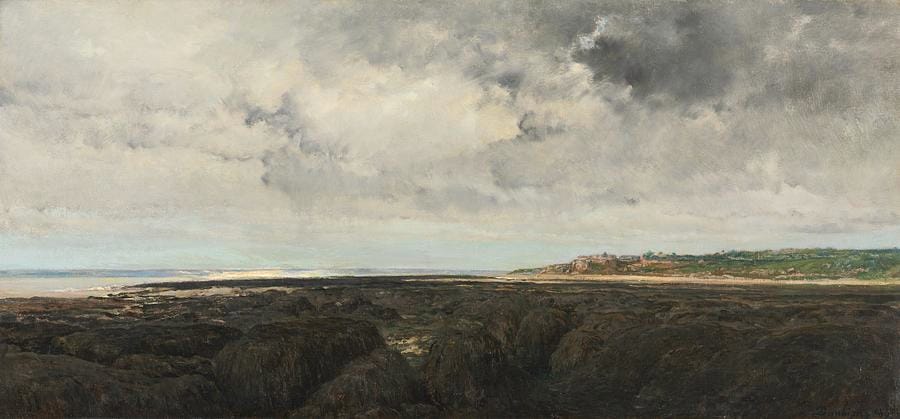
Almost the entire canvas is sky — a churning bank of gray and white cloud over a dark, low strip of Normandy coastline, with the village of Villerville barely a smudge on the horizon and the wet sand catching a little light in the foreground. Daubigny painted the Channel coast repeatedly in the 1860s and 1870s, and these seaside pictures are his boldest. There is no incident at all: no boats, no figures, no anecdote. Just weather coming in off the sea, painted by a man who had spent his life watching water and knew exactly how little he needed to show.
Boats on the Seacoast at Étaples
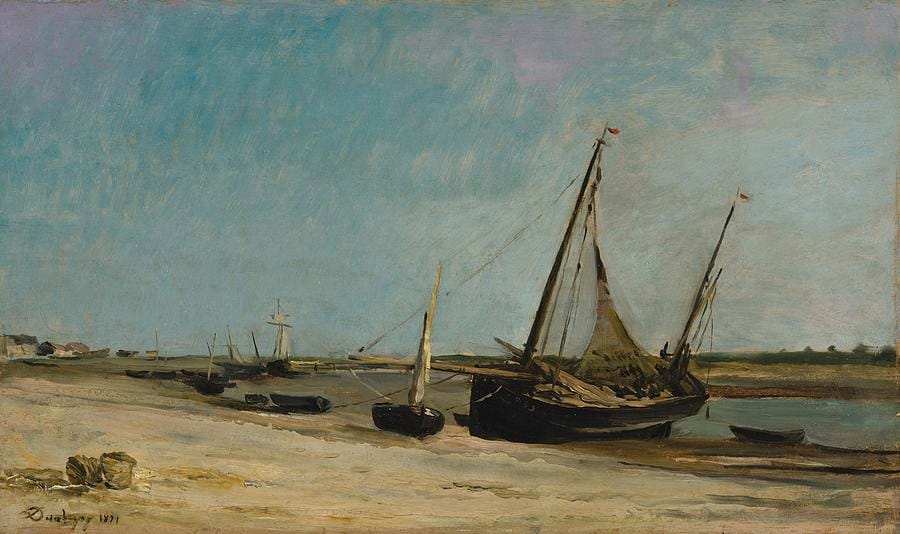
Fishing boats sit high and dry on the sand at low tide, masts and rigging drawn as thin dark lines against a broad turquoise sky, with figures and carts small along the shore. Daubigny worked on the Channel coast around 1871, in the unsettled period following the Franco-Prussian War and his stay in England. The palette here is cooler and cleaner than in his river pictures, and the beached hulls give him something he rarely used: strong angular shapes to set against all that horizontal calm. It is one of his most quietly satisfying compositions.
Banks of the Seine
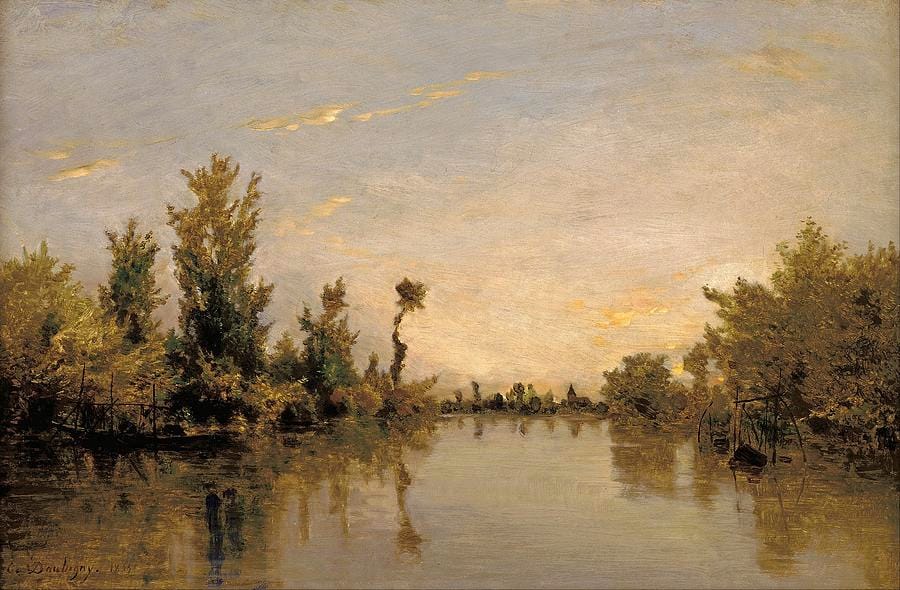
The river narrows into the distance between screens of trees, the water burnished gold by a low sun and the far bank dissolving into haze. Pictures like this came directly from Le Botin, the converted boat Daubigny used as a studio from 1857 onward, which let him take up positions no painter working from the bank could reach. The result is a viewpoint that sits level with the water, so that the river seems to open in front of the viewer rather than beside them. Monet, who later had a studio boat of his own, was paying Daubigny the sincerest kind of compliment.
Daubigny is the quiet hinge between the old landscape painting and the new. His rivers, orchards, and huge gray skies ask nothing of the viewer except attention, and they carry a room the way a window does — by giving it somewhere else to look.
Shop Charles-François Daubigny prints here, and explore the rest of our famous paintings collection for more of the world’s most beloved masterpieces.