Caravaggio’s Ten Most Famous Paintings
The Calling of Saint Matthew, Judith Beheading Holofernes, Medusa and more: the ten paintings that made Caravaggio the most influential — and most notorious — painter in Rome.

Michelangelo Merisi da Caravaggio (1571–1610) took his name from the Lombard town his family came from, and took his models from the streets of Rome. He painted saints with dirty feet, martyrs who look genuinely frightened, and apostles dressed like the laborers drinking in the tavern downstairs. To his admirers this was religious painting made urgently, shockingly real. To his critics it was vulgarity, and more than one of his altarpieces was rejected by the priests who commissioned it.
What nobody disputed was the light. Caravaggio built his pictures out of deep shadow pierced by a single hard beam, a technique later called tenebrism, and it gave his scenes the abruptness of something glimpsed rather than composed. He was also violent, litigious, and eventually a fugitive: in 1606 he killed a man in a brawl over a wager, fled Rome under a death sentence, and spent his last four years working his way through Naples, Malta, and Sicily while trying to earn a papal pardon. He died in 1610, aged thirty-eight, before it reached him. Here are ten of his most famous paintings.
The Calling of Saint Matthew
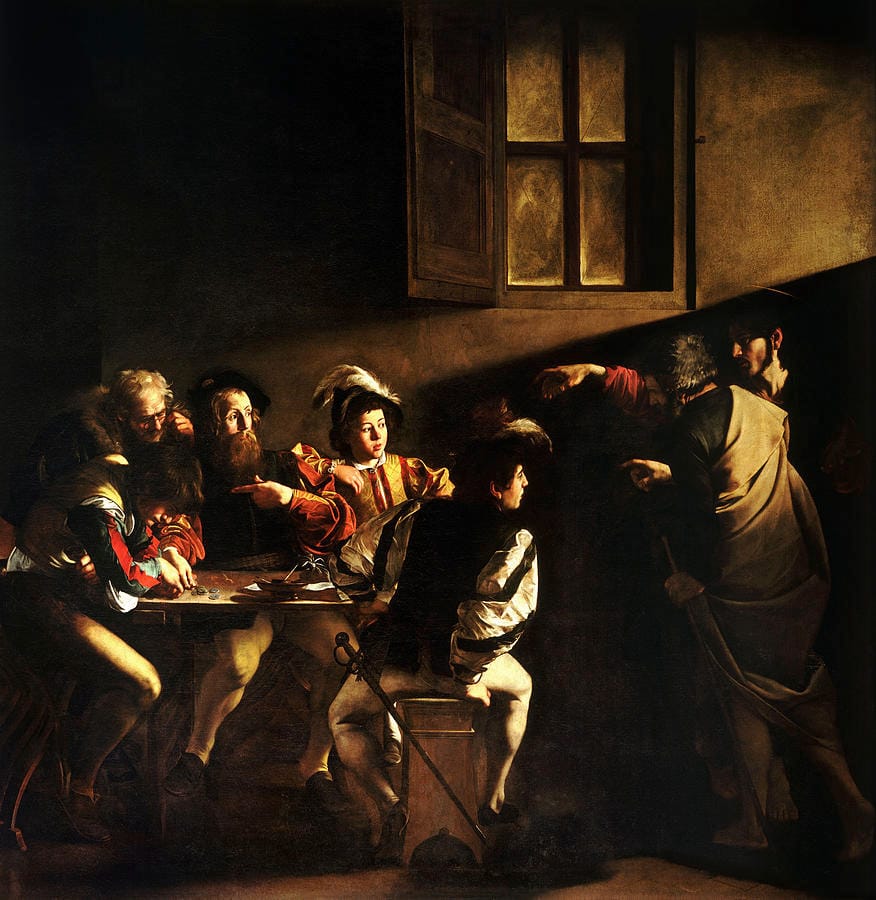
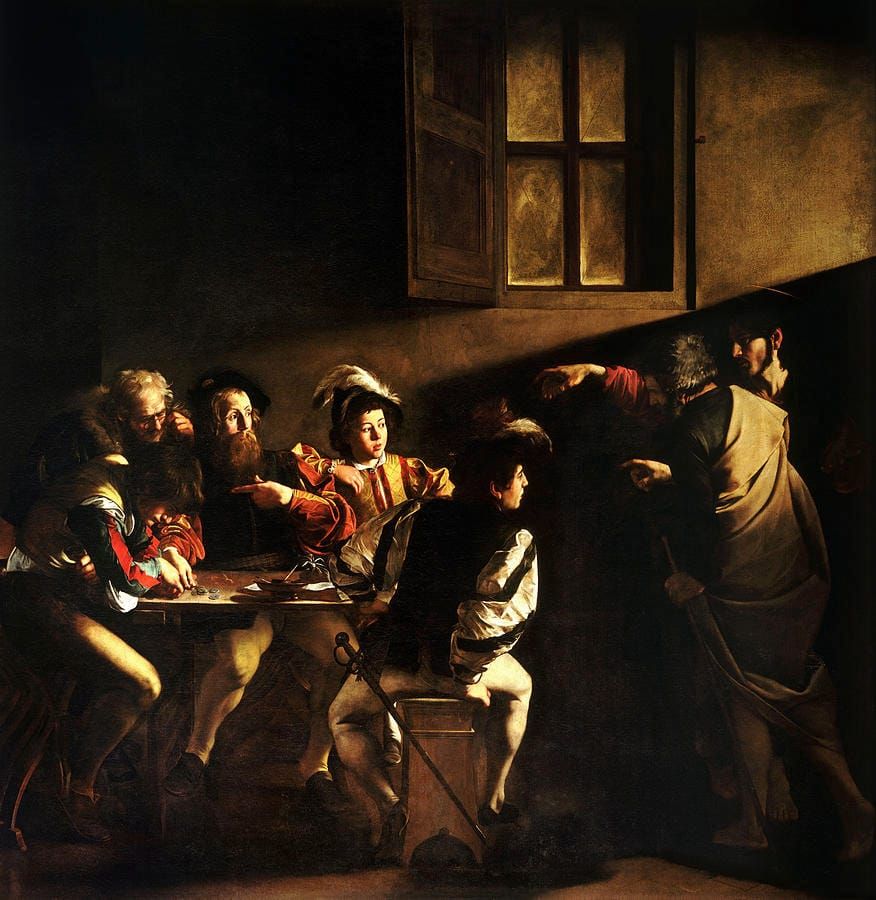
Painted around 1599–1600 for the Contarelli Chapel in San Luigi dei Francesi in Rome, The Calling of Saint Matthew is the picture that made Caravaggio famous almost overnight. Christ enters a dim room where a tax collector sits counting coins with a group of fashionably dressed young men, and points. A shaft of light follows the gesture across the wall. The genius of the painting is its ordinariness: the figures wear contemporary sixteenth-century dress, nobody has a halo except Christ, and the men at the table are so absorbed in money that most of them have not yet noticed anything has happened. Art historians still argue about which figure is Matthew — the bearded man pointing at himself, or the youth at the end of the table with his head down over the coins.
Judith Beheading Holofernes
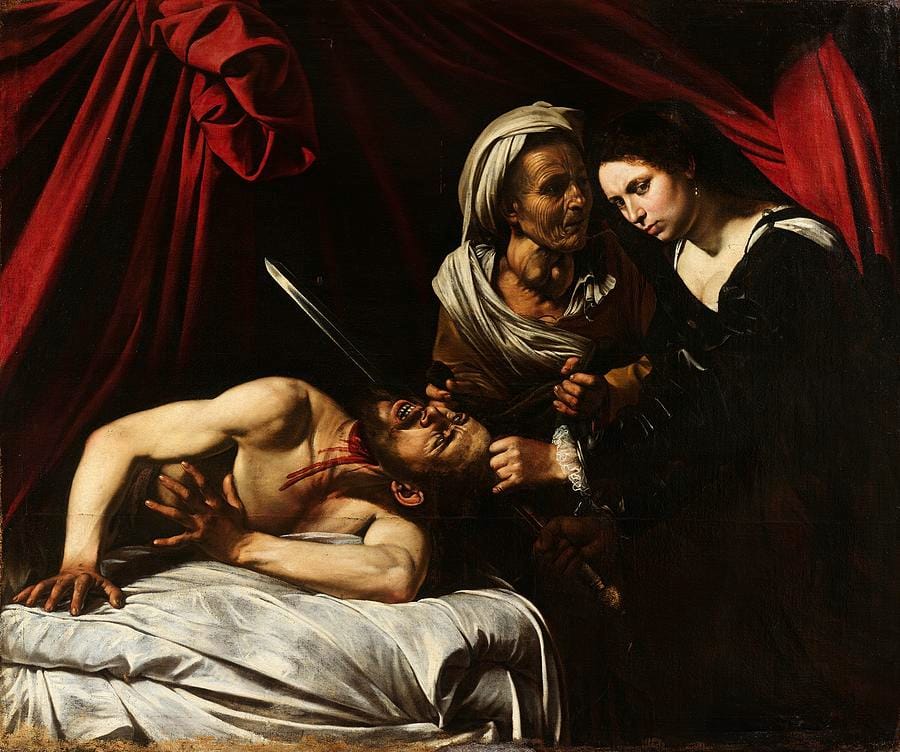
Caravaggio painted this around 1598–99, and it remains one of the most physically uncomfortable pictures in Western art. Judith, the Hebrew widow who saves her city by assassinating an enemy general, is shown mid-cut, leaning back with her brow furrowed in distaste rather than triumph. Her elderly maidservant waits at her shoulder with the cloth to carry the head away, staring with an intensity that borders on relish. Caravaggio refuses the usual convention of showing the deed already done. He gives us the moment itself, the blood arcing sideways, and Holofernes still conscious enough to roar.
The Supper at Emmaus
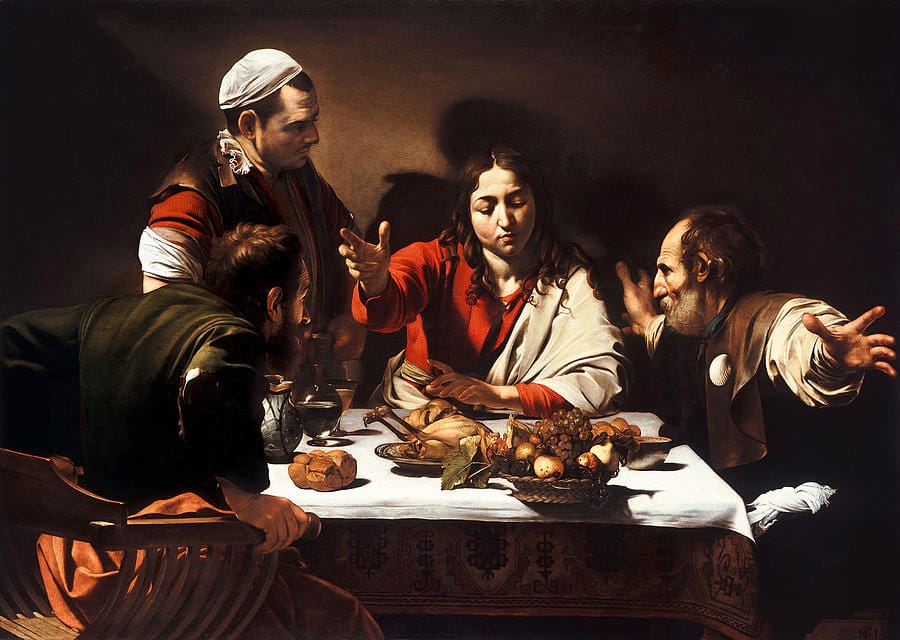
Two disciples share a meal with a stranger and realize, at the instant he blesses the bread, that they are sitting with the risen Christ. Caravaggio catches the recognition physically: one man grips the arms of his chair as if about to launch himself out of it, the other throws his arms wide, and the gesture breaks the picture plane and comes at the viewer. The basket of fruit teetering on the table edge is a famous piece of showing off — a still life good enough to stand on its own, placed where it looks about to fall into the room. The version in the National Gallery in London dates from 1601.
The Conversion of Saint Paul
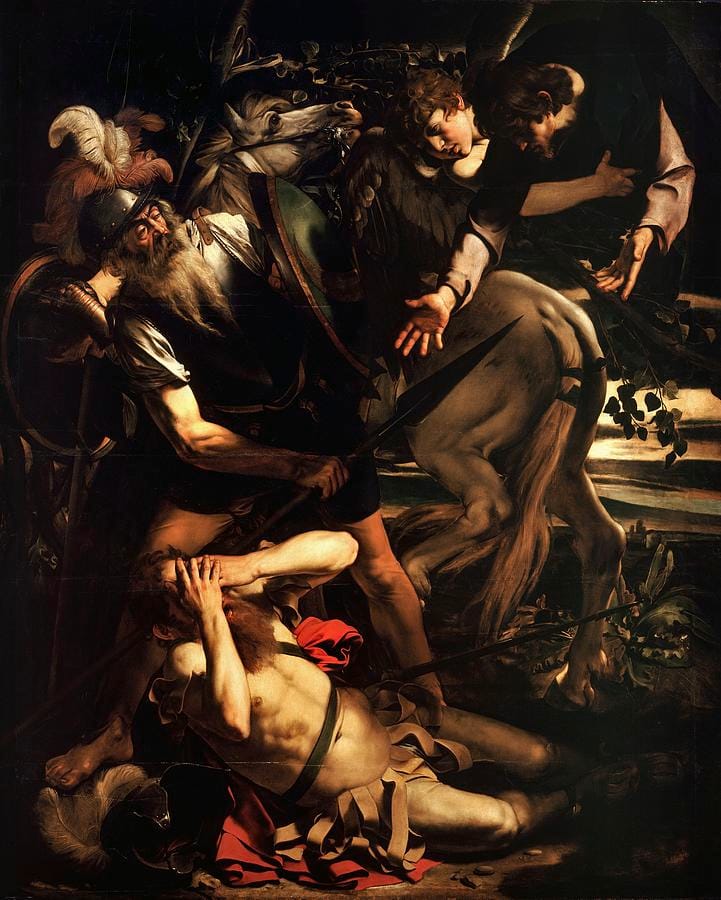
Commissioned in 1601 for the Cerasi Chapel in Santa Maria del Popolo, this is a conversion scene with almost nothing conventionally dramatic in it. Saul of Tarsus has been thrown from his horse on the road to Damascus and lies flat on his back with his arms flung upward toward a light only he can see. There is no vision in the sky, no chorus of angels. Most of the canvas is taken up by the enormous, patient body of the horse and the legs of a groom who has noticed nothing. Caravaggio puts the miracle entirely inside the fallen man, and leaves the rest of the world unmoved around him.
David with the Head of Goliath
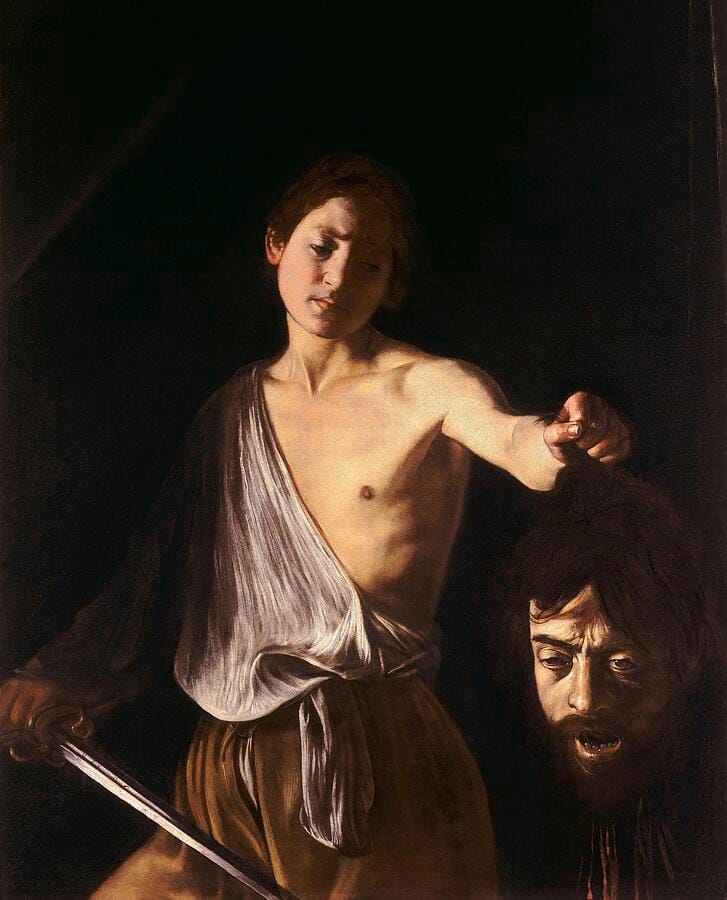
Painted late, around 1609–10, when Caravaggio was a wanted man hoping for a pardon, this is the darkest and most personal of his pictures. A young David holds out the severed head of the giant at arm's length, and his expression is not victory but something closer to pity. The head is generally accepted to be a self-portrait. Painted by a man under sentence of death who had every reason to send Rome an image of his own punishment, it reads less as a biblical subject than as a plea, and the sword in David's hand carries an inscription usually read as an abbreviation of the phrase “humility conquers pride.”
Medusa
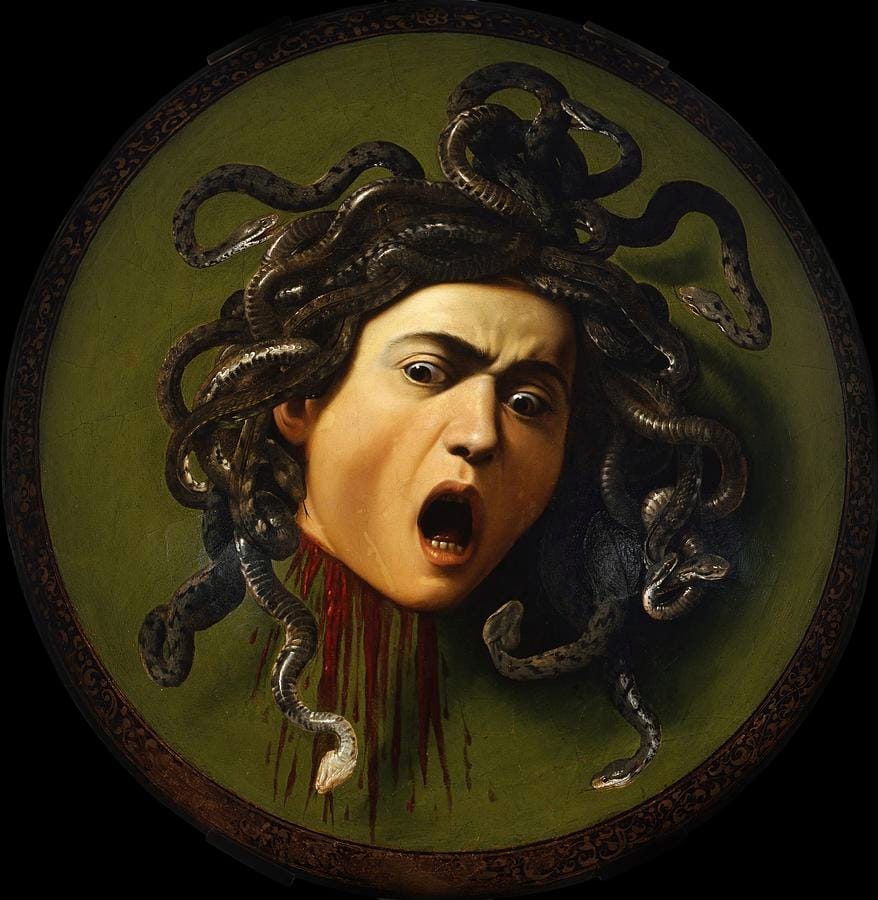
This is a painting on a convex ceremonial shield, made around 1597 for the Medici, and the object and the image work together: a shield that turns the viewer's own weapon back at them. Medusa's severed head is caught in the instant of realizing what has happened, mouth open, snakes still writhing, blood spilling from the neck — a decapitation painted on a curved surface so the face bulges out toward you. The face, once again, appears to be Caravaggio's own. It is the earliest and strangest of his several studies of a head cut from a body.
Narcissus
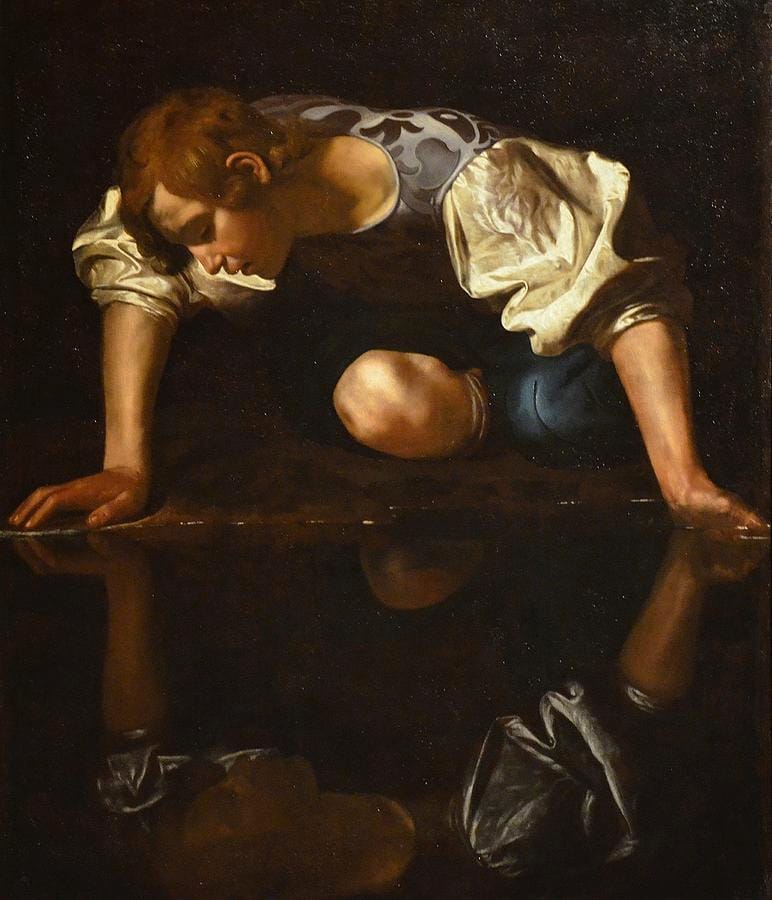
A young man kneels at the edge of a dark pool and stares at his own reflection, arms braced, forming a closed circle with the image below him. The composition is unusually simple for the period — two figures who are one figure, a bright knee at the center, and near-total blackness everywhere else. The attribution has been debated by scholars for over a century, though it has long hung under Caravaggio's name in Rome, and the treatment of light and the psychological trap of the subject are entirely consistent with him. Few paintings have made self-absorption look so much like drowning.
The Taking of Christ
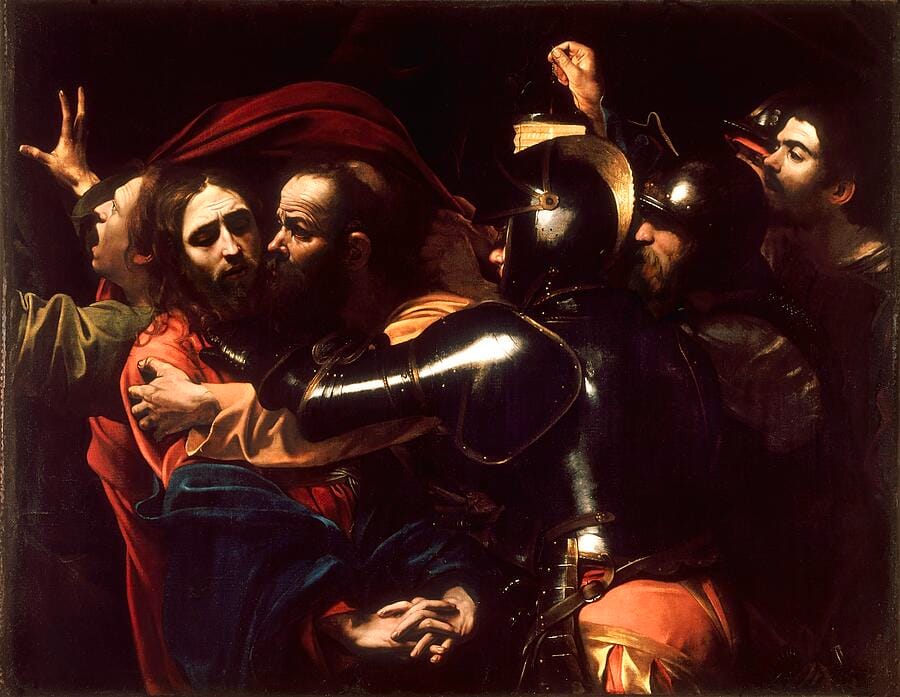
Painted in 1602, this is the arrest in the garden of Gethsemane rendered as a scuffle in the dark. Judas has just delivered the kiss and grips Christ's shoulder; a soldier in polished black armor reaches across the picture to seize him, his arm a hard diagonal that pins the composition together. At the right edge a man holds up a lantern and cranes to see — a self-portrait of the painter, making himself a bystander at the arrest. The picture hung unrecognized for decades in a Jesuit residence in Dublin, taken for a copy, and was identified as the original only in the early 1990s.
The Beheading of Saint John the Baptist
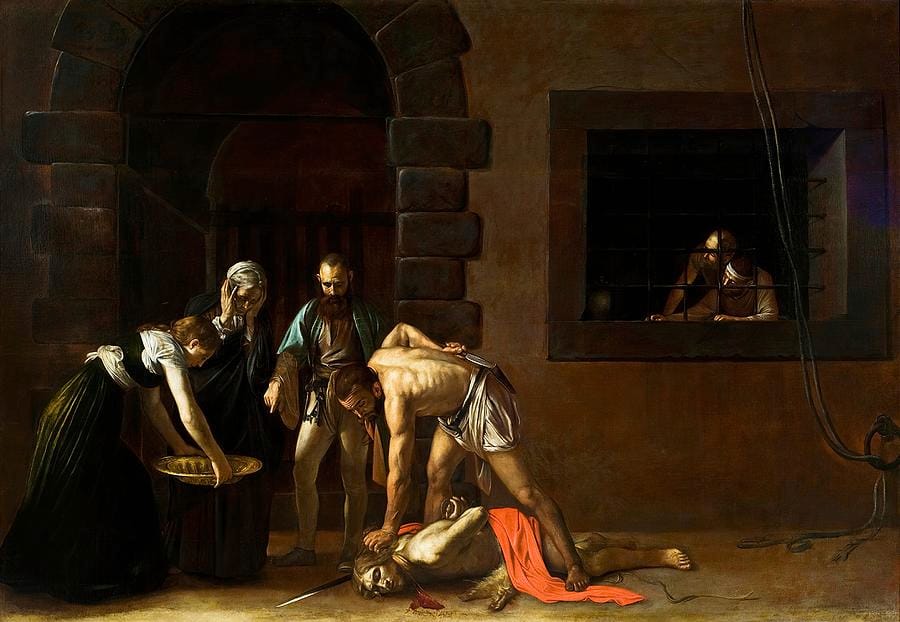
Painted in 1608 for the Oratory of the co-cathedral in Valletta while Caravaggio was in Malta, this is his largest canvas and the only surviving painting he is known to have signed. The signature is written into the blood running from the Baptist's throat. The composition is mostly empty wall: a prison courtyard, a jailer directing the executioner, a woman recoiling with a basin, two prisoners watching through the bars. The killing is almost administrative, and the vast blank space above the figures does more to convey horror than any amount of incident could.
Still Life with Fruit
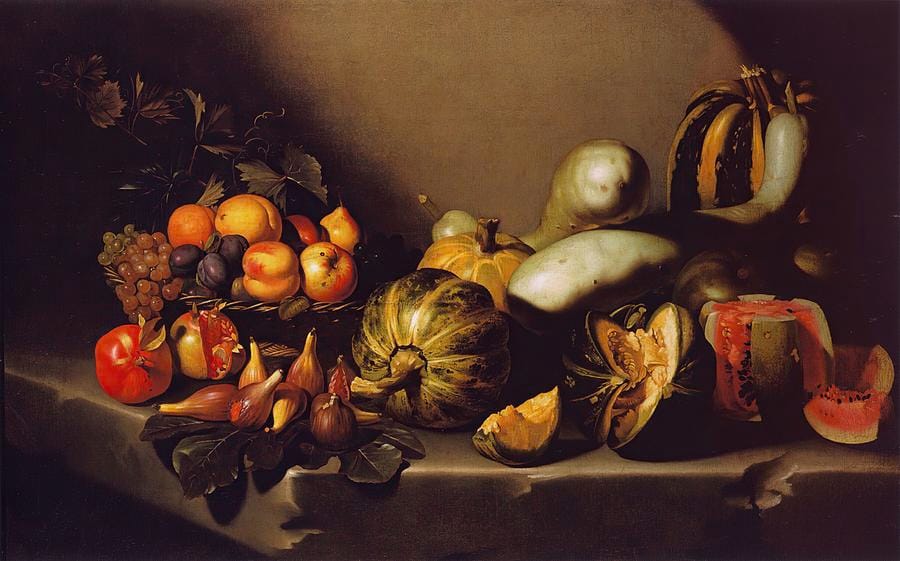
Caravaggio is reported to have said that it took as much craftsmanship to paint a good picture of flowers as one of figures — a startling claim at a time when still life sat at the bottom of the hierarchy of subjects. His fruit is never idealized. Leaves curl and brown at the edges, apples show worm holes, and the whole arrangement is lit with the same unsparing beam he turned on saints and executioners. Paintings like this one helped establish still life as a serious genre in Italy and set the terms other painters would follow for a century.
Caravaggio worked for barely fifteen years and left fewer than seventy paintings, but almost every European painter of the next generation went through him — Artemisia Gentileschi, Rubens, Velaźquez, and Rembrandt all absorbed his lighting and his insistence that sacred subjects be played by real bodies. The label “Caravaggisti” was coined for the painters who followed him.
Shop Caravaggio prints here, and explore the rest of our famous paintings collection for more of the world’s most beloved masterpieces.