Camille Pissarro’s Ten Most Famous Paintings
Boulevard Montmartre, Red Roofs, Jalais Hill and more: the ten works by the only painter who showed in all eight Impressionist exhibitions.

Camille Pissarro (1830–1903) was born on the Caribbean island of St. Thomas, then a Danish colony, to a Jewish merchant family, and came to Paris in his twenties. He was the oldest of the Impressionists and the only one to exhibit in all eight of their group shows, from the first in 1874 to the last in 1886 — the fixed point around which a famously quarrelsome movement organized itself.
He was also its most generous teacher. Cézanne worked beside him at Pontoise and called him a father figure; Gauguin learned from him before leaving for the Pacific; Van Gogh sought his advice. Where Monet chased weather and Degas chased the city, Pissarro mostly painted rural work — orchards, market days, kitchen gardens, peasants carrying hay — and he did it with a political conviction, anarchist in sympathy, that ordinary labor deserved the same attention art gave to gods and generals. Late in life, when an eye condition stopped him working outdoors, he moved to hotel windows and painted the boulevards of Paris. Here are ten of his most famous paintings.
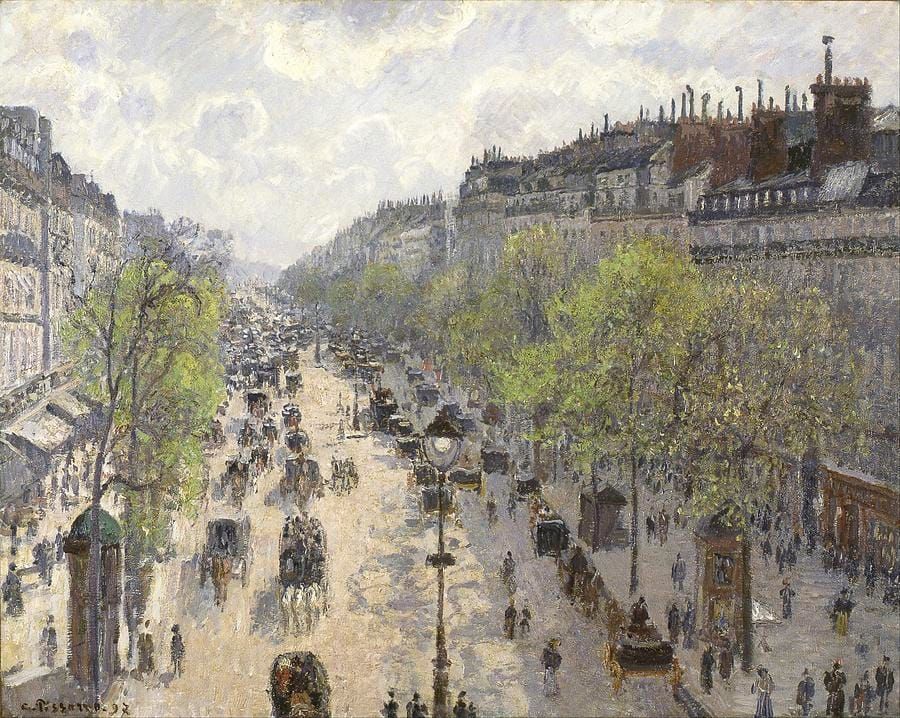
Boulevard Montmartre, Spring
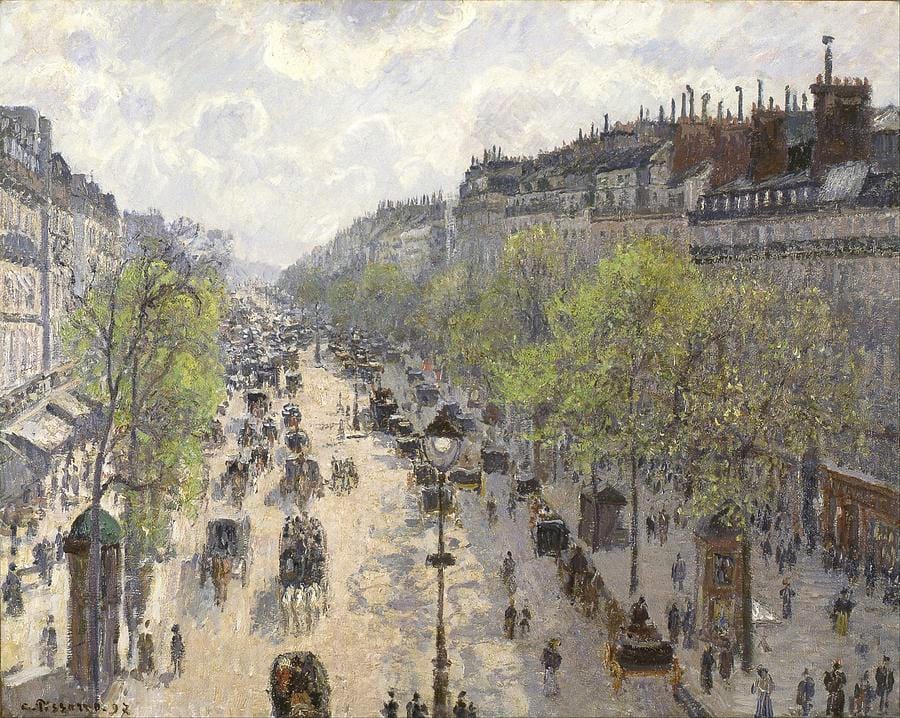
In the last years of his life a chronic eye infection made painting outdoors impossible, so Pissarro rented rooms above the Paris boulevards and worked at the window. The result was a series of canvases showing the same stretch of the Boulevard Montmartre in different weather, seasons, and hours — a serial method closer to Monet's than to anything else in his own career. From above, the crowds and carriages dissolve into flecks and dashes, and the subject becomes the movement of a city rather than any person in it.
Red Roofs, Corner Of A Village, Winter
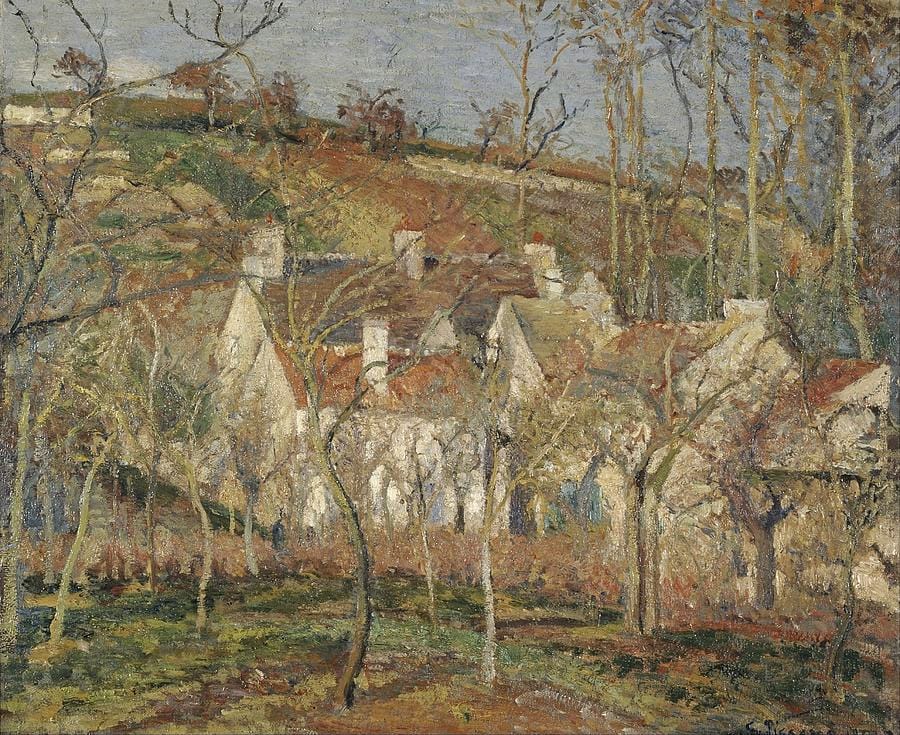
Painted in 1877, at the height of his working partnership with Cézanne, this is one of the most tightly constructed pictures Pissarro ever made. A cluster of village houses is glimpsed through a screen of bare winter branches, so the whole composition is filtered through a lattice of trunks and twigs. The warm reds of the roofs and the cool earth are built up in short, dense strokes. It is a landscape that insists you look through something to see it, and the structural discipline is exactly what Cézanne took away from their years working side by side.
Jalais Hill, Pontoise
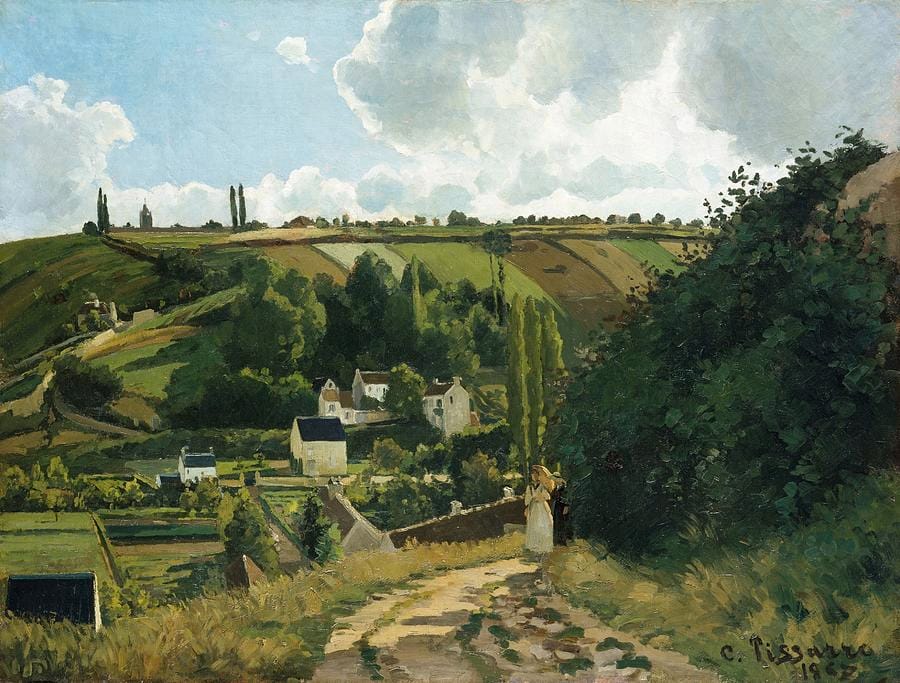
Exhibited at the Salon in 1868 and singled out for praise by Émile Zola, this is the painting that established Pissarro's mature manner before Impressionism had a name. A hillside of cultivated plots rises behind a country road, with two small figures walking. Zola admired its refusal to prettify — the plain earth, the ordinary crops, the absence of any picturesque incident. Pissarro settled at Pontoise, northwest of Paris, and spent much of the next two decades painting the working farmland around it.
The Crystal Palace
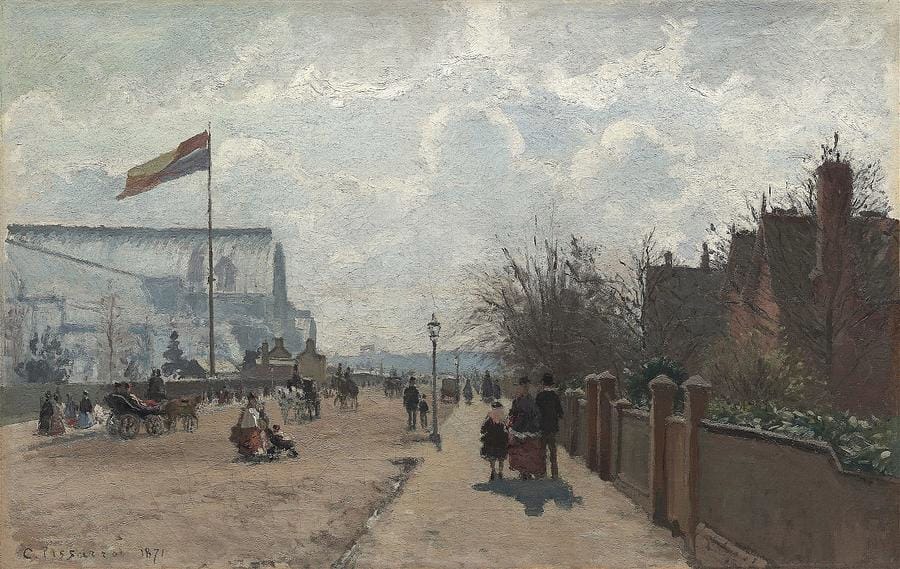
Painted in 1871, during the months Pissarro spent in London as a refugee from the Franco-Prussian War. He shows the relocated Crystal Palace not as an engineering marvel but as one more building on an ordinary suburban road, with carriages passing and a group of pedestrians in the foreground. While he was away, Prussian soldiers occupied his house at Louveciennes and destroyed most of the work he had left behind — by his own account, well over a thousand paintings. Only about forty canvases from his first twenty years survive.
The Harvest, Pontoise
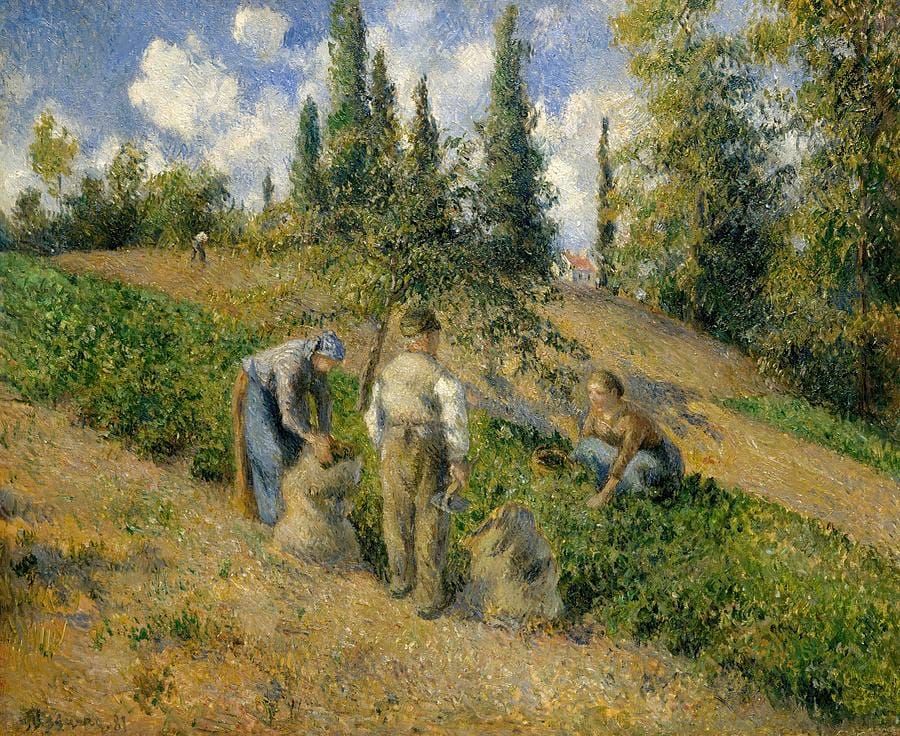
Figures bent over a field under a high summer sky, the crop laid out in bands of gold and green across the canvas. Pissarro painted agricultural labor throughout his career and refused to sentimentalize it: no noble peasants, no picturesque poverty, just people at work in a landscape they are shaping. He held anarchist convictions for most of his adult life, and pictures like this are the closest thing in Impressionism to a considered political position about who deserves to be looked at.
Young Peasant Having Her Coffee
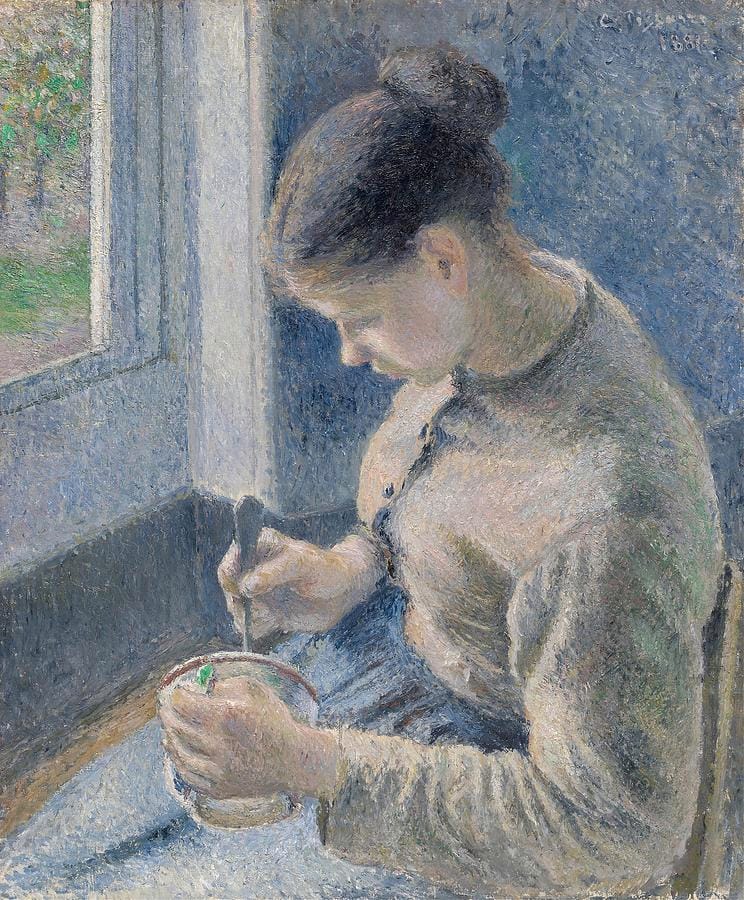
A young woman sits at a table with a bowl of coffee, absorbed and entirely unaware of being observed. In the 1880s Pissarro moved closer to his figures and painted a series of these single-figure rural subjects, applying the small regular touch he had adopted under the influence of Seurat's pointillism. The result gives an ordinary breakfast the compositional weight of a formal portrait, which was precisely the point.
The Garden Of The Tuileries On A Winter Afternoon
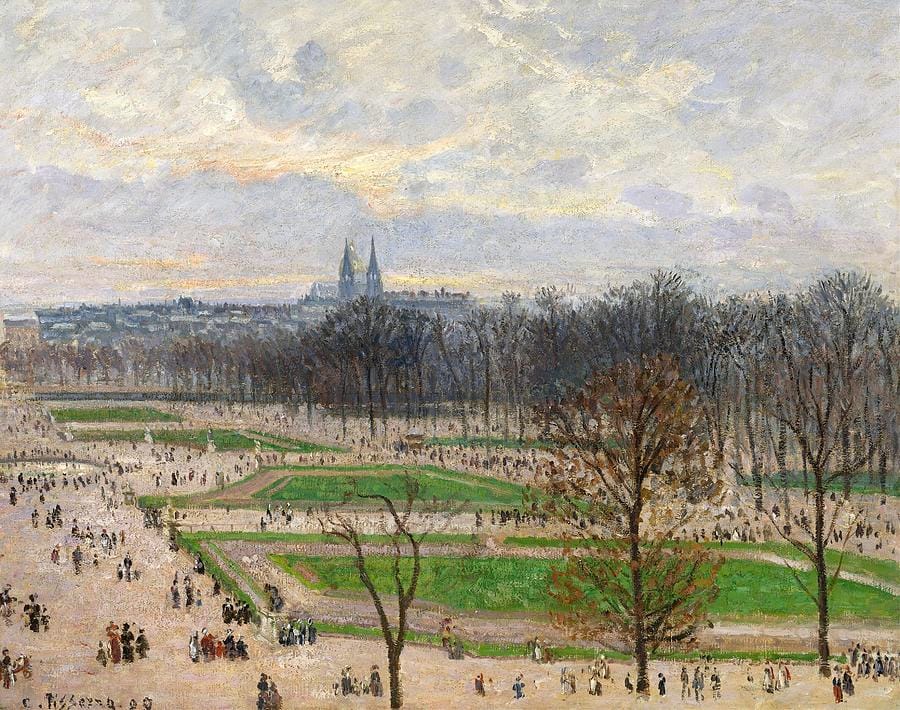
Another of the late window pictures, painted from an apartment overlooking the Tuileries. Bare trees stand in ranks across the garden, the paths cut geometric lines through the beds, and the Paris rooftops close the view at the back. The elevated viewpoint flattens the space into something almost like a map, and the low winter sun does most of the coloring. Pissarro produced dozens of canvases of this garden in different conditions during his last years.
The Road From Versailles To Louveciennes
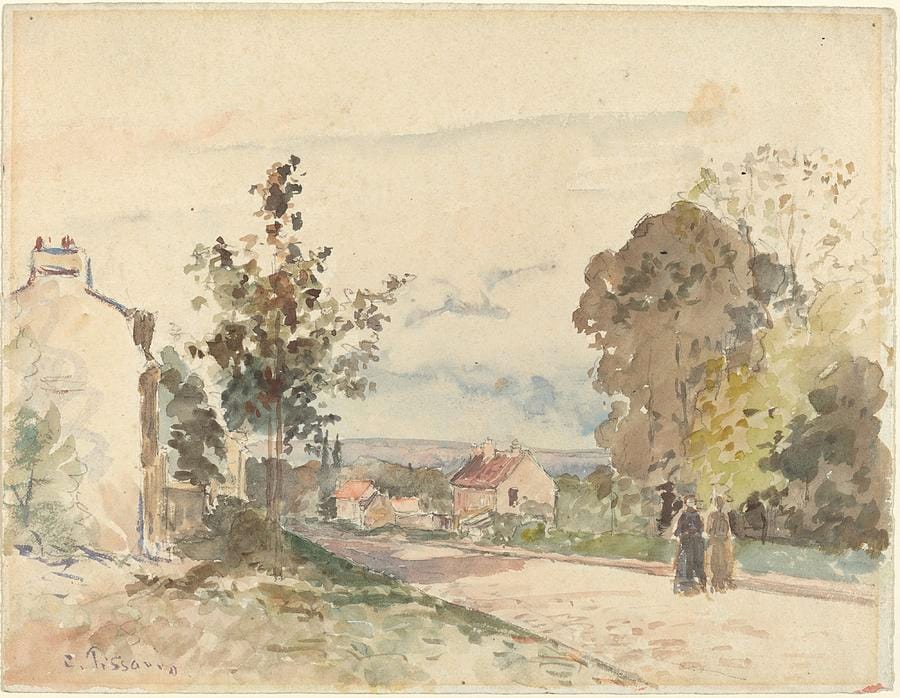
An early canvas from around 1870, painted at Louveciennes where Pissarro was living before the war. A road recedes into the distance under a tall sky, with figures walking and a screen of trees to one side. The composition — an emphatic diagonal running from the foreground into depth — is a device he used repeatedly, and the handling is broader and more atmospheric than in his later, more systematically built pictures.
Kensington Gardens, London
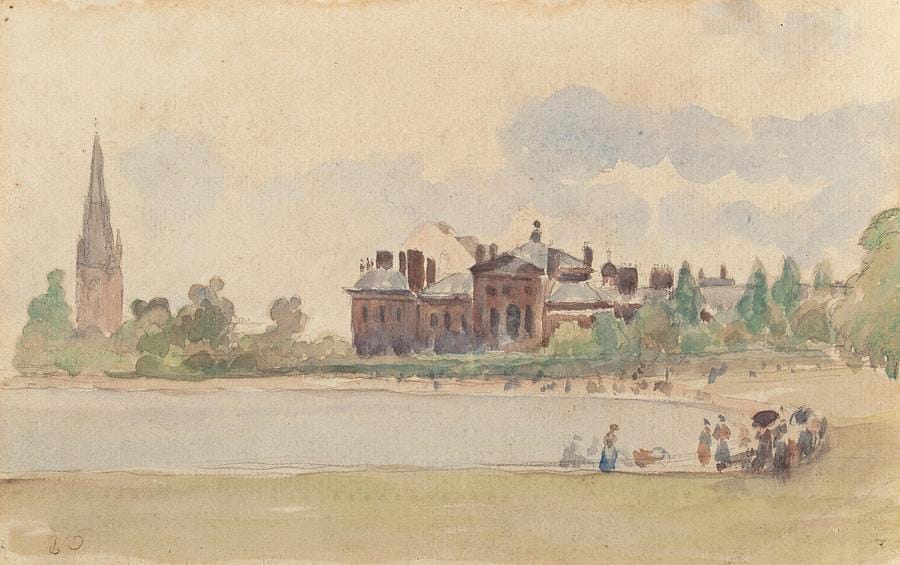
From one of Pissarro's several stays in England, where he had family and where he returned across three decades. The English parks gave him a subject halfway between his rural motifs and his late urban ones: cultivated open ground with figures moving through it, framed by mature trees. His London paintings are also historically useful, since they document suburbs and parks in the process of being built up around them.
Self-portrait
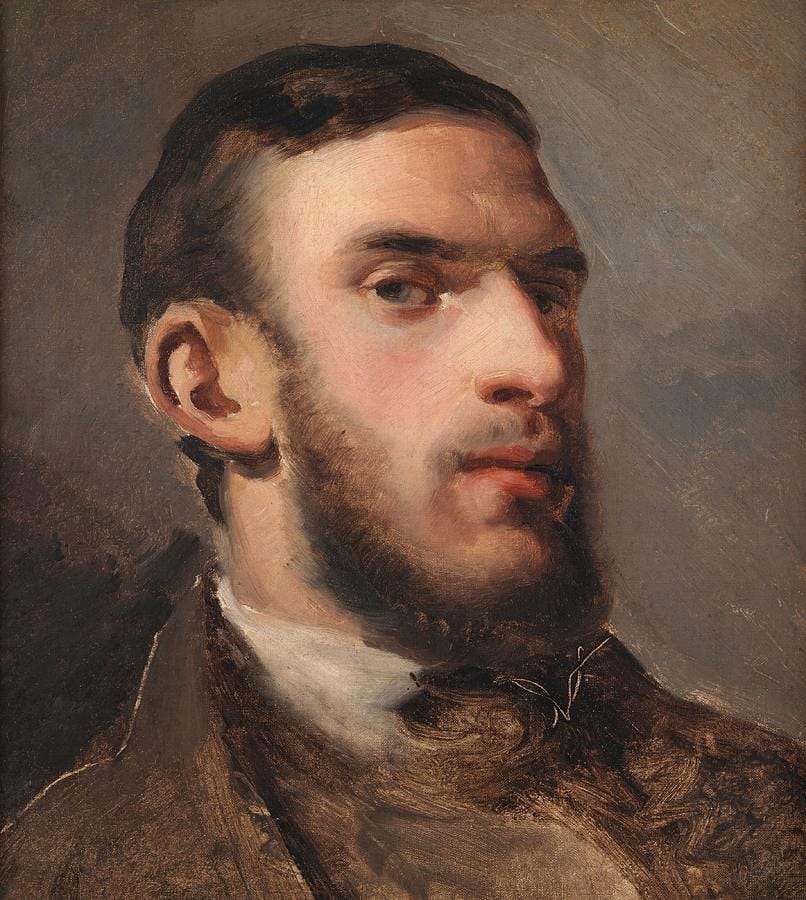
Pissarro painted himself only a handful of times, and always without flattery — a broad forehead, a heavy grey beard, small steady eyes, and no attributes of the profession beyond the fact of being looked at. By the 1870s the beard had made him look considerably older than he was, and it contributed to his standing among the younger Impressionists as the group's patriarch. Cézanne, who was not given to compliments, described him as humble and colossal.
Pissarro died in Paris in 1903, having spent forty years at the center of a movement whose other members were far more famous. His importance is easiest to see through the people he taught: Cézanne, Gauguin, and, later, his own son Lucien, who carried his methods to England.
Shop Camille Pissarro prints here, and explore the rest of our famous paintings collection for more of the world’s most beloved masterpieces.