Archibald Thorburn’s Ten Most Beautiful Bird Paintings
Snipe in the rushes, peregrines above the sea, ptarmigan in the snow: ten watercolors by Britain’s greatest painter of birds.

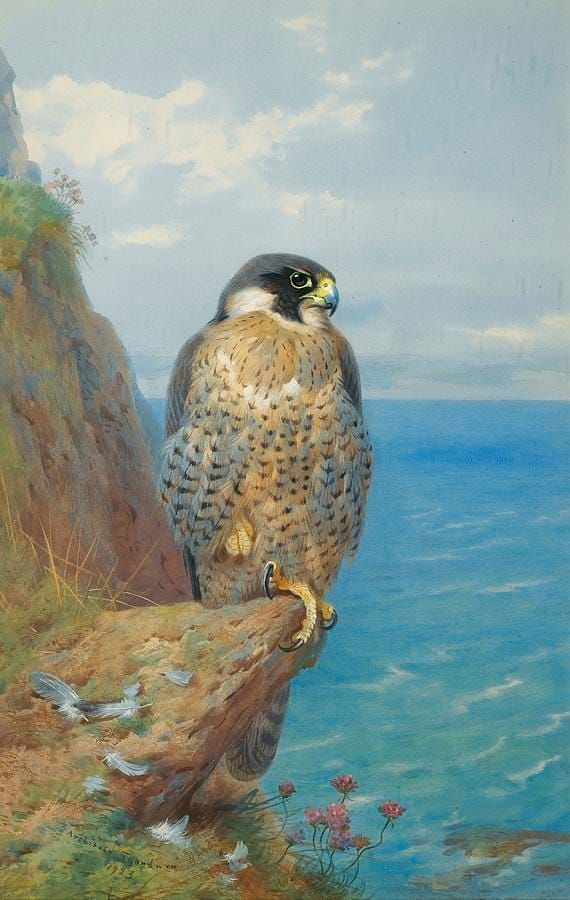
Archibald Thorburn (1860–1935) was born at Lasswade, just south of Edinburgh, the son of a miniature painter who worked for Queen Victoria. He was exhibiting at the Royal Academy in his early twenties, and by the end of the 1880s he was the most sought-after bird artist in Britain. He supplied the great majority of the plates for Lord Lilford’s Coloured Figures of the Birds of the British Islands, then wrote and illustrated his own four-volume British Birds — a set that has never really been surpassed and is still pulled apart by dealers for its plates.
What separates Thorburn from the illustrators around him is that he painted weather. Working almost entirely in watercolor and bodycolour rather than oil, he built up soft, dense surfaces in which a grouse or a woodcock sits inside real light, real wind and real ground. He knew his birds from long hours in the field, he got their posture and plumage exactly right, and he never made them pretty at the expense of being true. He was also a committed conservationist, designing Christmas cards for the young Royal Society for the Protection of Birds for more than three decades. Here are ten of his most beautiful works.
Peregrine at Auchencairn
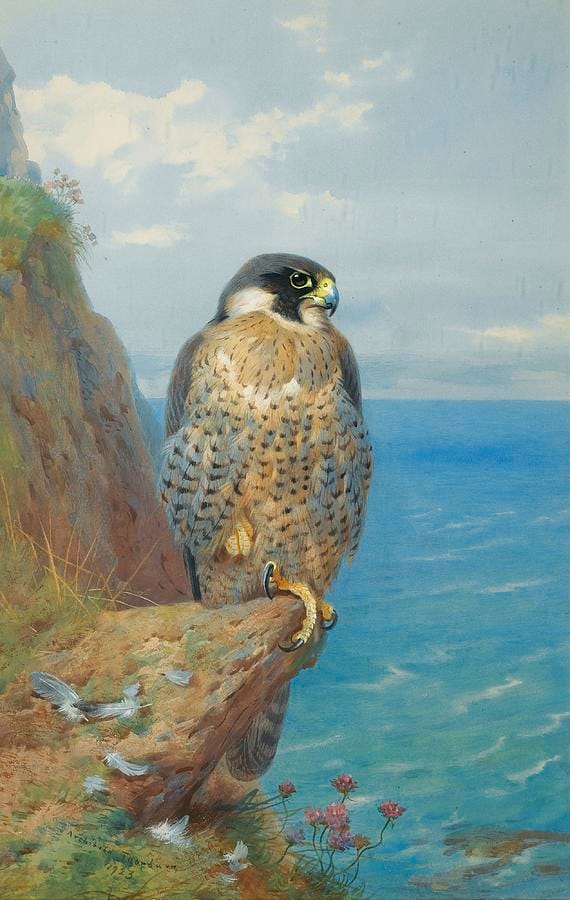
A peregrine falcon perches on a turf-topped ledge high above a turquoise sea, head turned over its shoulder, the dark hood and moustachial stripe framing a yellow-ringed eye and a slate-blue bill. Scattered white feathers on the rock below are all that is left of its last meal. Thorburn signed this one in 1923, and it is the finest of the pictures he made on the Solway coast at Auchencairn in Kirkcudbrightshire — pink sea thrift flowering in the crevices, a soft summer haze on the water, and the whole picture built on the contrast between the falcon’s absolute stillness and the drop beneath it.
A Pair of Snipe
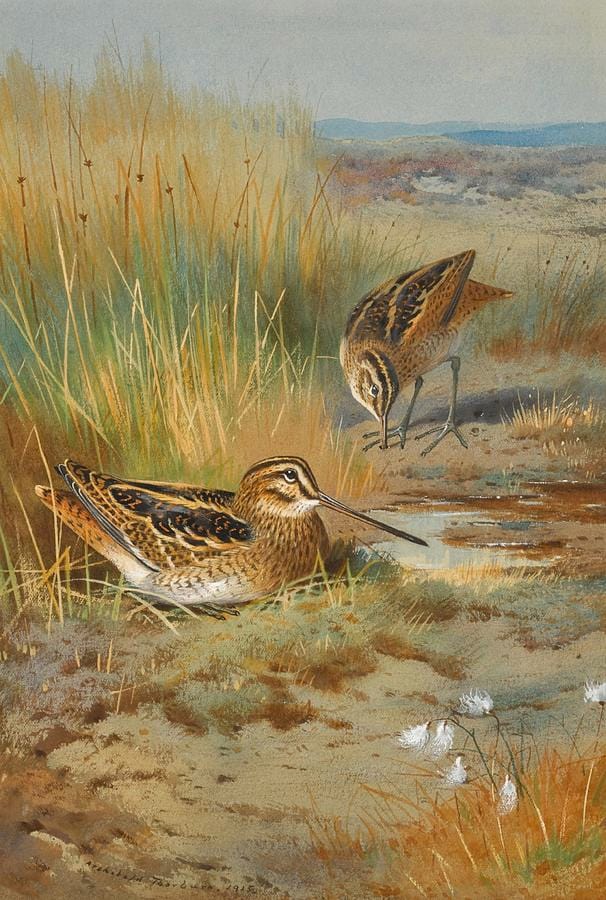
Two common snipe sit at the edge of a peaty pool on open moorland, one settled low in the rushes with its absurdly long bill held level, the other bent double behind it, probing the wet ground. Tufts of white bog cotton flower in the foreground and the hills fade away blue behind. The picture is built from a single family of russets, ochres and olive greens, and the birds’ striped heads and barred flanks dissolve into the vegetation so completely that the eye has to hunt for them. That is the point: snipe survive by being invisible until the moment they explode from underfoot. It is the most popular of all Thorburn’s images, and it shows why — nobody else could paint camouflage without losing the bird.
The Satyr Tragopan
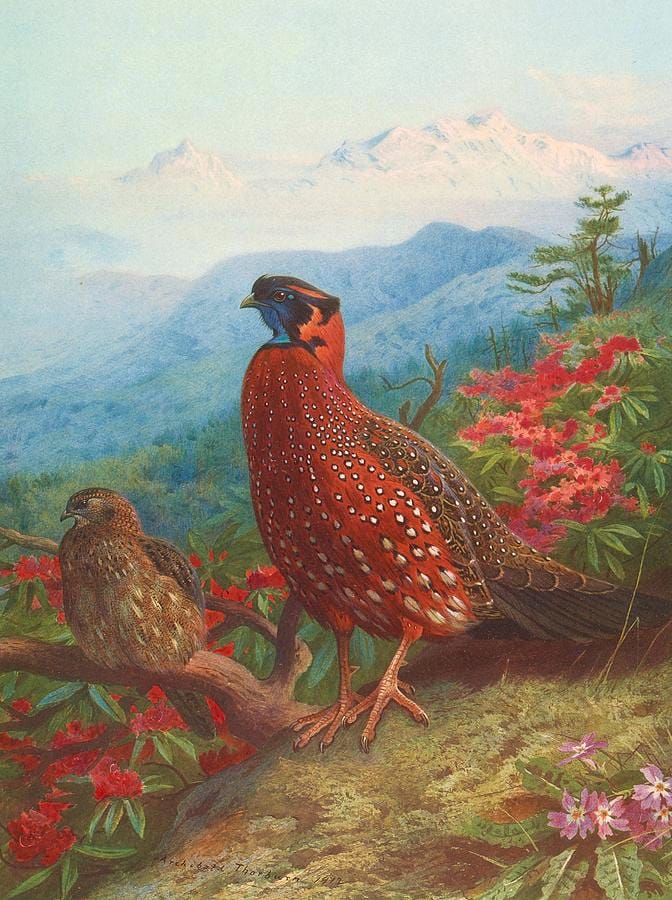
The satyr tragopan is a Himalayan pheasant of almost unbelievable color: a deep crimson body scattered with white spots ringed in black, bare blue skin around the eye, and — folded away except when he displays — a pair of fleshy blue horns. Thorburn puts the cock on a grassy shoulder among flowering scarlet rhododendrons, his quiet brown hen watching from a fallen branch, and behind them ridge after blue ridge climbing to snow peaks. He never went to the Himalaya, working instead from skins and from birds in living collections, which makes the assurance of the picture all the more remarkable. It is his most gorgeous single painting, and a reminder that his range went well beyond British moorland.
Bullfinches and Pyrus Japonica
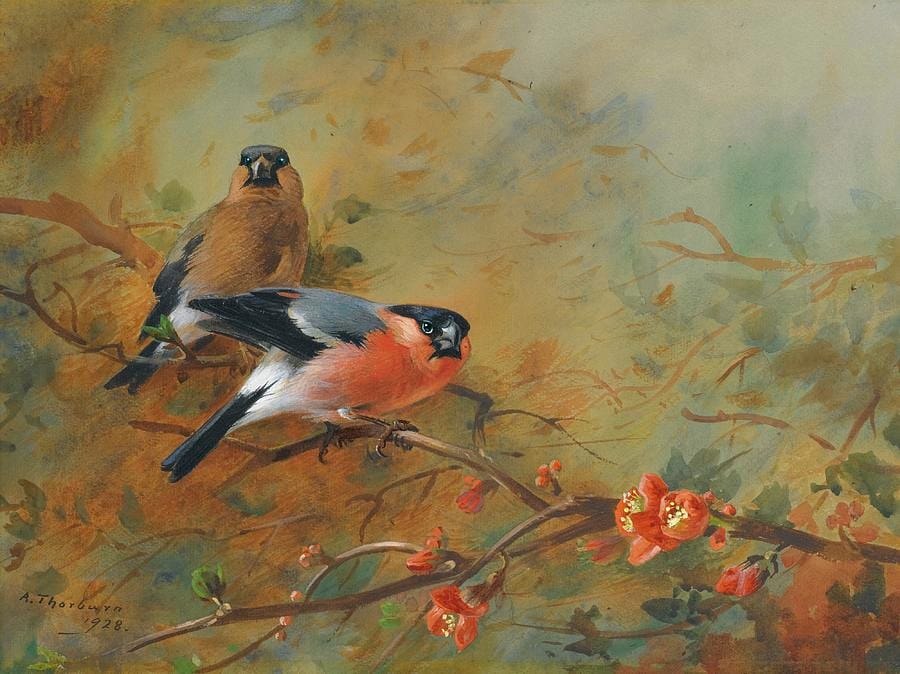
A cock bullfinch, rose-red beneath with a black cap and a thick stubby bill, perches on a branch above a spray of flowering Japanese quince, his soft fawn-brown mate sitting a little behind him; Thorburn dated it 1928, near the end of his career. The scarlet blossom is a deliberate risk — the same red family as the bird’s breast — and he pulls it off by keeping the background a warm blur of dun and gold so that both reds sing rather than fight. Bullfinches were then the gardener’s enemy for stripping fruit buds, which gives the picture a faint irony. It is one of his most charming garden subjects.
Through the Snowy Coverts (Blackgame)
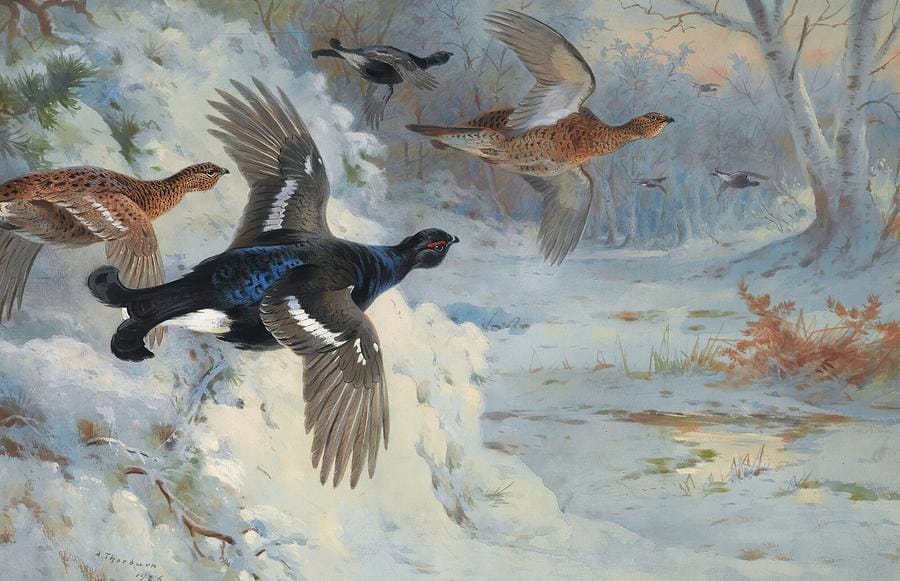
A blackcock drives across the foreground at head height, wings fully spread, white wing-bars flashing and its blue-black plumage shot with violet against the snow; a rust-brown greyhen powers away to the right, two more birds cut between the birches, and a pair of distant specks disappear into the trees. The whole covey is airborne at once. Thorburn was unusually good at flight, and this is one of his best flying pictures — the speed comes from the birds being caught mid-frame, half in and half out of the wood. Black grouse were far commoner in the Britain he knew than they are now, which gives the painting a documentary value he never intended.
Red-legged Partridge
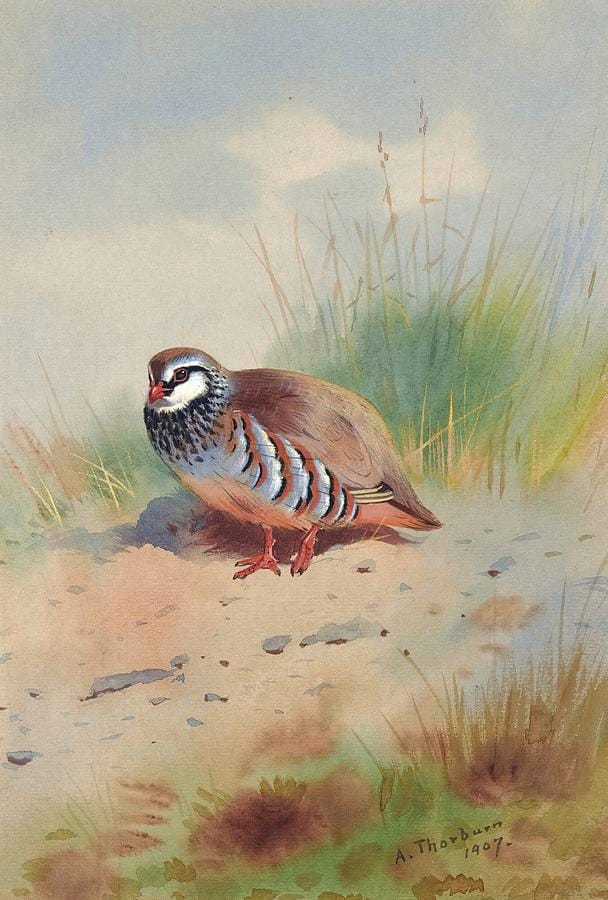
A single red-legged partridge stands side-on in a patch of thin sandy grass, dated 1907 — sealing-wax red bill and legs, a white throat outlined in black, a bib of dark speckling, and those extraordinary flank feathers barred in chestnut, cream and slate that make it the most handsomely marked of British game birds. The species is not native — it was introduced from the Continent in the eighteenth century and took hold in the dry east of England, exactly the sort of country Thorburn suggests here with a few strokes of pale grass. The restraint is typical of him: one bird, one bank, no incident, and nothing left uncertain.
Harlequin and Eider Ducks
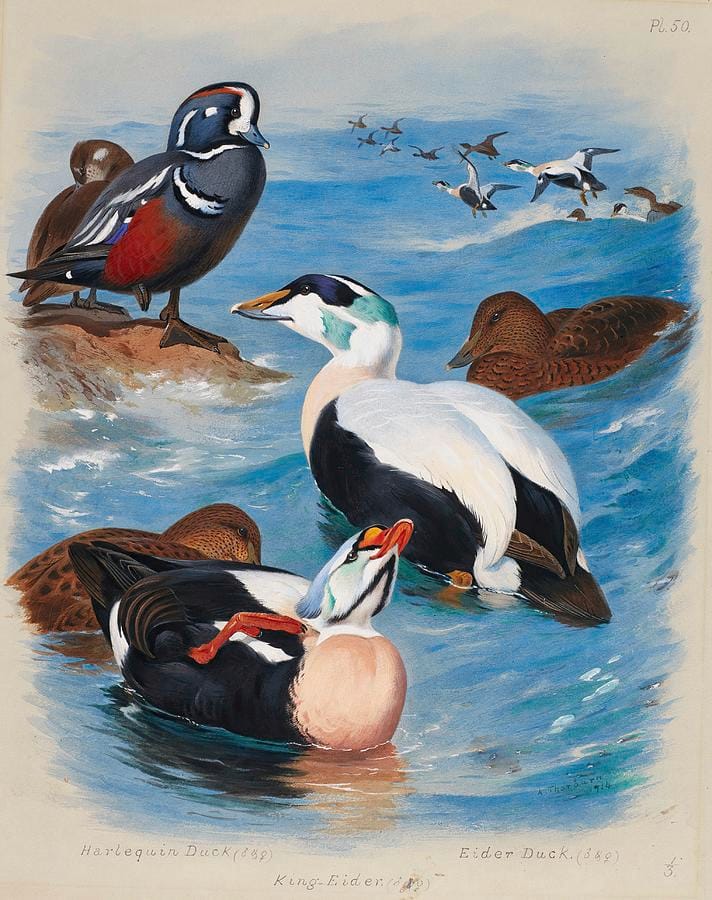
A book plate, and proof of how much art Thorburn brought to what was formally a scientific job. Three species of sea duck share one stretch of blue water: a harlequin drake on a rock, slate-blue with white crescents and chestnut flanks; a common eider drake below him, split cleanly black and white with a pistachio-green nape; and in the foreground a king eider, its orange shield and pale peach breast the most startling thing in the picture. The brown females get the same care as the males, a flock wheels away over the swell behind, and every bird behaves like a bird rather than posing as a specimen.
A Brace of Ptarmigan in the Snow
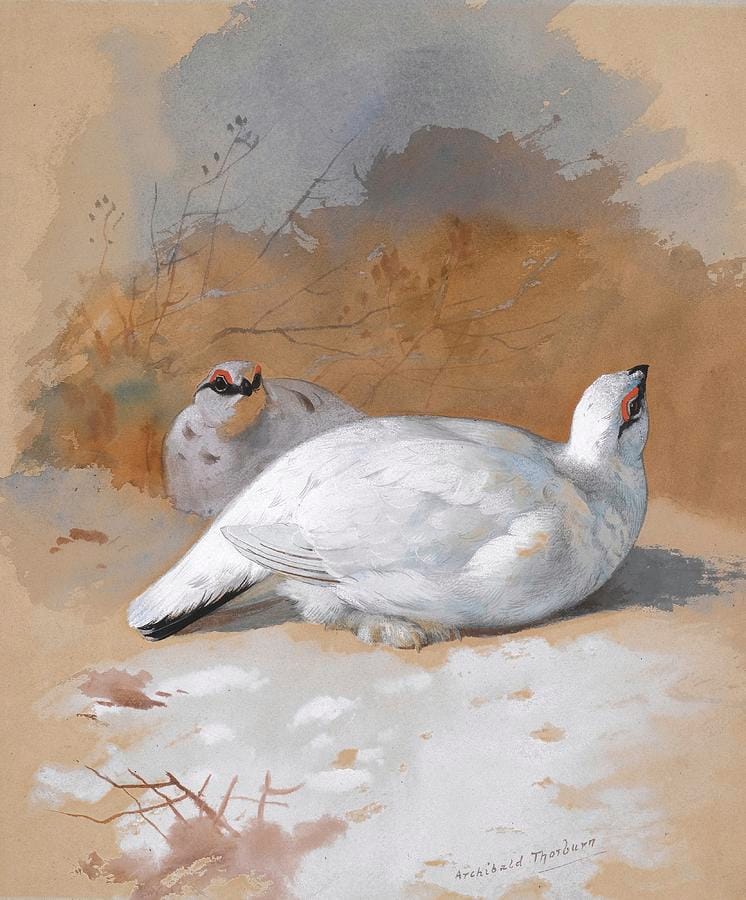
Two ptarmigan crouch in a patch of thawing snow against a loose wash of dead bracken, the paper left bare around the edges as though Thorburn had stopped the moment he had what he wanted. The nearer bird is in full white winter plumage, its only marks a dark eye, a black tail tip and a scarlet comb; the one behind it is still in mottled gray. Ptarmigan live higher than any other British bird, on the Cairngorm plateaux, and changing color with the season is how they survive up there. Painting white on white and keeping the birds solid is a technical feat, and he makes it look effortless.
Merlin and Larks
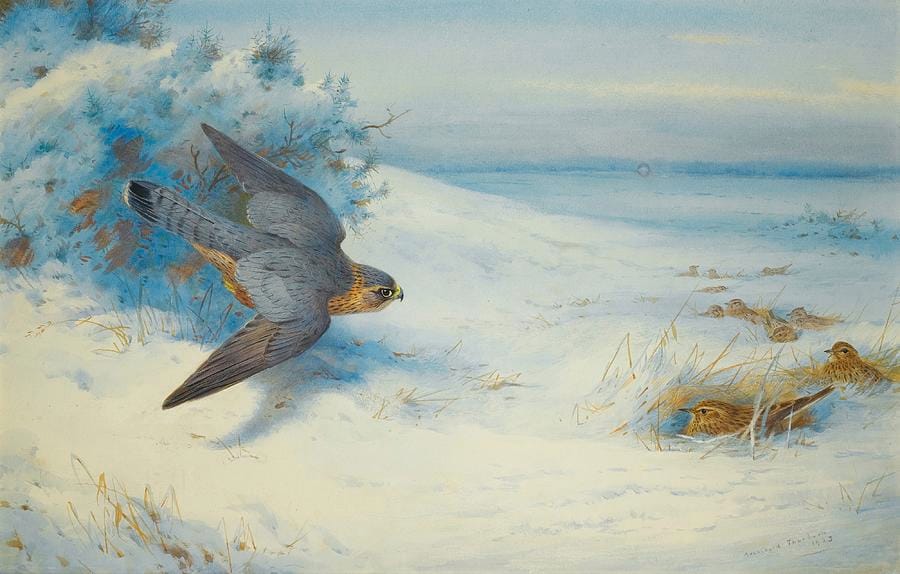
A cock merlin — Britain’s smallest falcon, barely bigger than a mistle thrush, blue-gray above with a rusty nape — sweeps in from behind a snow-laden juniper, flying low and level across a white moor. At the far right of the picture, a scatter of larks crouches in the drifted grass, still and unaware, seconds from being scattered. Thorburn leaves the whole middle of the paper empty snow, so the eye has to travel the distance the hunt is about to cover. Merlins hunt small birds by out-flying them in level chase rather than stooping from a height, and this gets that exactly right.
Pheasants
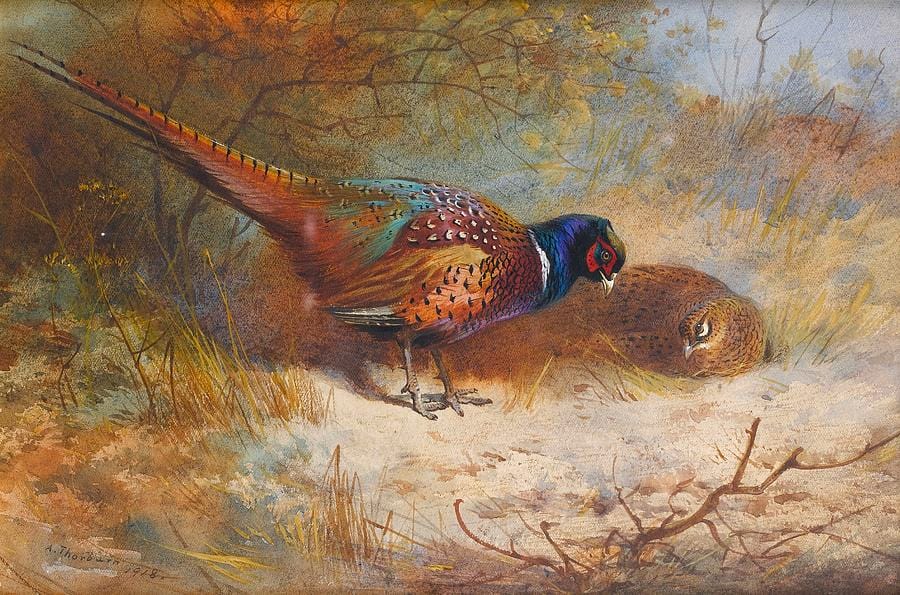
A cock pheasant in full color — bottle-green head, scarlet face wattles, a white collar, a body of copper and bronze scaled with black, and that extravagant barred tail trailing half the width of the paper — steps across pale wintry ground at the edge of a wood, while a hen crouches beside him with her head down, her mottled browns almost lost against the bracken. Pheasants were the great sporting bird of Thorburn’s England, and no artist painted them better; he understood that the whole effect depends on iridescence, and built it up in tiny strokes rather than reaching for bright pigment. This is the kind of picture that made his reputation with the country-house public.
Thorburn’s work has never gone out of favour, and it is easy to see why: the birds are accurate enough for a naturalist, the landscapes are quietly beautiful, and the color is warm without ever being loud. A snipe in the rushes or a pheasant in a winter wood settles into a hallway or a study as though it had always been there.
Shop Archibald Thorburn prints here, and explore the rest of our famous paintings collection for more of the world’s most beloved masterpieces.